


By Fatou Sillah
A new national survey by the Centre for Policy, Research, and Strategic Studies (CepRass) finds that more Gambians are dissatisfied than satisfied with the government’s handling of crime, underscoring a broader lack of public confidence despite notable regional variations.
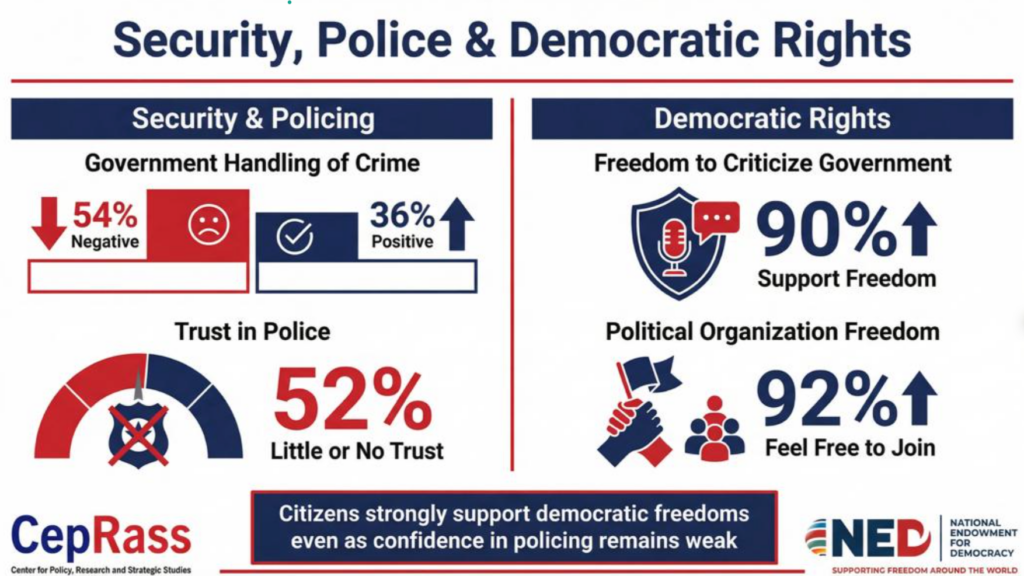
According to the poll, only 6 percent of respondents said the government was handling crime “very well,” while 30 percent rated its performance as “fairly well.” In contrast, 25 percent said crime was handled “fairly badly,” and 30 percent described the response as “very badly.” Another 7 percent said it was handled neither well nor badly, while 3 percent did not offer an opinion.
Taken together, 36 percent of respondents expressed a positive view of the government’s performance on crime, compared with 54 percent who rated it negatively—a gap the report says reflects limited public confidence and a prevailing sense of dissatisfaction.
“This suggests that public confidence in the government’s response to crime is limited and that dissatisfaction outweighs approval,” the report states.
The findings also highlight sharp regional differences. In Kuntaur, the government received some of its strongest marks, with 57 percent of respondents rating its handling of crime positively, including 13 percent who said “very well” and 44 percent “fairly well.” Only 28 percent in the region offered negative assessments.
In Banjul, opinions were somewhat more favorable than the national average, with 56 percent rating the government’s performance positively, though 30 percent still said crime was handled badly.
Elsewhere, the picture was more critical. In Brikama, just 32 percent of respondents rated the government’s handling of crime positively, while 61 percent expressed negative views, including 39 percent who said it was handled “very badly.”
Respondents in Janjanbureh and Mansakonko reported more mixed assessments, though negative perceptions continued to slightly outweigh positive ones, the survey found.
Comments are closed.