


By Fatou Sillah
A new nationwide survey by the Centre for Policy, Research, and Strategic Studies (CepRass) indicates that public perception of key services in The Gambia remains largely negative, with several sectors drawing more criticism than approval.
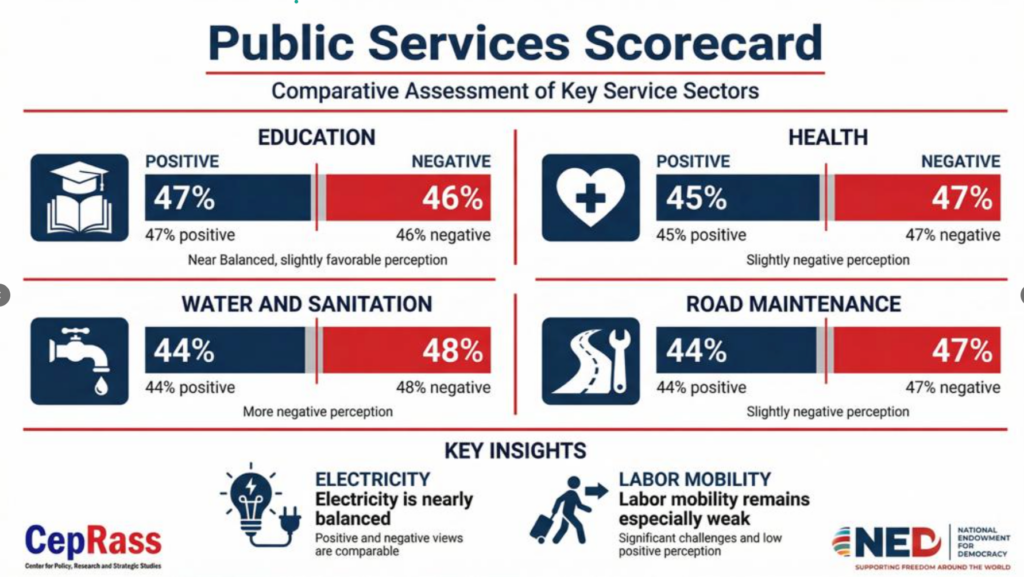
The findings show that while overall ratings of public services are mixed, they tend to lean unfavorably. Labor mobility, for instance, is viewed as ineffective by about 45 percent of respondents, compared with 32 percent who consider it effective. Water and sanitation services received negative ratings from roughly 48 percent of those surveyed, while road maintenance and health services were each rated negatively by about 48 percent and 47 percent, respectively.
Other sectors, including education, electricity, and agricultural development, elicited more divided opinions, reflecting a public that is split between positive and negative assessments.
“Overall, the evidence points to a citizenry that remains strongly committed to democratic freedoms but is increasingly dissatisfied with economic management, political responsiveness, corruption control, and several areas of service delivery,” the report said.
The survey suggests that dissatisfaction with service delivery persists even as public engagement in democratic processes remains high. Respondents expressed growing concern about governance outcomes, particularly in areas tied to accountability and economic performance.
“As the 2026 presidential election approaches, these results suggest that public support will be heavily shaped by performance on affordability, accountability, and responsiveness,” the report added.
According to CepRass, the survey was conducted nationwide using a multistage stratified random sampling method. It covered 1,245 households across 83 enumeration areas, with interviews carried out among randomly selected likely voters aged 17 and above who were present at the time.
The organization said stratification was applied across local government areas, with enumeration areas selected proportionate to population size and households randomly chosen within those areas.
Comments are closed.