


By Seedy Jobe
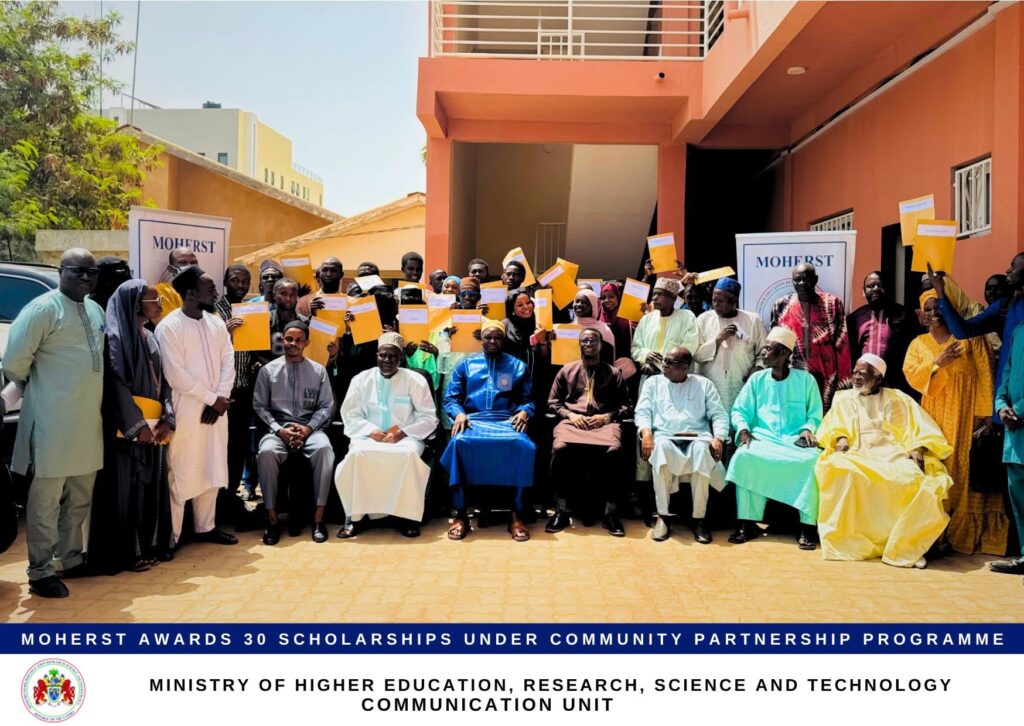
The Ministry of Higher Education, Research, Science, and Technology on Friday awarded 30 scholarships to students from the coastal communities of Tujereng, Pirang, and Faraba Banta in an effort to widen access to higher education and deepen local participation in national development initiatives.
The scholarships is financed by The Gambia Government. The awards were presented at a ceremony held at the ministry’s conference hall, attended by government officials, community leaders, and student beneficiaries.
“This is a promise made and a promise kept,” said Prof. Pierre Gomez, the minister of higher education, describing the initiative as a product of cooperation between the government and host communities.
The program, he said, emerged from agreements reached in 2025 with communities that provided land for key education projects. In May of that year, Tujereng allocated land for a fisheries center of excellence, prompting the ministry to commit a scholarship package valued at 4.48 million dalasis to the community. A month later, similar commitments were extended to Pirang and Faraba Banta in recognition of their support for the University of The Gambia’s Faraba Banta campus.
Each community, according to the ministry, will receive scholarships worth 4.48 million dalasis, bringing the combined allocation for Pirang and Faraba Banta to 8.96 million dalasis.
Under the five-year program, each community will be allotted 10 scholarship slots annually—five at the diploma level and five at the bachelor’s or master’s level—at public institutions. The 30 scholarships awarded this year mark the first phase of the initiative, which is expected to benefit 150 students by its conclusion.
“These are not just numbers,” Prof. Gomez said. “Each scholarship represents a student, a family, and a community that believes in education.”
He urged community leaders to ensure that future selections prioritize newly qualified students and called for greater participation by young women, emphasizing the need for gender balance in higher education.
Addressing the recipients, he said that award letters had been finalized and that payments would begin promptly. He encouraged students to excel in their studies and return to contribute to their communities.
The minister also praised local selection committees for their role in vetting candidates, calling the process a model of collaboration between government and communities.
The scholarship program, he added, reflects a broader effort to expand equitable access to education and build a skilled workforce capable of supporting the country’s development goals.
Comments are closed.