

Supreme Court Upholds Law Expanding President’s Amnesty Powers Over Commission Findings

The Supreme Court has upheld the constitutionality of the Commission of Inquiry (Amendment) Act 2023, ruling that the National Assembly acted within its constitutional authority when it enacted legislation allowing the President to grant amnesty to individuals barred from holding public office by the findings of a commission of inquiry.
In a unanimous decision delivered by a five-member panel, the court dismissed a constitutional challenge brought by the Coalition of Progressive Gambians and journalist Kemeseng Sanneh, widely known as Kexx Sanneh, against the Attorney General and the Clerk of the National Assembly.
The ruling settles a closely watched legal dispute over the scope of Parliament’s legislative powers and affirms that the amendment remains valid and enforceable.
At the center of the case was the Commission of Inquiry (Amendment) Act 2023, which the National Assembly passed on Sept. 2, 2023. The legislation created a mechanism enabling the President to grant amnesty to individuals who have been disqualified from holding public office following the findings of a commission of inquiry.
Before the amendment, such disqualifications were generally regarded as final consequences flowing from a commission’s recommendations. The new law gives the executive the authority to lift or mitigate those restrictions.
The plaintiffs argued that Sections 19, 20, and 21 of the amendment were inconsistent with Sections 200 through 206 of the 1997 Constitution, which establish the framework governing commissions of inquiry. They contended that Parliament had exceeded its constitutional mandate by passing legislation that, in effect, weakened the legal force of commission findings.
According to the applicants, allowing the President to grant amnesty undermined the integrity and binding nature of commissions of inquiry, whose findings are intended to promote accountability in matters of public interest.
The central constitutional question before the court was whether the National Assembly could lawfully enact legislation permitting the executive to remove or reduce sanctions arising from commission findings.
The Supreme Court answered that question in the affirmative, concluding that the National Assembly acted within the bounds of its constitutional authority and did not violate the Constitution in passing the amendment.
The judgment also affirmed Parliament’s power to determine the legal consequences flowing from commissions of inquiry, effectively recognizing its authority to reshape the statutory framework governing how those findings are implemented.
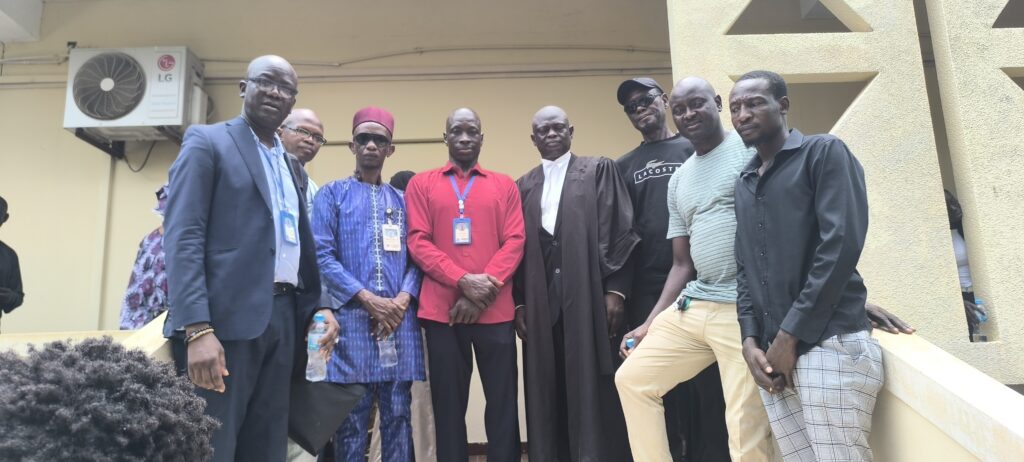
Speaking to reporters after the judgment, Senior Counsel Lamin J. Darboe, who represented the plaintiffs, said he respected the court’s decision but disagreed with its reasoning.
“I respect the decision of the Supreme Court. But I disagree with the decision,” Mr. Darboe said.
Asked whether the plaintiffs would seek a review of the ruling before the Supreme Court, Mr. Darboe said that option was effectively unavailable because the judgment had been unanimous.
“The decision was a unanimous decision by the five-judge panel,” he said, adding that his legal team would instead consult with their clients on whether to pursue the matter before the ECOWAS Court of Justice.
The ruling means the Commission of Inquiry (Amendment) Act 2023 remains in force, and the President retains the legal authority to grant amnesty to individuals disqualified from public office as a result of the findings of a commission of inquiry.
If you’d like, I can also make this even closer to The New York Times style by adding more legal context, trimming repetitive passages, and sharpening the lead with greater emphasis on the constitutional implications of the ruling.
Comments are closed.