

African Finance Ministers Press for Debt Relief and Industrial Shift at Banjul Caucus

By Seedy Jobe
Africa’s finance ministers and central bank governors concluded a three-day summit in the Gambia on Wednesday with a unified call for sweeping changes to the global financial system and a decisive push to industrialize the continent, warning that without structural reforms, Africa’s development ambitions will remain out of reach.
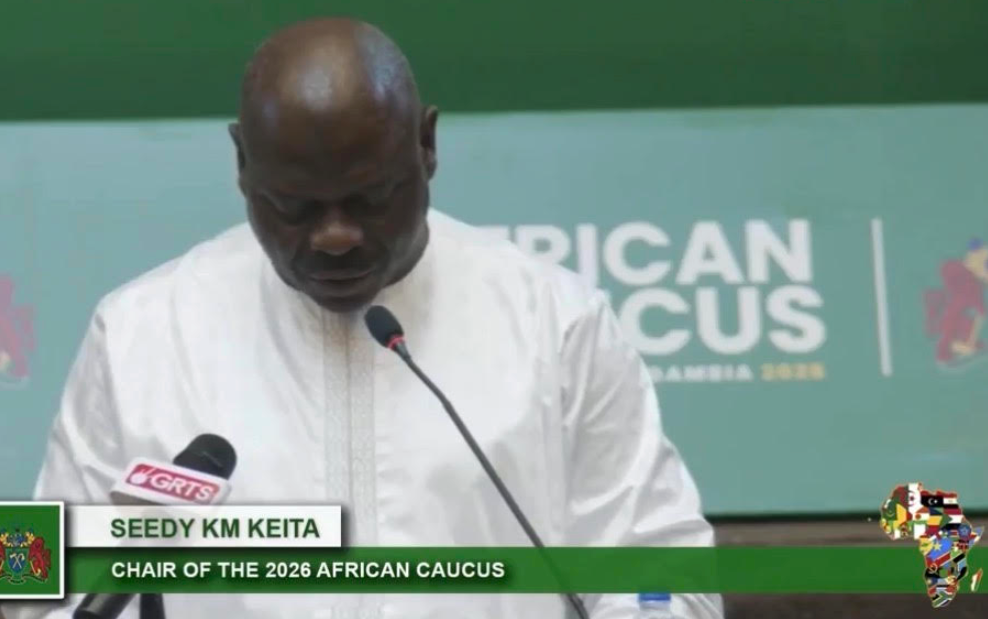
Seedy Keita, The Gambia’s Minister of Finance and Economic Affairs and chair of the 2026 African Caucus, delivered the closing statement on behalf of African governors of the Bretton Woods institutions at the Sir Dawda Kairaba Jawara Conference Center, which had drawn senior officials from across the continent alongside representatives of the international diplomatic community.
Mr. Keita praised the International Monetary Fund and the World Bank for their long engagement on macroeconomic stability, infrastructure, trade, energy, and digital integration, but he made clear that incremental support would no longer suffice.
“Predictable, sustainable, and diversified financing is central to Africa’s ability to advance structural transformation and finance long-term development priorities,” he said.
The gathering reflected a growing impatience among African policymakers with a global financial architecture they say is poorly suited to their circumstances. Tight fiscal space, rising debt burdens, and dependence on commodity exports have left many countries vulnerable, officials said, even as the continent’s young and rapidly expanding population creates urgent demand for jobs, infrastructure, and public services.
A central preoccupation of the caucus was debt. Mr. Keita reiterated longstanding African demands for urgent reform of global debt resolution mechanisms, welcoming the launch of a borrowers’ platform during the 2026 IMF and World Bank spring meetings and urging all African nations to join the initiative to coordinate positions and share best practices.
He also pressed the IMF to protect the Poverty Reduction and Growth Trust and to accelerate quota and governance reforms that would amplify Africa’s voice within the institution.
On revenue, Mr. Keita argued that strengthening domestic resource mobilization must serve as the foundation for rebuilding fiscal space and weaning governments off expensive external borrowing. He called on the fund and the bank to support Africa’s efforts to broaden tax bases, modernize revenue systems, combat illicit financial flows, and harness digitalization to improve compliance.
Perhaps the most emphatic theme of the caucus was Africa’s need to move beyond exporting raw materials. Mr. Keita called for local processing of critical minerals linked to the global energy transition and urged a decisive shift toward value addition and intra-African trade under the African Continental Free Trade Area.
He also called for the creation of an industrialization compact for Africa by 2035 and the establishment of a permanent secretariat to track implementation of caucus recommendations — a signal that African governments intend to hold multilateral partners to their commitments.
Regional financial integration featured prominently as well. While acknowledging regulatory progress, Mr. Keita described capital markets across the continent as still shallow and fragmented, and he called for accelerated integration and targeted technical assistance to deepen them.
The ministers placed small and medium-sized enterprises at the center of their employment agenda, particularly for women and youth, and called for coordinated action to close persistent financing gaps for such businesses.
On infrastructure, Mr. Keita argued that energy, transport, logistics and digital connectivity must be developed together as an integrated system capable of supporting regional industrial value chains rather than pursued in isolation.
He also made the case for treating human capital as a core economic objective. The caucus called for expanded, long-term financing for education and technical and vocational training aligned with the demands of industrialization, digitalization and the green transition, and it pressed for stronger data systems to measure outcomes.
Mr. Keita closed by reaffirming the Bretton Woods institutions as indispensable partners while insisting their engagement must become more coherent and more responsive to Africa’s structural priorities.
The tone of the gathering suggested that Africa’s economic policymakers, long accustomed to receiving prescriptions from Washington, are increasingly determined to set the terms of those partnerships themselves.
Comments are closed.