

Dangote Tells African Policymakers: Industrialization Is the Only Route Out of Poverty

By Seedy Jobe
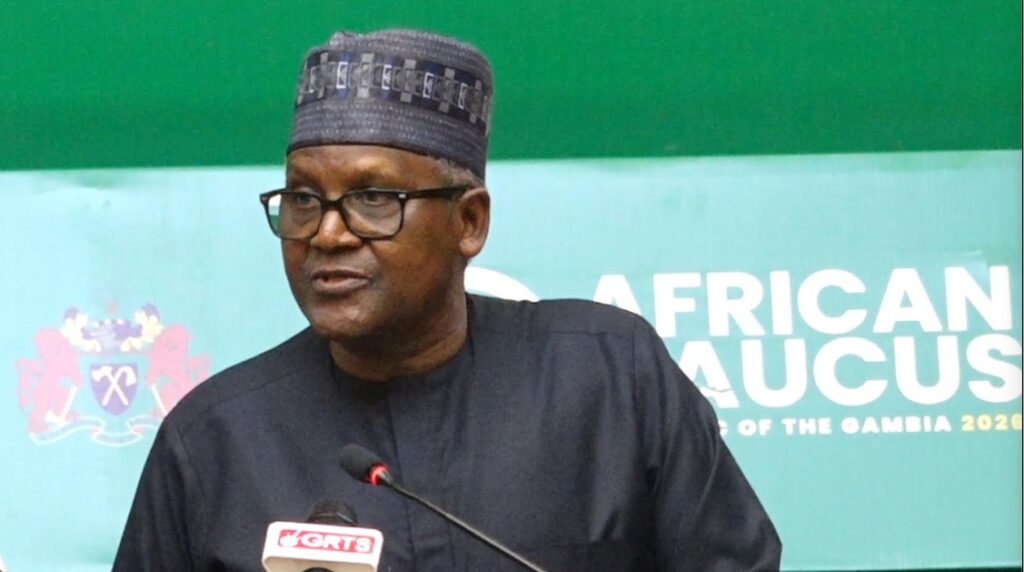
Aliko Dangote, Africa’s wealthiest industrialist, told a gathering of finance ministers, trade officials, and diplomats on Tuesday that the continent has no credible path to prosperity without deliberate industrial transformation, and that building factories without dismantling trade barriers between African nations will not be enough.
“No country in modern economic history has achieved high-income status without industrialization,” Mr. Dangote, the president and chief executive of Dangote Industries Limited, told delegates at the 2026 Africa Caucus meeting at the Sir Dawda Kairaba Jawara Conference Center. “Not one.”
The meeting, now in its second day, drew Gambia’s Finance Minister Seedy Keita, Trade Minister Mod K. Ceesay, Guinea-Bissau’s Prime Minister Ilidio Vieira Te, executive directors, and representatives of the international diplomatic community.
Mr. Dangote, whose industrial empire spans cement, petrochemicals, and agriculture across the continent, argued that Africa’s predicament is not a shortage of resources but a failure to convert them into finished goods. He noted that Africa holds roughly 18 percent of the world’s population, 30 percent of its mineral reserves, and nearly 60 percent of its uncultivated arable land—but remains the least industrialized region on earth. Manufacturing accounts for only 10 to 11 percent of Africa’s gross domestic product, compared with more than 25 percent in East Asia, and the continent’s share of global merchandise exports has stagnated at around 3 percent, with more than 70 percent of those exports still raw commodities.
The cost of that gap, he said, is staggering. Africa loses an estimated $40 billion to $50 billion each year by shipping unprocessed materials abroad to be manufactured and sold back to the continent at a markup.
“Growth driven only by commodities raises incomes temporarily,” he said. “Industrialization creates wealth permanently.”
He drew on the trajectories of Britain, the United States, South Korea, China, and Vietnam to argue that their escapes from poverty were not the product of fortune but of deliberate policy: sustained infrastructure investment, export orientation, and coordinated industrial planning. Africa’s projected population of 2.5 billion by 2050, he warned, would become a liability rather than a dividend unless the continent creates roughly 20 million new jobs a year—a target, he said, that only an industrial economy has the scale to meet.
Mr. Dangote said the moment is urgent but also opportune. With global supply chains being restructured, demand for critical minerals surging because of the energy transition, and digital technologies lowering the cost of manufacturing, he described the current period as perhaps the greatest industrial opening Africa has seen in 50 years.
He was equally pointed, however, about the limits of national strategies pursued in isolation. Africa, he noted, still conducts just 14 to 17 percent of its trade with itself, compared with roughly 70 percent within Europe. The consequences are felt in daily commerce.
“It costs me more money to take goods to Ghana from Nigeria — a journey of a day and a half — than to bring goods from Spain,” he said, attributing the disparity to tariff barriers, inconsistent regulations and inadequate transport infrastructure.
Mr. Dangote held up the African Continental Free Trade Area, which encompasses a combined gross domestic product of more than $3.5 trillion and a market of 1.5 billion people, as among the most consequential initiatives the continent has undertaken since independence. But he said industrialization and integration must advance together; neither, on its own, will be sufficient.
He also outlined his company’s own commitment to the continent’s transformation. Under what he called Dangote Vision 2030, the company plans to invest $46 billion across Africa over the next four years. He said the company intends to open a 700,000-barrel-per-day refinery in Lamu, on Kenya’s coast, as early as September or October.
Prime Minister Vieira Te of Guinea-Bissau, also addressing the gathering, described the meeting as arriving at a critical juncture, with Africa navigating tighter global financial conditions and a series of external shocks.
He thanked President Adama Barrow and the Government of The Gambia for hosting the forum, saying it reflected the country’s commitment to African cooperation, and called on delegates to move beyond the commitments of the 2025 Banjul Declaration and toward concrete action. That, he said, means accelerating infrastructure investment, developing innovative financing mechanisms, properly valuing the continent’s environmental assets and pressing for reform of the international financial architecture.
“More than ever, our shared ambition must be to transform the continent’s vast potential into concrete results for our citizens,” he said.
Mr. Vieira Te pointed to Guinea-Bissau’s recent completion of the 11th review of its International Monetary Fund-supported program as evidence that sound policy can deliver results even under difficult external circumstances.
“This experience demonstrates that economic resilience results not only from external circumstances,” he said, “but above all from the quality of public policies and the ability of governments to anticipate.”
He called for a stronger and more predictable partnership with the I.M.F. and the World Bank, arguing that diversified development financing is essential to fund the long-term structural transformation the continent requires.
Comments are closed.