

Gambia Hosts African Finance Summit Amid Calls to Close the Continent’s Investment Gap

By Seedy Jobe
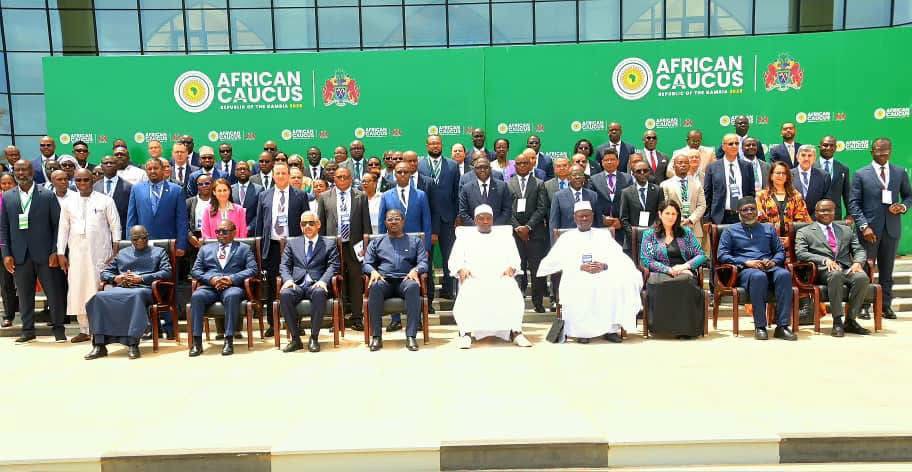
Finance ministers, central bank governors, and senior officials from across Africa gathered in the Gambia on Monday for the 2026 African Caucus, a three-day summit focused on unlocking investment, spurring innovation, and broadening economic inclusion across a continent that its leaders say is too often misread by the world.
The conference, held at the Sir Dawda Kairaba Jawara Conference Center, brought together President Adama Barrow, the president of the African Development Bank Group, the president of the Economic Community of West African States, the prime minister of Guinea-Bissau, executive directors, and representatives from the international diplomatic community. It opened against a backdrop of global economic uncertainty, tightening financial conditions, and structural pressures that delegates said were straining growth across Africa.
The agenda centered on two broad priorities: securing the financing needed to drive structural economic transformation and channeling the continent’s vast natural resource wealth into quality jobs and inclusive growth—with particular emphasis on deepening Africa’s engagement with the Bretton Woods institutions.
Gambia’s Minister of Finance and Economic Affairs, Seedy Keita, opened the proceedings by framing Banjul’s selection as a signal of growing international confidence in the country’s stability and economic trajectory.
He cited a series of indicators to make the case. Tax revenue, he said, had more than doubled—rising from the equivalent of $11 billion in 2022 to $25 billion in 2025—through digitalization and improved compliance, without any increase in tax rates. The economy grew at 6 percent in 2025. Inflation, despite global headwinds, stood at 7.5 percent. Electricity access had reached 90 percent of the population nationwide, and the country was on track for universal coverage by the end of 2026. More than 1,200 kilometers of roads had been built, roughly a third of them financed from domestic resources.
“The economy grew at 6 percent in 2025, and inflation, despite the global pressures, is at 7.5 percent,” Mr. Keita said.
He called the summit’s theme—transforming Africa’s economies through investment, innovation, and inclusion—a call to action and urged delegates to leave with a unified declaration that reflected the continent’s collective priorities.
The African Union Deputy Chairperson, Ambassador Selma Malika Haddadi, used her remarks to reframe how the world should understand Africa’s economic moment. She argued that the traditional investment lens—one focused on risk mitigation and short-term returns—was no longer adequate and that resilience on the continent must be built from within.
“Africa is not a peripheral story to the world economy,” she said. “Africa is one of the central stories of the 21st century.”
She tied her remarks to Agenda 2063, the African Union’s long-range development blueprint, and called for deeper regional integration, stronger domestic markets and African-led innovation.
The starkest diagnosis came from Dr. Sidi Ould Tah, president of the African Development Bank Group, who outlined what he described as four paradoxes holding Africa back from its potential.
Africa holds roughly 18 percent of the world’s population and more than 30 percent of its known mineral reserves, he noted, yet accounts for barely 3 percent of global trade and economic output. The continent faces an annual financing gap of $400 billion for the structural transformation its economies require — even as more than $4 trillion sits largely idle in African banks, pension funds and sovereign wealth funds.
“Investors are not short of appetite,” Dr. Ould Tah said. “They are short of instruments that make Africa’s risk bankable.”
Ousmane Diagana, the World Bank’s Vice President for Western and Central Africa, anchored his remarks in demographic reality. Between 2030 and 2050, he said, 90 percent of the growth in the world’s working-age population will occur in Africa, with Sub-Saharan Africa alone adding more than 620 million people. Nine in ten jobs on the continent are already generated by the private sector, he noted, but most remain concentrated in low-productivity work.
“Those three words — investment, innovation, and inclusion — converge on a single purpose: jobs, more jobs, and better jobs,” Mr. Diagana said.
Delegates said they hoped the summit would produce more than declarations. Leaders called for concrete policy outcomes: measures to restore fiscal space, targeted investments to unlock growth, and structural reforms to expand economic opportunity across the continent.
Comments are closed.