

Former Soldier Testifies to Alleged Torture After 2006 Coup Attempt; Defence Challenges Link to Sanna Manjang

By Fatou Sillah
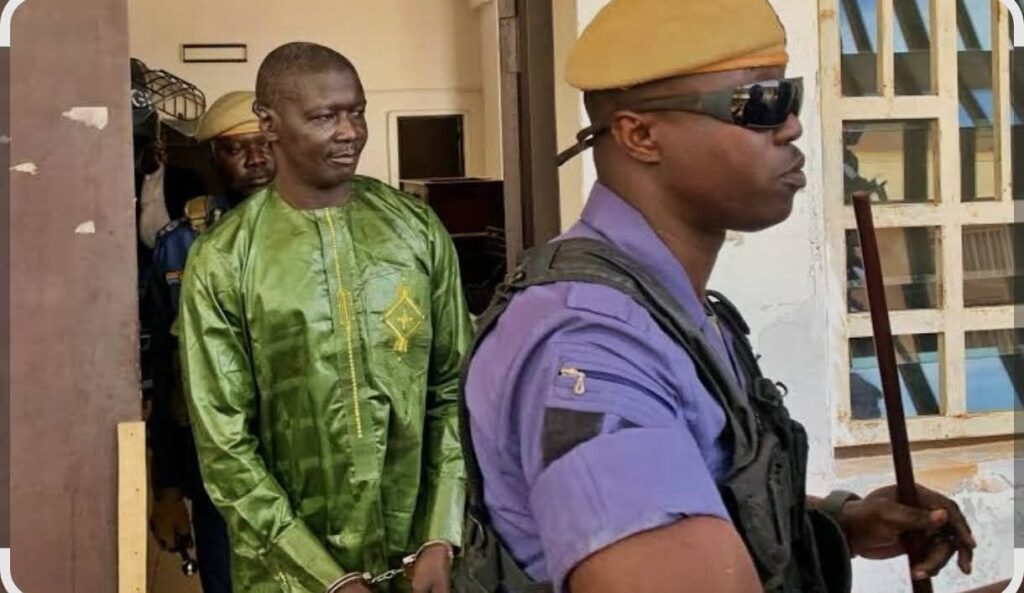
A former Gambian soldier told the High Court on Monday that detainees arrested after the failed 2006 coup attempt described being tortured by members of the military’s feared “Junglers” unit, including the accused, Sanna Manjang. Under cross-examination, however, the defence sought to undermine the witness’s account by highlighting that his testimony was based largely on what other detainees had told him and that he did not personally know Mr. Manjang.
The testimony came as the murder trial of Mr. Manjang continued before Justice Sidi K. Jobarteh. The prosecution was led by Deputy Director of Public Prosecutions E.R. Dougan, assisted by Counsel A. Badjie, while Counsel S.K. Jobe represented the accused.
The prosecution’s seventh witness, Babou Janha, a former member of the Gambia Armed Forces who now works as a contractor in Sinchu Alagie, testified that he served in the military for nearly 27 years after enlisting on May 12, 1996. During his service, he said, he was assigned to several units, including the Gambia Navy, the GAF Police, and the military headquarters in Banjul, where he served as a driver to Colonel Ndure Cham.
Mr. Janha testified that in the aftermath of the alleged coup plot of March 21, 2006, scores of soldiers and civilians were arrested. He said he was detained on April 4, 2006, at the GAF Headquarters in Banjul by General Alagie Martin.
He told the court that he was taken to the National Intelligence Agency, where he was severely beaten during interrogation by the late Musa Jammeh, General Alagie Martin, and soldiers from the State Guard Battalion. Later that evening, he said, he was transferred to Mile II Central Prison.
At Mile II, Mr. Janha said he found several military officers and civilians who had also been detained in connection with the alleged coup, including Colonel Dunja Darboe, Yaya Darboe, Faring Sanyang, Pierra Mendy, Wassa Camara, Alieu Jobe, Tamsir Jassey, Oustass Sey, Hon. Demba Dem, and Alieu Lowe.
He testified that many of the detainees bore visible injuries. According to his account, Buja Darboe had a broken arm, Yaya Darboe’s eyes were swollen and bloodshot, Faring Sanyang had what appeared to be a deep wound on his neck, and Tamsir Jassey walked with difficulty. He said detainees later told him they had been tortured.
Mr. Janha further testified that during a trial-within-a-trial in subsequent court-martial proceedings, Yaya Darboe identified members of the “Junglers,” an alleged military unit accused of carrying out torture on behalf of the former government, as those responsible for the assaults. According to Mr. Janha, Mr. Darboe named Malick Jatta, Michael Correa, Mustapha Sanneh, Sanna Manjang and Modou Jarjue.
The witness said detainees exchanged information while bathing or gathering near prison toilets, where they discussed their treatment and identified those they believed had assaulted them.
Defence Questions Reliability of Testimony
During cross-examination, defence counsel S.K. Jobe focused on the source and reliability of Mr. Janha’s evidence.
Mr. Janha agreed that the beatings he described were carried out by soldiers attached to the State Guard Battalion, whose commander at the time was General Serign Modou Njie. He also acknowledged that, under normal military practice, soldiers do not undertake operational duties without orders or the knowledge of their commanding officer, although he said he could not say whether that occurred in this instance.
Counsel Jobe then suggested that in March 2006, Mr. Manjang was stationed in Kanilai, where he led a patrol team, rather than serving at the State House, where the alleged abuses took place. Mr. Janha replied that he was unaware of Mr. Manjang’s posting.
Asked directly whether he knew the accused personally, Mr. Janha responded: “I do not know Sanna Manjang.”
The defence also challenged his recollection of the Court-Martial proceedings, suggesting that Yaya Darboe never mentioned Mr. Manjang during his testimony.
Mr. Janha disagreed.
“He mentioned the people I mentioned here. He mentioned all of them,” the witness told the court.
When asked whether he could produce any Court-Martial record to support that assertion, Mr. Janha acknowledged that he could not, adding only that “it is in the proceedings.”
He also confirmed that while some detainees suffered broken bones, Yaya Darboe did not sustain a broken hand.
Mr. Janha testified that he and Yaya Darboe interacted daily during their detention and were close throughout their time at Mile II Prison.
The prosecution declined to re-examine the witness, and Justice Jobarteh discharged him.
Judge Warns State After Further Delay
Following the witness’s testimony, the prosecution sought an adjournment to call its next witness.
When the case resumed on Tuesday, however, Deputy DPP Dougan informed the court that the prosecution could not proceed because its next witness was unavailable. He apologized for the delay and assured the court that the State would take the necessary steps to ensure the case progressed.
Counsel Jobe opposed the application, arguing that the explanation was inadequate. He reminded the court that at the previous sitting the prosecution had attributed delays to a witness arriving late and had assured the court the matter would be resolved.
He also questioned the prosecution’s management of the case, noting that several witnesses listed by the State had yet to testify and asking what concrete steps had been taken to secure their attendance. He further recalled an earlier understanding that multiple witnesses would be available to testify, an arrangement that, he said, had not materialized.
The prosecution responded that it was not seeking repeated adjournments or showing disrespect to the court, maintaining that the earlier delay had been addressed.
Justice Jobarteh granted the adjournment but warned that it would be the final adjournment the court would allow on account of the prosecution’s preparedness.
The judge directed the State to be ready to proceed at the next hearing, cautioning that failure to do so could attract sanctions.
The trial was adjourned until July 17, 2026, when the prosecution is expected to call its eighth witness.
Comments are closed.