


By Seedy Jobe
The Central Bank of The Gambia (CBG) has reported an uptick in inflation, attributing the increase to renewed geopolitical tensions and rising global commodity prices.
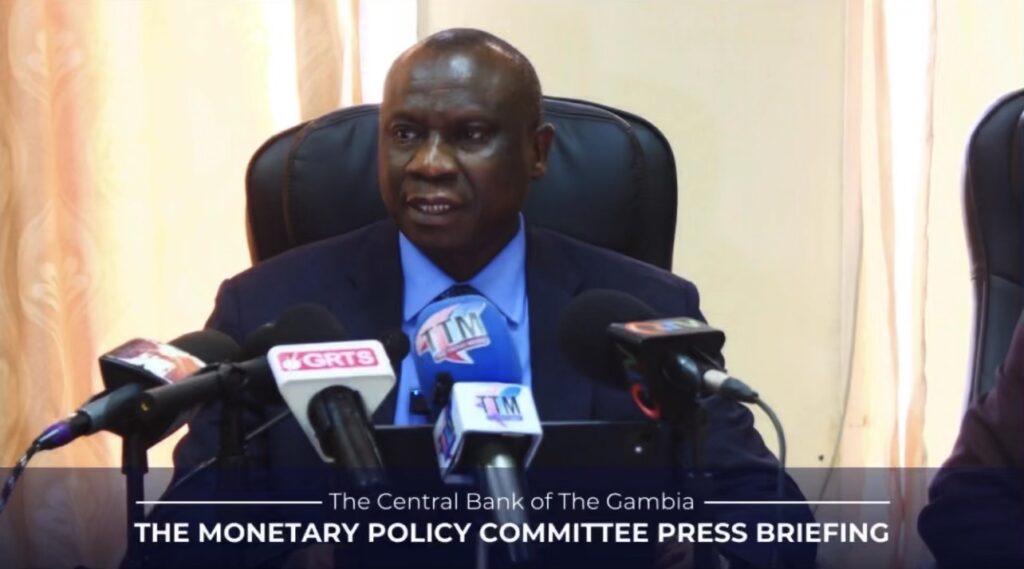
Presenting the Monetary Policy Committee (MPC) statement in Banjul on Thursday, May 21, 2026, the CBG Governor, Buah Saidy, disclosed that headline inflation rose to 7.0 percent in April 2026, up from 6.6 percent in December 2025 and 6.4 percent in January 2026.
He noted that recent inflationary trends signal a reversal of earlier moderation, driven largely by higher global energy prices, increased transport costs, and broader external price pressures.
“Headline inflation increased to 7.0 percent in April 2026, from 6.6 percent in December 2025 and 6.4 percent in January 2026,” Hon. Saidy stated. “The recent uptick in inflation partly reflects higher food and nonfood prices amid amplified geopolitical tensions and elevated import costs.”
According to the CBG, food inflation rose to 6.7 percent in April 2026, from 6.2 percent in January, largely due to higher prices for meat, fish, fruits, and nuts. Non-food inflation also accelerated to 7.2 percent from 6.4 percent, driven by increased costs in transport, housing, utilities, and selected services.
Core inflation indicators showed a marked increase, suggesting broader domestic price pressures. Core 1 inflation, which excludes energy, rose sharply to 6.6 percent in April from 3.4 percent in January. Core 2 inflation, which excludes both energy and food, climbed to 6.5 percent from 4.6 percent over the same period.
“Core 1 inflation, which strips out volatile energy prices, increased to 6.6 percent in April 2026, from 3.4 percent in January 2026. Similarly, Core 2 inflation, which further excludes volatile food prices, rose to 6.5 percent from 4.6 percent over the same period, suggesting domestic inflationary pressures are becoming more broad-based and renewed upside risks to the inflation outlook,” Hon. Saidy said.
On the external sector, the CBG reported a deterioration in the country’s balance of payments position. The current account deficit widened to US$20.83 million (0.8 percent of GDP) in the first quarter of 2026, compared to US$13.19 million (0.5 percent of GDP) during the same period in 2025.
The goods trade deficit also expanded to US$284.37 million, up from US$248.07 million a year earlier, reflecting a 20.6 percent increase in total imports.
Despite these pressures, the foreign exchange market remained relatively stable, with total transactions reaching US$644.19 million in the first quarter. Remittance inflows totaled US$246.08 million between January and March 2026, representing a 17.2 percent increase compared to the same period last year.
The Gambian Dalasi showed marginal appreciation, strengthening by 0.3 percent against the US dollar and 0.5 percent against the British pound during the review period.
Looking ahead, the CBG revised its 2026 real GDP growth forecast downward to 5.7 percent, a 0.5 percentage-point reduction attributed to the economic impact of the ongoing conflict in the Middle East.
On public finances, domestic debt rose to D53.3 billion at the end of March 2026, equivalent to 24.0 percent of GDP, up from D51.99 billion (23.4 percent of GDP) a year earlier. The debt portfolio remains heavily skewed toward short-term instruments, which account for 54.8 percent of total domestic debt.
The central bank emphasized the need for continued vigilance as global uncertainties persist and domestic inflationary pressures intensify.
Comments are closed.