

Opinion: Why Seeking a Third Term Could Be President Adama Barrow’s Worst Political Decision

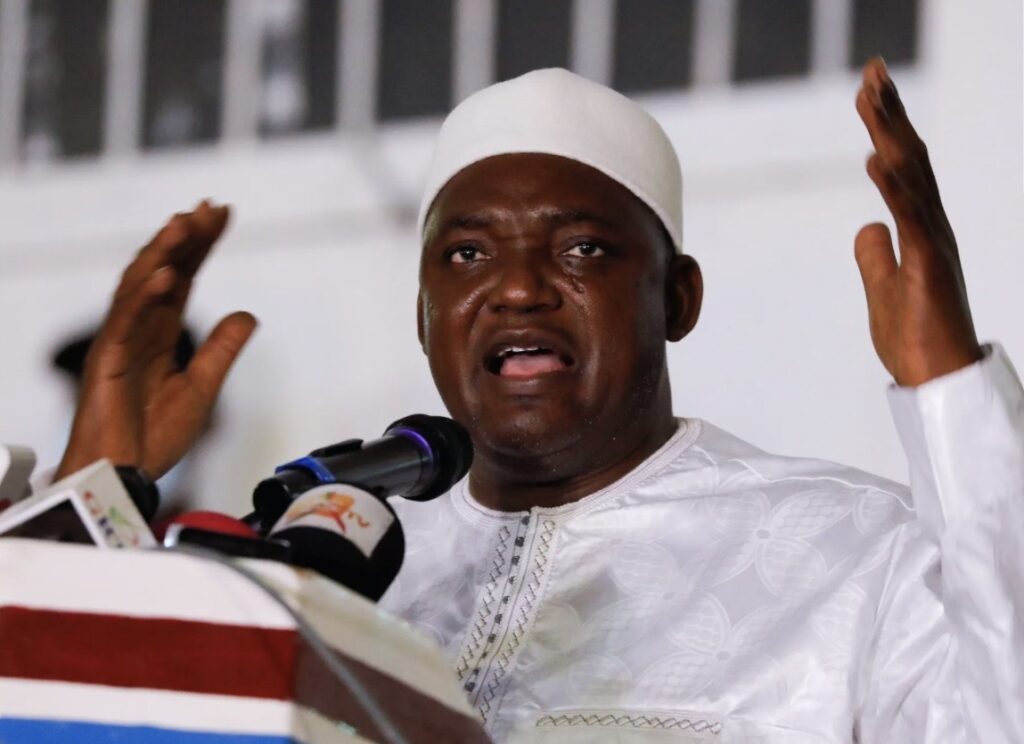
H.E Adama Barrow, President Of The Gambia
By Maa Touray
A decision by President Adama Barrow to seek a third presidential term may prove to be the most consequentialpolitical decision of his political career. At first glance, such a claim may appear exaggerated. After all, the president currently enjoys political advantages and could plausibly win another election. And this is exactly the thesis of this article: leaders at the height of their power often make decisions that ultimately lead to their political downfall. History is replete with many such cases. For those who should leave power, instead of taking a bow and leaving gracefully, they would end up being forced out disgracefully.
So, in pursuit of a third term, President Barrow will have to confront two formidable challenges: the burden of history and the weight of his words. Each presents difficult obstacles to overcome.
The Burden of History
The first burden of history President Barrow would face is the historical experience of The Gambia itself. The country emerged from 22 years of authoritarian rule under President Yahya Jammeh, a period defined by the entrenchment of power and the weakening of democratic institutions. Before Jammeh, President Sir Dawda Kairaba Jawara governed for nearly three decades, benefiting from repeated electoral victories that extended his tenure.
Barrow’s victory in 2016 was widely seen as a historic opportunity to break the cycle of overstaying in power and lay the foundation for stronger democratic norms. So, seeking a third term, though legally permissible under the 1997 Constitution—after the rejection of the 2020 Draft Constitution—would run counter to the collective aspiration of democratic renewal that emerged after the end of Jammeh’s rule. For many Gambians, the desire for new leadership model remains deeply rooted, and ending self-perpetuation is a core tenet of the principles of “Never Again”.
The second burden of history President Barrow must deal with isthe recurring pattern of leaders making critical decisions at the height of their political strength—due to hubris or political miscalculations—that later turn out to be costly. There are several such cautionary examples across Africa:
In 1991, after nearly three decades in office, President Jawara announced that he would not seek another term. However, facing pressure from loyalists and political allies, he reversed his decision and contested the 1992 election. Although he won, his government was overthrown just two years later in the 1994 military coup that brought Jammeh to power.
Similarly, in Guinea, President Alpha Condé pushed through constitutional changes in 2020 to allow himself to run for a third term after a decade in power. He won the election but was removed from office in a military coup the following year, led by the special forces unit he had ironically created to protect his regime.
Even leaders who avoid coups can find that controversial political decisions undermine their legacy. President Yahya Jammeh believed he had the electoral system firmly under his control and the loyalty of the military, assuming that neither elections nor a coup could remove him from power. Yet a series of miscalculations culminated in his shocking defeat in the 2016 presidential election. He refused to concede and then attempted to annul the result after initially accepting defeat. This led to intervention by ECOWAS troops from which he fled into exile in Equatorial Guinea.
In Senegal, former president Macky Sall faced significant political backlash after attempting to postpone the 2024 presidential election, a move later reversed by the country’s constitutional authorities. His hand-picked successor, Amadou Ba, lost. The candidate from his nemesis party, Patriotes africains du Sénégal pour le travail, l’éthique et la fraternité(PASTEF), Bassirou Diomaye Faye, won the election. Sall is currently living in exile in Morocco, facing legal action and accusations of high treason from the new government.
These examples demonstrate a recurring lesson: legal authority does not always translate into political legitimacy. Leaders may act within the law yet still face severe political consequences.
The Weight of His Words
The second hurdle facing President Barrow’s bid for a third term is the weight of his own words. Political leadership ultimately rests not only on legal authority but also on credibility and trust. From the start, President Barrow has spoken publicly in favor of presidential term limits and democratic reforms. He once stated publicly that he supported presidential term limits and that the practice would begin with his own presidency. Then over the years, his tone changed. At one point he remarked, “during a campaign one can say anything, but once in office one may do something different.” This had many people wondering if he only gives his words out of convenience rather than out of conviction.
In politics, credibility rests on the expectation that a leader’s word is their bond. On the other hand, in life, people can be ensnared by their own words—when the weight of their wordscomes back to haunt them.
Among the key promises President Barrow reneged on were the three-year transitional arrangement and the pledge to support constitutional reforms introducing presidential term limits. The Constitutional Review Commission produced a draft constitution in 2020 after extensive consultations and significant public expenditure. However, the draft ultimately failed to pass in the National Assembly, widely believed to have been influenced by the president and his allies, as had it passed, it would have barred him from serving for more than two terms.
Term limits are the seal or linchpin for democratization, acting as preventative measures against the self-perpetuation and erosion of democratic norms. The other key promise that Barrow reneged on or has been dragging his feet on was to curtail corruption and institute accountability. Currently, corruption is more rampant than under President Yahya Jammeh.
The Perils of Invoking Divine Justification in Politics
More recently, Barrow has added a theological argument to his defence of seeking a third term. At a meeting with religious leaders at the State House, he suggested that leadership is ultimately ordained by Allah, citing the 30-year rule of President Jawara and the extended tenure of President Jammeh from the expected 2-year transitional period as examples of how leaders sometimes remain in power far longer than initially expected.
However, the critical lesson seemingly overlooked in that narrative is that both Jawara and Jammeh ultimately left office under disgraceful circumstances after prolonged rule, Jammeh with a lesser number of years and leaving much more disgraceful and humiliated. Moreover, attributing political leadership to divine will raises deeper contradictions, since the same reasoning would also justify Jammeh’s presidency, which Barrow himself opposed for 22 years.
The argument therefore invites reflection not only on the dangers of overstaying in power, but also on the moral implications of invoking faith to justify political ambition, especially when public trust depends on keeping one’s word, not divulging what is confided in you, and presenting narrativeswithout embellishment.
Legacy Versus Power and Self-Serving Advisors
President Barrow has overseen notable achievements during his decade in office, particularly in infrastructure development. No one can take that from him. So, his supporters may argue that his infrastructure record merits continuity, and that the constitution permits a third term. But history shows that legal permission does not always translate into political protection– Jawara and Condé also acted within their laws yet still fell.
Nonetheless, the question at stake is larger than any single development project or political victory. It concerns the long-term health of democratic institutions in The Gambia. Sometime back President Barrow said that he had initially planned to step down after two terms but changed his mind to prevent the “early demise” of his National People’s Party (NPP). He should go back to that plan and stick to it. History shows that President Jawara once yielded to pressure from allies urging him to stay longer in office. It didn’t end well for him.
Furthermore, President Barrow should recognize that many of those encouraging him to seek a third term are acting out of self-interest rather than genuine loyalty, and such support can quickly disappear once it no longer serves them—just as figures like Seedy S.K. Njie and others abandoned Yahya Jammeh when his power collapsed. History shows that even leaders who once appeared powerful and secure can fall from influence tohumiliation, a reality illustrated by former presidents such as Macky Sall, Alpha Condé, and Blaise Compaoré. The presidency can elevate an individual to the highest authority in a nation, but it can also end in profound personal and political downfall. From grace to disgrace.
Term limits ensure that leadership renewal remains possible and that no individual becomes indispensable to the political system. Democracies are strengthened when leaders willingly step aside and allow institutions—not personalities—to define the future of governance.
Ultimately, the decision facing President Barrow is not merely about whether the constitution permits a third term or whether he can win the next election. It is about how history will remember his presidency. He may choose to pursue another term and risk turning a decade of leadership into a contentious political struggle. Or he may step aside after two terms and be remembered as the leader who helped restore democratic norms after one of the country’s most difficult periods.
The choice is his. History suggests that leaders who know when to leave often secure the stronger legacy.
President Barrow surely knows, “when one must choose between their friend and some other person, they should choose their friend. However, if one must choose between themselves and their friend, they should choose themself. “
Comments are closed.