


By Makutu Manneh
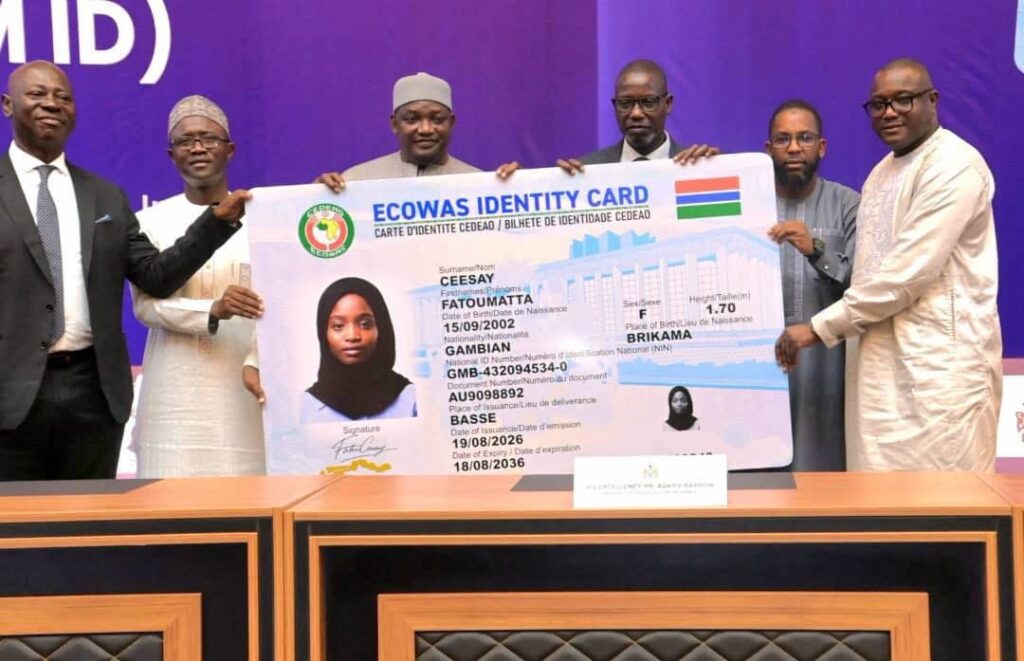
The Government of The Gambia on Tuesday officially launched the National Identity Management System (NIMS), a flagship digital initiative aimed at strengthening secure and reliable identification, improving access to public services, and advancing the country’s broader digital transformation agenda.
Officials described the system as a critical national asset that will enhance identity management, strengthen governance, improve public service delivery, and support crime prevention through a secure and integrated identification framework.
Launching the initiative, President Adama Barrow said the new system will ensure that every Gambian is formally recognized within a unified national identity database, creating greater opportunities for inclusion, improved service delivery, and sustainable national development.
The president announced that Gambians aged 18 years and above can now register and receive a biometric ECOWAS identity card instantly. Valid for 10 years, the card is expected to facilitate regional travel within the ECOWAS sub-region while providing easier access to a range of government and private-sector services.
President Barrow said assigning every Gambian a unique digital identity will enable public institutions to collect and manage data more accurately by reducing duplication, minimizing administrative inefficiencies, and improving the efficiency of service delivery.
He stressed that a trusted national identity system is a fundamental responsibility of a sovereign state, describing it as essential for effective national planning, efficient public administration, and meaningful citizen participation in national development.
“This development reflects the principle that the identity of Gambians belongs to the Gambia. Every item of data collected remains the property of the government and people of The Gambia,” President Barrow said.
Moses Baiden, Chief Executive Officer of Margins ID Systems Application Limited, the company that developed the platform, said the system was designed to protect citizens against digital identity theft and fraud while strengthening government planning and public service delivery.
According to Baiden, the digital identity platform will support a broad range of sectors, including social protection, financial services, border management, crime prevention, and national planning and budgeting for essential public services.
He added that digital identity systems linking citizens to government and informal-sector services have become significant drivers of economic growth across Africa, contributing substantially to national economic output.
Speaking on behalf of the Ministry of Communications and Digital Economy, Director General of the ICT Agency, Professor Abdou Karim Jallow, described the launch as The Gambia’s first comprehensive national digital identity system.
He said the initiative marks a shift from fragmented identity databases to a unified digital ecosystem capable of securely sharing verified information across government institutions.
“This enables the government to move from fragmented systems towards a more integrated digital ecosystem. Digital ID therefore becomes an important enabler of interoperability, allowing systems to remain independent while securely communicating and enhancing verified information,” Prof. Jallow said.
He noted that identity management is a core function of every modern state, as effective governance depends on the ability to accurately identify individuals, verify their identities, and ensure that government institutions can consistently recognize citizens across multiple services.
Prof. Jallow further emphasized that the digital identity extends beyond a physical identity card, describing it as a secure and trusted digital representation of an individual that uses biometric technology to facilitate electronic identification, authentication, and verification across both public and private-sector platforms.
The National Identity Management System forms part of the government’s wider digital transformation strategy and is one of several flagship initiatives aimed at modernizing The Gambia’s security infrastructure, strengthening public administration, and promoting inclusive and sustainable national development.
Comments are closed.