

NHRC Report Cites Progress on Human Rights in Gambia but Warns of Persistent Abuses

By Seedy Jobe
The National Human Rights Commission on Tuesday released its 2025 State of Human Rights Report, acknowledging legislative and institutional progress in The Gambia while warning that torture allegations, prison conditions, violence against women and children, and delays in implementing key reforms continue to undermine the country’s human rights record.
The report was presented during a news conference at a beachside hotel, where the Commission also provided updates on the government’s implementation of the Truth, Reconciliation and Reparations Commission (TRRC) recommendations and the findings of its recent prison monitoring visits.
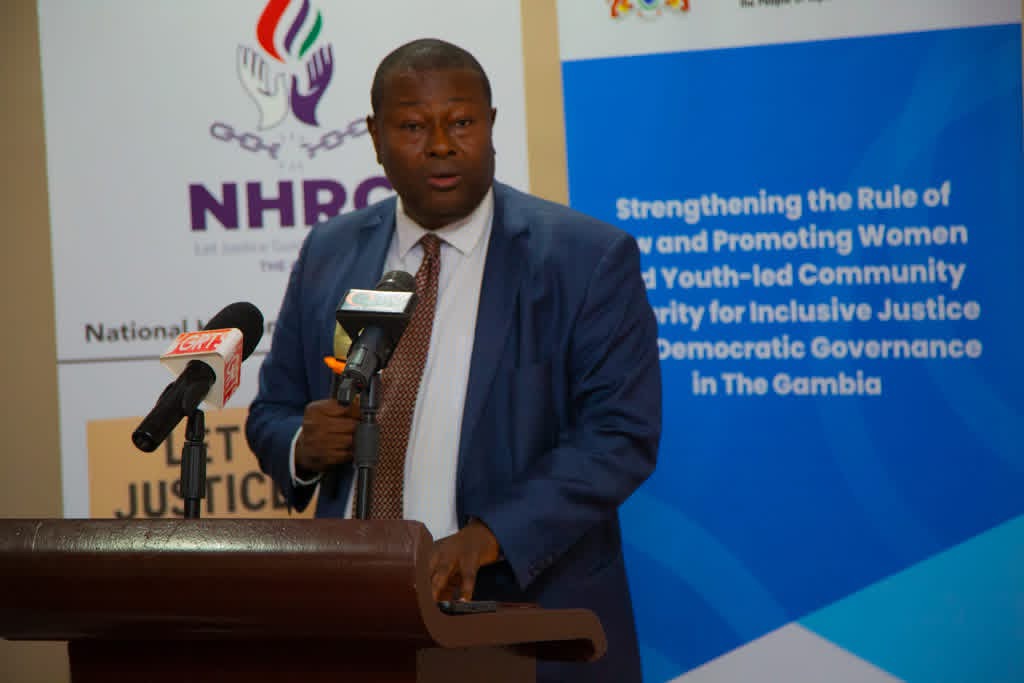
Emmanuel Joof, the chairman of the commission, said protecting human rights requires sustained commitment from government institutions, the judiciary, civil society organizations, the media, and ordinary citizens.
“Human rights is everybody’s business, including the media,” Mr. Joof said. “Progress should never make us complacent, because we cannot slide back to where we were.”
Established under the National Human Rights Commission Act of 2017 and operational since 2019, the NHRC is an independent statutory body that reports to the National Assembly. Mr. Joof emphasized that the commission neither serves the government nor operates in opposition to it, but instead carries out its constitutional mandate independently while engaging with state institutions and development partners.
He also noted that the commission has retained its A Status accreditation from the Global Alliance of National Human Rights Institutions, signifying continued compliance with the United Nations Paris Principles governing the independence of national human rights institutions.
Reviewing the commission’s work during 2025, Mr. Joof said it focused on issues including business and human rights, climate change, hate speech, discrimination based on the caste system, sexual and gender-based violence, disability rights, and rights-based budgeting. The commission also contributed to the review of several pieces of legislation, including the Criminal Offences Act 2025, the Criminal Procedure Act 2025, and the Reparation Act, which established the Reparation Commission.
In carrying out its protection mandate, he said, the commission investigated complaints, mediated disputes, monitored detention facilities, organized legal aid clinics, and tracked implementation of the government’s White Paper on the TRRC recommendations.
Mr. Joof also urged journalists to play a constructive role in advancing human rights by verifying information, avoiding sensationalism and hate speech, protecting the identities and dignity of victims and children, and ensuring balanced reporting.
Presenting the report, NHRC Legal Officer Ida Jatta said the commission received more than 60 complaints during 2025, with roughly half resolved through investigations, mediation, or recommendations.
She pointed to what the commission described as significant legislative gains, including the enactment of the Criminal Offences Act 2025 and the Criminal Procedure Act 2025, legislation that modernizes the country’s criminal justice system and abolishes the death penalty for capital offenses. The creation of the Reparation Commission was also identified as a major institutional milestone.
The report, however, concludes that serious human rights concerns remain.
According to the commission, complaints alleging torture and other forms of inhumane treatment involving security institutions increased to 11 in 2025 from seven the previous year. It also recorded five complaints involving alleged violations of the right to liberty.
The report cites slow implementation of the Persons with Disabilities Act 2021 and says many older people continue to face economic hardship because of inadequate policy support.
While expressing concern over an increase in violent crime, the commission said public security measures must remain consistent with human rights standards. It also raised concerns about allegations of excessive force by police, including the case involving Omar Badjie, and called for greater accountability.
Conditions in detention facilities also remained a concern, according to the report, which identified overcrowding, poor sanitation, inadequate health care and prolonged detention in police cells and prisons.
On the rights of women and children, the commission said female genital mutilation continues despite its prohibition under Gambian law. It also cited ongoing cases of rape and sexual assault, child abuse, exploitation, child marriage and the continued number of children who remain out of school despite constitutional guarantees of free and compulsory basic education.
The commission called for faster implementation of the Persons with Disabilities Act through a fully funded national action plan and increased government budget allocations.
The briefing also included an update on the implementation of the government’s White Paper responding to the recommendations of the Truth, Reconciliation and Reparations Commission.
Abdou Manneh, the NHRC’s Principal Investigation Officer, said the government has accepted 263 recommendations made by the TRRC. Of those, 46 have been fully implemented, 129 are in progress and 101 remain outstanding.
He said that, of the 304 implementation activities identified by the commission, 65 have been completed, 155 are ongoing and 84 have yet to begin.
Between May and December 2025, five implementation activities were completed, while 17 advanced from “not implemented” to “ongoing,” Mr. Manneh said. Among the developments highlighted were the enactment of new criminal justice legislation and the operationalization of the Reparation Commission.
Mr. Manneh noted that the NHRC has published annual assessments of the government’s implementation of the White Paper since 2023, in accordance with paragraph 563 of the document. While previous reports covered the period from May to May, the commission has adopted a January-to-December reporting cycle, making the current publication a supplementary update covering June through December 2025.
The commission said it would continue engaging the government and the National Assembly to encourage implementation of its recommendations and strengthen the protection of human rights in The Gambia.
Comments are closed.