
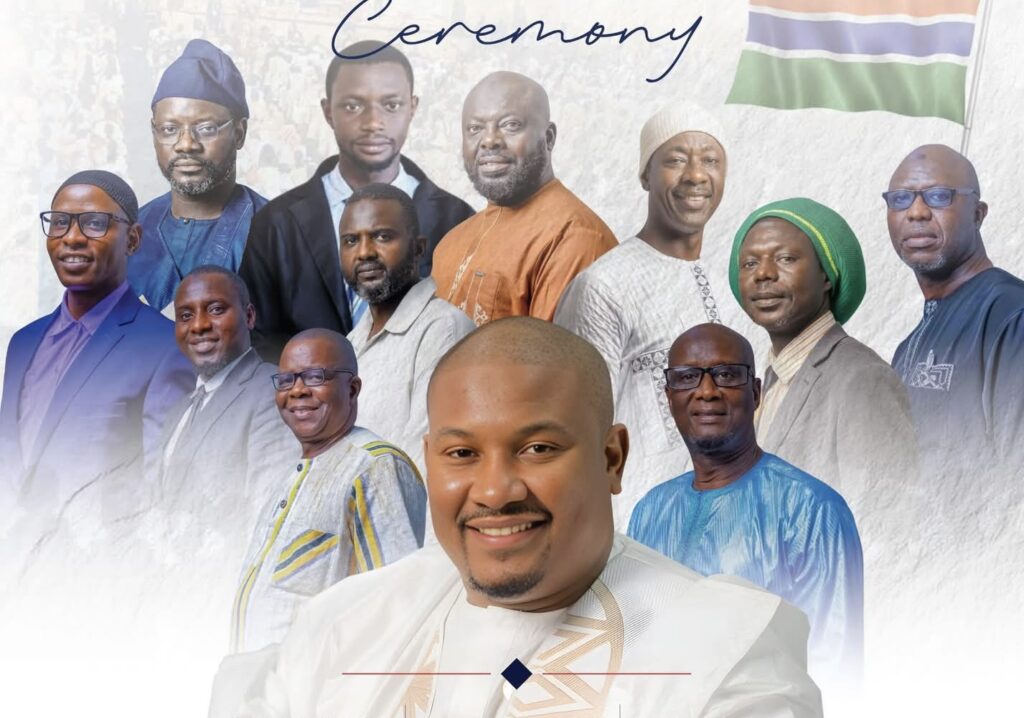
Members of the coalition 2026
By Journalist Hatab Fadera
Since the 2021 elections, there has been intense discourse in some quarters about the need for a third force in the presidential race to defeat incumbent Adama Barrow. Proponents of this idea have argued that our political space needed a new trajectory, one in which the main candidates would be beyond Barrow (Godson) and Ousainu Darboe (Godfather).
While Coalition 2026 did not necessarily start as a launchpad for this third force, it is now more accurately seen as exactly that. At its launch, Coalition 2026’s principal goal was to unify the entire opposition into a single bloc against Barrow. However, as talks dragged on for weeks, opposition stakeholders faced the grim reality that their differences were irreconcilable. This led to the mass withdrawal of registered political parties, leaving only UNITE and APP-Sobeyaa as the only registered parties. Coalition 2026’s efforts to consolidate faltered further after the withdrawal of Essa Mbaye Faal’s APP-Sobeyaa over several concerns, including “delegate inducement” and disagreement over the ratification of a running mate. To add to the chaos, the Coalition’s Mediation Committee (CMC) Chair, Yerrow Mballow, and member ex-VP Fatoumatta Jallow-Tambajang walked out of the convention after their suggestion to delay proceedings by two weeks to investigate the allegations was overruled. Despite this setback, delegates pressed ahead, selecting Kanifing Mayor and UNITE leader Talib Ahmed Bensouda as its presidential candidate.
Since that convention, Coalition 2026 has consolidated its bloc by welcoming back the CMC Chair, Yerrow Mballow, and others, including Dr. Ousman Gagigo’s Patriotic Progressive Alliance (PPA), which severed ties with the Gambia For All (GFA) party. At an MOU signing on August 20, the coalition unveiled 10 stakeholders, with the UNITE Party being the major stakeholder.
UNITE Party
Since its split with the UDP in late 2025, the UMC, now UNITE, has emerged as one of the country’s most rapidly evolving new political forces. In just 11 months, the party has positioned itself as the new kid on the block, commanding influence that surpasses that of many existing opposition parties, as evidenced by its activities and recent polling.
UNITE’s performance is by no means accidental. It’s the end result of hard work, strategic thinking, efficient organization, and effective resource mobilization. What may also have contributed to the party’s influence is that, following its formation as a movement, it quickly rolled out its strategy, building political structures across regions and providing mobility for its grassroots coordinators. In modern Gambian politics, there is no better way to run an effective political party than to create structures and provide incentives. UNITE understood this.
What I think also works for UNITE is effective messaging and branding, which are critical to managing a party’s image. A review of UNITE’s online properties indicates that it is effectively using new media for creative, multi-platform messaging to engage its audience. This strategy would likely appeal to the younger demographic that is actively present online.
But beyond the party, UNITE has a candidate who is a two-term mayor. As expected, the party has been leveraging Mayor Bensouda’s track record at KMC to make the case for what a Bensouda presidency would be like. The party points to the mayor’s integrity, commitment to accountability, and his innovative approach to development and governance.
All the above explain why the mayor’s presidential prospectshave surged since last year. In the Gambia Participates’ latest poll, the mayor now has a 19 percent chance of winning the presidential election, a significant increase from 2 percent in last year’s poll (Gambia Participates, 2026). Even though the mayor trailed the incumbent (32 percent) and veteran opposition leader Ousainu Darboe (25 percent), this increase is significant considering that he is a new entrant at the national level.
UNITE’s Challenge
Despite UNITE’s prospects, it remains very new to national politics. It has not yet been battle-tested, and its true strength or impact will be measured by the outcome of the December 5 presidential election. Momentum can be easily built around new movements or ideas, but sustaining it and translating it into tangible electoral results is the real challenge. UNITE should take a cue from GDC’s 2016 momentum, when the purple party emerged as a real political force only to see that momentum wane after 2016. Until the upcoming elections, the party must continue to nurture its structures and outline the alternative programs it intends to offer to Gambians.
Coalition 2026 stakeholders
Unlike the other coalitions, this one is largely dominated by movements and yet-to-be-registered political parties. They are: Patriotic Progressive Alliance (PPA), Pastef Gambia, Defending the Gambian Interest (DGI), People’s Right Party (PRP), Forward Gambia (FORGAM), National Reform Congress (NRC), Gambia Movement for Progress (GMP), Save The Gambia Movement (STGM), National Democratic Association (NDA), Patriotic Nationalist Platform (PNP), and Movement of National Unity (MONU).
It’s fair to argue that many of these movements were previously unheard of, making it hard to measure their true impact. However, in a crucial election year with high stakes, these movements cannot be simply written off. They come from communities where they are likely to be supported by a few. Their combined energy will no doubt impact Coalition 2026. It’s also important to note that a good number of them might represent some sections of the independent or undecided voting bloc, thus making their participation in the Coalition 2026 significant.
NUP
While the National Unity Party (NUP) is not an official member of the Coalition 2026, its alliance with the UNITE Party is a plus for the coalition. NUP, despite being a small party, is experienced in presidential elections. In the 2021 presidential election, NUP received about 1% of the vote. However, the party has since changed leadership and increased its political participation.
Comments are closed.