


By Journalist Hatab Fadera
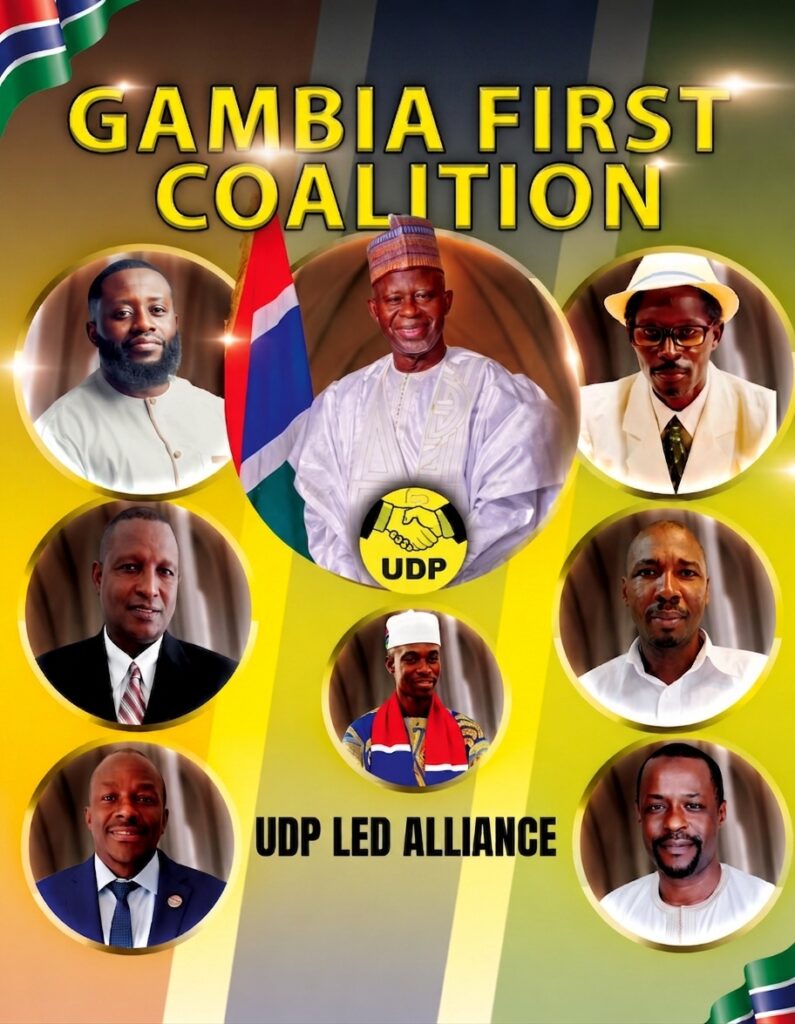
On August 14, 2026, events at the Kairaba Beach Hotel felt like déjà vu, reminding Gambians of the historic Coalition 2016 convention that selected Adama Barrow as a unified opposition presidential candidate. That day, the Gambia First Coalition (GFC) emerged as a political front favoring the largest opposition party, the United Democratic Party (UDP), to lead it into the 2026 presidential elections.
Coming on the heels of a chaotic Coalition 2026 building process that saw key registered political parties withdraw over several concerns, including the candidate-led approach, the Gambia First Coalition is poised to be a major force in this year’s election. That’s because it’s led by veteran opposition leader Ousainu Darboe, who has placed second in every presidential election he has contested since the formation of the United Democratic Party in 1996, most of them under a brutal dictatorship. In fact, a recent poll placed Darboe second (25 percent), trailing the incumbent by just 7 percent (Gambia Participates, 2026). In that poll, which surveyed 1,556 registered voters across 53 constituencies in the country’s eight local government areas, 41 percent of respondents said the UDP-led coalition could win the election.
Road to UDP-led Coalition
In September 2025, following internal turmoil and a political rupture that threatened the main opposition party, the future of UDP seemed bleak. The party lost nearly its entire national organizing and campaign structures to a splinter group led by Kanifing Mayor Talib Ahmed Bensouda. Key figures – Ebrima Dibba, deputy national organizing secretary; Karafa Sonko, national campaign manager; Kemo Bojang, key youth leader; Baboucarr Jammeh, deputy national campaign manager; Matty Kanyi, a councilor; and Tombong Saidy, administrative secretary for media and communication, all left the party after their preferred candidate withdrew, as it became clear his path to securing it was slim against Darboe.
At that time, I stated that the political implosion had weakened the party. However, I also stated that the UDP is no stranger to splinters and that the party would bounce back, reorganize, and strengthen its structures. I was writing with two incidents in mind that preceded the Unite Movement for Change (UMC, which morphed into the UNITE Party), notably Lamin Waa Juwara’s expulsion and eventual formation of the National Democratic Action Movement (NDAM) in 2002, and President Adama Barrow’s separation and formation of the National People’s Party (NPP) in 2019. In each case, the UDP bounced back and reorganized because it’s a grassroots party with the most loyal electoral base. No splinter can move the party’s core conservative base. It’s rock solid.
Today, more than 10 months after UNITE splintered, the UDP has not only reorganized but has become very effective in its engagement. Not only did it quickly fill the vacancies left by UNITE’s principals, but those entrusted with those positions have stepped up to deliver on behalf of the party. UDP continues to organize countless successful national and Diaspora events, including a recent major fundraising. The crowd at its 30thanniversary in Brikama on August 23 was electrifying, showcasing the depth of its strength and endurance.
Perhaps the party’s greatest achievement since that splinter is its agreement with five registered political parties and movements under a party-led framework. This development is meaningful, as it demonstrates the party’s ability to build trust among like-minded groups and enter a coalition. Significantly, it’s always been the UDP’s position for a party-led coalition against an incumbent. While they have forged similar alliances in the past, this is the broadest it has achieved in the past 30 years.
UDP has also stepped up its messaging and elevated the political conversation. Today, its official messaging is sharper and more engaging, focusing on issues and defining its own narrative. Arguably, one of the biggest challenges UDP has been confronting is a deep-seated negative narrative surrounding the party and its leadership. For a party that was at the forefront of the country’s fight against the dictatorship, it was the main victim of the autocrat’s negative narrative. However, it’s impressive that UDP has been doing a great job of combating this narrative and defining its own. A review of its official social media platforms, mainstream media appearances, and political rallies shows that the party does its best to push out coordinated messaging, especially around programs it intends to deliver once it takes office. At the center of that is the pledge for its candidate to serve just one term, during which it will embark on reform programs abandoned by the Barrow Administration, including constitutional reform.
Beyond its organizational and narrative overhauls, the UDP has also enjoyed political stability regarding its elected representatives. Unlike before the 2021 presidential elections, when eight of its National Assembly Members defected to President Barrow, the UDP has maintained its 15 elected and one affiliated lawmakers and kept its mayor and chairpersons in Banjul, Brikama, and Mansa Konko. Additionally, most of its elected councilors have remained loyal to the party, except in Kanifing, where several councilors left with Mayor Talib Bensouda.
This numerical strength of elected representatives, coupled with the party’s strong support base, national structures, and a strong Diaspora presence, lent credence to the argument that it is better positioned to lead a unified opposition against Barrow in the polls. This argument is what led to the emergence of the Gambia First Coalition, which has the following members: UDP, Gambian People’s Advancement Party (GPAP), Alliance for Democracy and Development (ADD), Gambia Alliance for National Unity (GANU), Golden Era Party (GEP), Citizens’ Coalition for Change (CCC), and People’s s Progressive Party (PP)
PPP
Within the Gambia First Coalition (GFC), the People’s Progressive Party (PPP) is the oldest political stakeholder, which ruled the country for three decades under founding President Jawara. The dictatorship that banned the party in its infancy significantly affected it, as many of its supporters joined the new party, the UDP.
Fast-forward to today, the PPP remains a separate entity. It was a key stakeholder in the 2016 Coalition that brought President Adama Barrow to power. It renewed its political alliance with Barrow in the 2021 presidential elections. However, the post-dictatorship period has seen the PPP beset by several internal leadership crises. Notwithstanding, under its current Independent Electoral Commission-endorsed leadership, the pink party has been repositioning itself as a major political player.
Today, the party has been doing an impressive job of restructuring. This includes smart, high-quality messaging and branding, transparent engagement with party structures, fundraising through party book sales, more visible leadership, and grassroots mobilization. This, among other things, is the strength the PPP will bring to the Gambia First Coalition.
While the party’s last major elected representation was 2017-2022, when it had two National Assembly Members from Banjul, it recently attempted to contest the Half Die local government by-election in Banjul.
The PPP remains influential in that its name continues to be synonymous with Sir Dawda Kairaba Jawara’s legacy. With continued restructuring, the party will remain an important player in national politics. It will bring its coalition-building experience in particular to this new opposition bloc.
ADD
In the last presidential election, little was known about the Alliance for Democracy and Development (ADD) led by stylish Malick Camara. In that election, ADD backed Barrow. However, in the lead-up to this year’s election, ADD’s leader has been playing an influential role in efforts to get the opposition to coalesce against Barrow. In fact, ADD started what became known as the Coalition 2026. However, the party later exited its own coalition process because it preferred a party-led process over the adopted candidate-led process. ADD would go on to be a founding member of the Gambia First Coalition, rallying behind the UDP. The party, registered with the IEC, has never contested any elections. However, the fact that it initiated two coalition-building processes shows that its leadership is strategic and engaged.
GPAP
The Gambian People’s Advancement Party (GPAP) was registered in November 2025. The GPAP leader, Dr. Papa Faal, a grandnephew of ex-President Jawara, made a failed bid for the presidency in 2021 as an independent but was rejected by the IEC. Faal, a U.S. Army veteran, would go on to back President Barrow in the said election. However, since 2021, Faal has diverged with Barrow on his governance, and he’s active in uniting the opposition against the former’s third-term bid. At the GFC MOU signing, Faal, who was part of the December 30th, 2014 attack to dislodge the dictator, spoke on behalf of the stakeholders at the August 14 MOU signing, calling for opposition unity against the incumbent.
GANU
The Gambia Alliance for National Unity is headed by former Attorney General and Justice Minister Sheikh Tijan Hydara. Since its formation, GANU has shuttled between political alliances. In the run-up to the 2021 elections, GANU and former President Yahya Jammeh’s No To Alliance announced a political front. GANU attended a massive rally in Kanilai, where the dictator declared the alliance. That alliance was short-lived, as GANU quickly rallied behind NPP. He would go on to be appointed ambassador to Cuba, where he served for years before being recalled following an internal dispute. As recently as May 2026, GANU entered an alliance with Kebba Madi Bojang’s National Democratic Party (NDP) and Alliance Reorientation Economic Force (WAREF).
Golden Era Party
This yet-to-be-registered party is one of the new political movements taking part in this year’s election. Headed by two Gambian American returnees and entrepreneurs, the party’s leadership was the first to declare its support for a UDP-led grand coalition. The party’s leadership is articulate and, despite being newcomers, has been proactive in this election season.
Watch out for part three, focusing on Coalition 2026.
Comments are closed.