


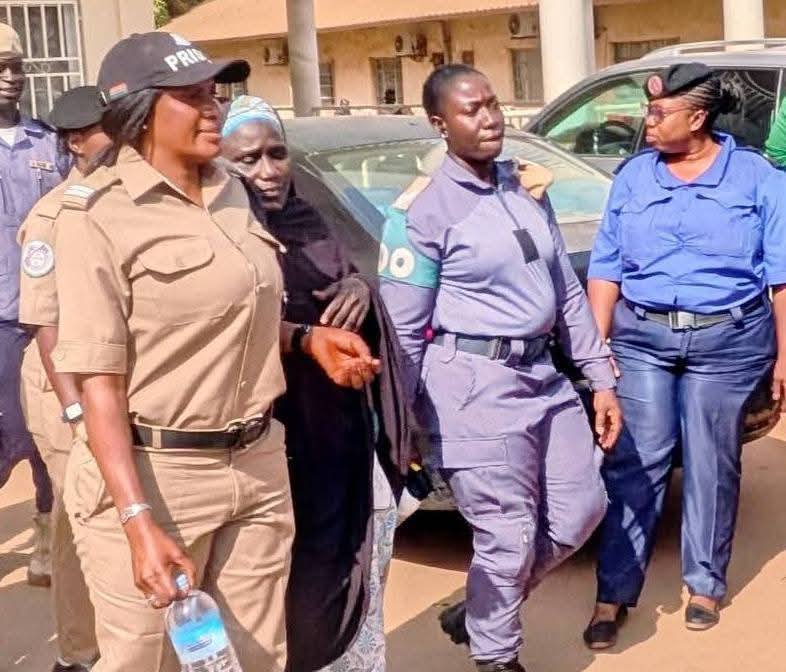
Counsel K. Jallow, representing Fatou Camara—one of three women standing trial over the death of an infant allegedly subjected to female genital mutilation (FGM)—has filed a no-case submission, urging the court to acquit her client without requiring a defence.
In the application before Justice I. Janneh of the Banjul High Court, the defence argues that the prosecution’s case is fundamentally flawed, relying on hearsay evidence, rejected statements, and inconsistent medical findings, and that it cannot sustain a conviction.
Fatou Camara of Wellingara, the first accused, faces two charges: conspiracy to commit a felony and engaging in prohibited female circumcision, contrary to Section 32A(2)(b) of the Women’s (Amendment) Act, 2015. The prosecution alleges that she carried out FGM on Baby Sarjo Conteh on or about 8 September 2025, an act it claims led to the child’s death. The second and third accused persons are Hawa Conteh and Oumie Sawaneh. The current submission applies solely to the first accused.
During the trial, the prosecution called 11 witnesses—primarily police officers and medical personnel—and tendered several exhibits, including photographs, hospital records, and an autopsy report. Its case centers on the claim that the infant died as a result of FGM allegedly performed by the accused.
However, the defence contends that key pieces of evidence were ruled inadmissible. These include cautionary and voluntary statements purportedly obtained from the accused persons, which the court rejected for non-compliance with Section 31(2) of the Evidence Act and the Judges’ Rules. According to Counsel Jallow, this left the prosecution without any direct incriminating evidence.
“The prosecution’s case, even at its highest, does not disclose any evidence upon which a reasonable tribunal could convict the first accused,” Jallow submitted.
In a detailed, witness-by-witness analysis, the defence argues that there is no admissible evidence linking Fatou Camara to the alleged offences. Testimony from the first three prosecution witnesses—all police officers from the Child Welfare Unit—is described as purely procedural, with none witnessing the alleged act. Other testimony, the defence argues, is based entirely on second-hand accounts.
The defence further challenges the evidential value of testimony from a police officer who attended the autopsy and attempted to link photographic evidence to FGM, noting that the officer is not a medical expert qualified to determine the cause of death.
Medical testimony is also disputed. One doctor admitted under cross-examination that she never examined the deceased and relied solely on information from hospital meetings. Another senior medical witness acknowledged that his knowledge of the case came from a colleague who was not a pathologist.
Central to the defence’s argument is the autopsy report prepared by Professor Ogun, a pathologist at Edward Francis Small Teaching Hospital. While the report attributes the cause of death to external haemorrhage and references alleged genital cutting, the defence highlights what it describes as critical inconsistencies. Under cross-examination, the pathologist conceded that he could not determine the instrument used, could not independently establish the cause of the injuries, and acknowledged that timely medical intervention might have prevented the death.
The defence also points to what it calls an “unexplained shift” in the report—from initial uncertainty, noting the child “allegedly” underwent genital cutting, to a firm conclusion linking the death to FGM without sufficient supporting analysis.
Further, Counsel Jallow argues that the pathologist may have been influenced by a prior narrative, having been provided with a Medical Examination Form indicating that the child had been circumcised before the autopsy. The defence maintains this information constitutes hearsay rather than an independent clinical finding.
Additionally, a Brought-In-Dead (BID) form from Bundung Maternal and Child Health Hospital, admitted as evidence, recorded the cause of death as “unknown, probably hypovolemic shock (coincidence)” and made no reference to FGM. The defence argues that this contemporaneous record undermines the prosecution’s claim that FGM was the definitive cause of death.
The no-case submission, brought under Section 245 of the Criminal Procedure Act 2025, asks the court to dismiss the charges on the basis that the prosecution has failed to establish a prima facie case.
Counsel Jallow cited several legal authorities in support, including Batch Samba Faye v The State, as well as Nigerian and English precedents such as Ibeziako v Commissioner of Police and R v Galbraith, which set out the threshold for upholding a no-case submission.
The defence identifies three key failures in the prosecution’s case: lack of evidence of any conspiracy; absence of proof that the first accused performed the alleged act; and failure to establish, through credible and consistent medical evidence, that FGM was the cause of death.
“To call upon the first accused to enter a defence would be to compel her to answer allegations the prosecution itself has failed to establish,” Jallow argued. “That would amount to a reversal of the burden of proof, which the law does not permit.”
If upheld, the application would result in Fatou Camara’s acquittal without the need to present a defence.
Comments are closed.