

Defence and Prosecution Clash Over “No-Case” Submission in GALA Unlawful Assembly Trial

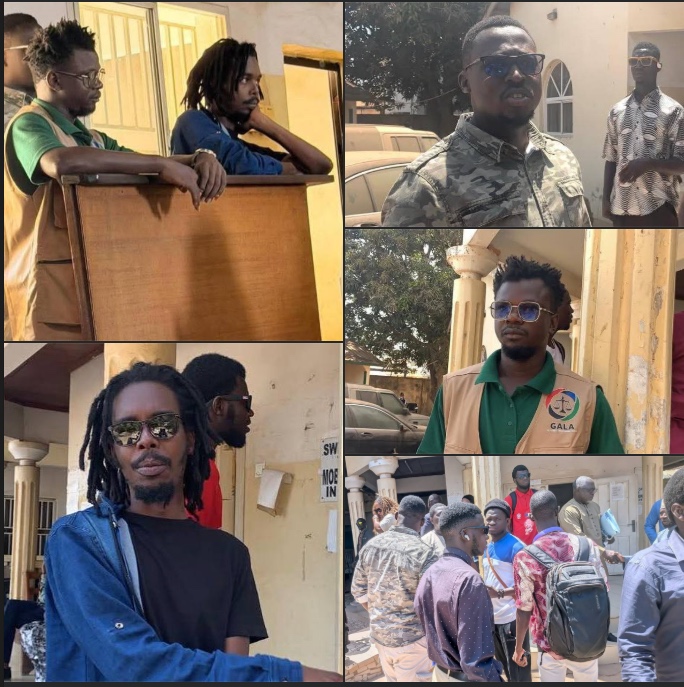
The trial of Kemo Fatty, Alieu Bah, and Omar Camara over charges of unlawful assembly and common nuisance reached a critical juncture this week at the Kanifing Magistrates’ Court, where defence and prosecution sharply disagreed on whether the state had presented enough evidence for the accused to be called upon to enter a defence.
Principal Magistrate Sallah Mbye is expected to rule on a defence application for a “no-case to answer” submission, filed by defence counsel L.S. Camara, which argues that the prosecution’s evidence is insufficient to sustain the charges.
The case stems from an incident involving members associated with the Gambia Association for Legal Advocacy (GALA), who were accused of staging an unlawful assembly in connection with a planned activity at the National Audit Office.
In a detailed submission, L.S. Camara told the court that the prosecution had failed to establish the essential elements of the offences charged, particularly the requirement to prove both criminal intent and a prohibited act.
“The burden of proof rests solely on the prosecution and never shifts,” he argued, adding that the evidence presented did not demonstrate either actus reus or mens rea.
He said the state had not shown that the accused participated in an unlawful assembly or caused any disturbance amounting to common nuisance.
“What is before the court is a charge of holding an unlawful protest without a permit, yet the evidence only suggests they were trying to hold a press conference,” Camara submitted.
He further contended that prosecution witnesses consistently described the gathering as a planned press briefing in a public space, not a protest or unlawful assembly as charged.
Citing authorities including the Nigerian case Ibeziako v. Commissioner of Police (1963), the English decision R v. Galbraith (1981), and regional jurisprudence, Camara argued that a no-case submission should succeed where the prosecution’s evidence is either absent, discredited, or incapable of supporting a conviction.
He urged the court to discharge the accused.
Commissioner Sanneh, representing the Inspector General of Police, opposed the application, insisting that the prosecution had established a prima facie case requiring the accused to enter their defence.
He told the court that four police witnesses had testified and that their evidence, taken together, supported the charges.
According to him, Police Officer Dawda Jallow (PW1) testified that upon arriving at the National Audit Office, officers encountered a large and “chaotic” crowd gathered in anticipation of a press conference. He said the accused were instructed to leave but allegedly refused, prompting the deployment of intervention units.
Officer Landing Bojang (PW2), Sanneh said, testified that the accused insisted on holding an event at the location without a permit and failed to comply with police instructions to disperse.
A third witness, Officer Colley (PW4), did not attend the scene but participated in the subsequent investigation and interviewed individuals connected to the case.
Sanneh also argued that the accused’s conduct met the legal threshold for unlawful assembly under Section 62, which defines such an offence as a gathering of three or more persons likely to cause public disturbance or fear of breach of the peace.
He further relied on provisions of the Public Order Act requiring permits for public gatherings, as well as Section 137 of the Criminal Code on common nuisance, arguing that the accused’s actions disrupted public order and caused inconvenience.
The proceedings were marked by several objections from the defence, particularly over claims made by the prosecution that were not reflected in the official record.
At one point, when Commissioner Sanneh asserted that witnesses had identified the accused as acting on behalf of GALA, defence counsel objected. Magistrate Mbye reviewed the record and confirmed the statement was not reflected in the proceedings.
A similar issue arose when Sanneh claimed the accused had admitted GALA membership during police interviews. The court again found no supporting record, prompting the commissioner to adjust his submission.
In response, Camara maintained that the prosecution had repeatedly attempted to expand its case beyond the charges before the court.
He argued that reliance on the Public Order Act was misplaced, noting that the accused were not charged under that legislation.
“Section 5 of the Public Order Act did not apply to the accused persons as they are not charged under that Act,” he said.
He also accused the prosecution of mischaracterising Section 137 of the Criminal Code on common nuisance.
After hearing both sides, Magistrate Sallah Mbye adjourned the matter to 11 June 2026 for ruling on the no-case submission. The decision will determine whether the accused will be required to enter their defence or be discharged.
Comments are closed.