

President Barrow Inaugurates 91-Kilometer Kiang West Road Network; Officials Hail Rural Connectivity Boost

By Seedy Jobe
The head of the Gambia’s National Roads Authority on Saturday hailed the newly inaugurated Kiang West Roads Project as a transformative investment that would knit together rural communities long separated by poor infrastructure, while urging residents to take ownership of its upkeep.
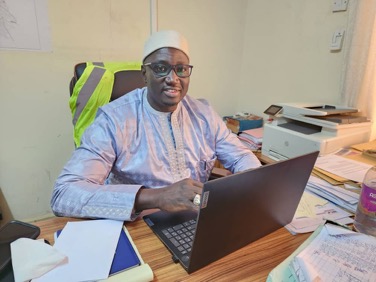
Speaking at the inauguration ceremony, Sulayman Sumareh Janneh, the managing director of the National Roads Authority, described the 91-kilometer network as more than a public works project.
“These roads are not merely strips of engineered pavement,” Mr. Janneh said. “They are pathways of possibility.”
Framing the project in sweeping terms, he added that it represented “a clear declaration that no region is peripheral, no community is forgettable, and no citizen is beyond the reach of national progress.”
The project, located in the Lower River Region, is intended to improve connectivity across Kiang West, a largely agricultural area where communities have historically struggled with seasonal isolation due to flooding and poor road conditions. According to Mr. Janneh, the new roads will significantly reduce travel times between villages, markets, schools, and health facilities.
“Today history pauses just long enough for us to witness the power of vision translated into stone, asphalt, and opportunity,” he said. “They shorten distances that once separated farmers from markets, mothers from health care, children from schools, and communities from opportunity.”
He added that where residents once faced “mud and seasonal floods,” mobility would now “flow with purpose and dignity.”
The inauguration was attended by President Adama Barrow, whose presence, Mr. Janneh said, underscored the administration’s commitment to extending development beyond urban centers.
“It affirms your enduring belief that development must travel beyond city limits,” he said, addressing the president. “It has to go across farmlands, reach riverbanks, and arrive at every doorstep of our rural communities.”
Officials said the project consists of several interconnected road sections totaling 91 kilometers. These include the 39-kilometer Sankandi–Karantaba stretch; the Kolikunda–Jali–Kantong Kunda–Keneba–Tenda corridor of 3 kilometers; Manduar to Tankular at 8.1 kilometers; Manduar to Joli at 11.2 kilometers; Manduar to Gise at 5.4 kilometers; and a 17.2-kilometer network covering the Karantaba Gamtel bypass, Karantaba–Mandinaba, and Kemoto–Karantaba–Misira routes.
“These roads traverse through vital settlements and productive corridors, stitching together communities and strengthening the economic fabric of the Lower River Region,” Mr. Janneh said.
He also outlined the technical specifications of the project, noting that it was built to modern engineering standards. The roads feature a bituminous surface dressing designed to withstand seasonal weather conditions, as well as a 10-meter carriageway width, including shoulders, to improve traffic flow and pedestrian safety.
The works further include reinforced concrete culverts, side drains, and erosion control systems intended to manage stormwater and reduce environmental impact, according to the National Roads Authority.
Mr. Janneh said the project was executed by the Gambian contractor GAI Construction, under the supervision of engineers and consultants from Cityscapes Consultancy, with what he described as strict quality control oversight by the authority.
While praising the technical execution, he turned his attention to the long-term sustainability of the infrastructure, urging residents to help protect it.
“Engineering alone cannot preserve these roads,” he said. “Their future now rests in the hands of the communities they serve.”
He called on residents to respect traffic regulations and treat the roads as shared national assets.
“To the people of Kiang, traditional leaders, youth, women, and elders, your patience and cooperation were not passive,” he said. “They were acts of partnership. This achievement belongs to you.”
As the ceremony concluded, Mr. Janneh cast the project as part of a broader national effort to address inequality through infrastructure development.
“Today, we do not simply commission roads,” he said. “We unlock opportunity. We bridge inequality. We lay foundations for shared prosperity.”
He added, “May these roads serve Kiang West with strength and reliability. And may they remind us that when vision meets action, progress follows.”
Comments are closed.