

Justice and Electoral Reform Take Center Stage as UDP Leads Memorial Procession for Solo Sandeng
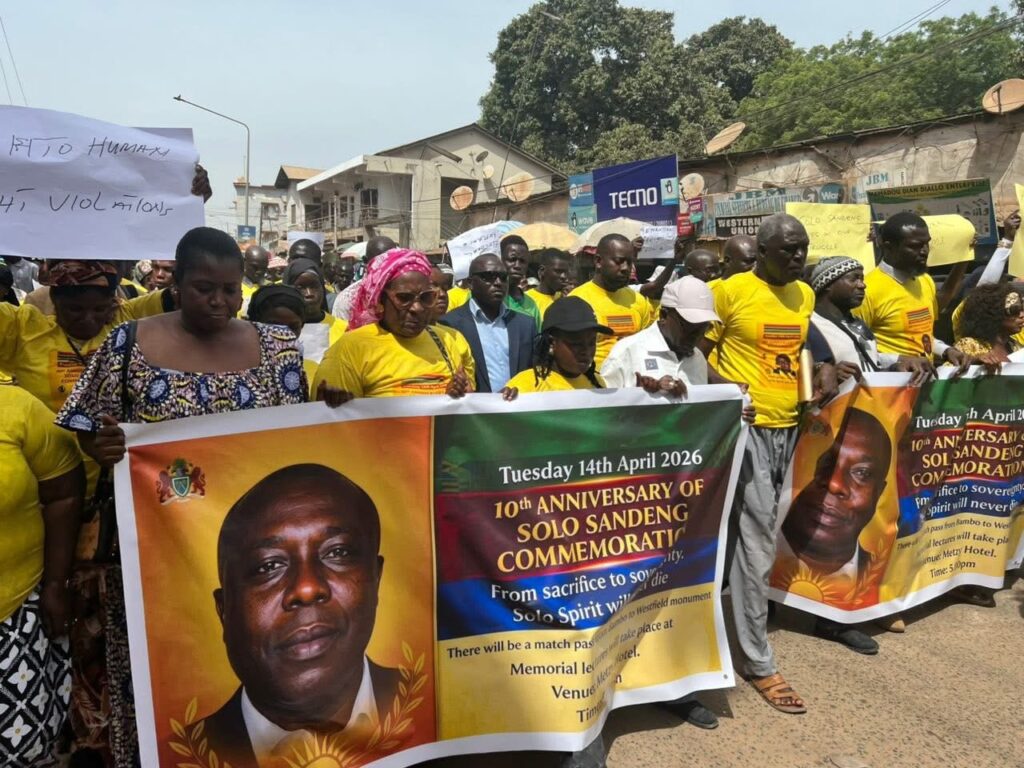
The party leader and others during the procession
By Seedy Jobe
The United Democratic Party on Tuesday led a memorial procession honoring Ebrima Solo Sandeng, commemorating his role in The Gambia’s pro-democracy struggle under former President Yahya Jammeh.
The march, which stretched from Bamboo to Westfield, drew a broad cross-section of participants, including party members, activists, and victims of past state repression. Marchers moved in solidarity, carrying placards and chanting calls for sustained commitment to democracy, justice, and human rights, as they paid tribute to Mr. Sandeng’s legacy.
Among those present were the party’s secretary general and leader, Ousainou ANM Darboe, alongside senior officials, grassroots supporters, and survivors of abuses during the Jammeh era.
Addressing the gathering, Mr. Darboe said Mr. Sandeng and his colleagues had not set out to advance a partisan agenda but rather a national cause centered on electoral reform.
“Solo and his colleagues did not go out to promote a United Democratic Party agenda,” he said. “They went out to advance a national agenda—one directed at electoral reforms.”
He argued that the country’s legal and constitutional framework at the time had been structured to entrench incumbency, describing it as untenable.
“Solo, his colleagues, and of course the organization, the party that he belonged to, believed that this was a non-starter. It’s a situation that cannot be allowed to continue,” he said, adding that their demands included reforms aligned with international democratic standards, such as freedom of association and the right to protest without prior authorization.
Mr. Darboe also recalled widespread opposition among political parties to the Jammeh government’s decision to raise presidential nomination fees to one million dalasis, later reduced to half that amount.
“The promise to the Gambian people was electoral reforms, a repeal of the Public Order Act, a new constitution, a constitution that gives the Gambian citizens the ultimate power and right to ensure that they effectively control their government,” he said.
Also speaking at the event was the chairman of the Brikama Area Council, Yankuba Darboe, who invoked the enduring legacy of those who died in the struggle. Quoting the ancient Greek philosopher Socrates, he said the souls of the righteous are “both immortal and divine,” adding that Mr. Sandeng and others continue to live on in spirit.
He paid tribute to survivors and activists, including Kafu Bayo, Falang Sonko, Fatou Camara and Modou Ngum, thanking them for their sacrifices and resilience.
“We will continue to remember you, and we will continue to celebrate this date on the 14th of April every year,” he said, describing the date as symbolic of the country’s liberation from fear under the former National Intelligence Agency.
Mr. Darboe added that the struggle for justice and reform remains unfinished. “But the struggle, as Falang lamented here, continues until we are able to achieve the goals and objectives of Solo and many who went out on that day and many who subsequently went after.”
Falang Sonko, a victim of the crackdown, described the anniversary as deeply painful. “Today is a very difficult day for us, the victims, because this is something we have lived through. We know what it feels like because it happened to us. We did it out of love for our country, to push for real electoral reforms. But the saddest part is that, to this day, nothing has changed. ‘Never again’ now feels just like ‘all over again.’”
He added that the commemoration should draw all Gambians, calling it a national moment of reflection.
Another survivor, Aja Fatou Camara, described being arrested during the protest, stating that despite the demonstration remaining peaceful, she was assaulted and forcibly put into a Police Intervention Unit vehicle.
“A security officer slapped me and threw me inside a PIU truck,” she said, emphasizing that they had taken part in a peaceful protest out of love for their country.
Mr. Sandeng, then the UDP’s national organizing secretary, led a peaceful protest on April 14, 2016, calling for electoral reform. He died in state custody days later. His death sparked widespread outrage at home and abroad and became a turning point in the movement that ultimately brought an end to Mr. Jammeh’s 22-year rule.
Comments are closed.