


By Seedy Jobe
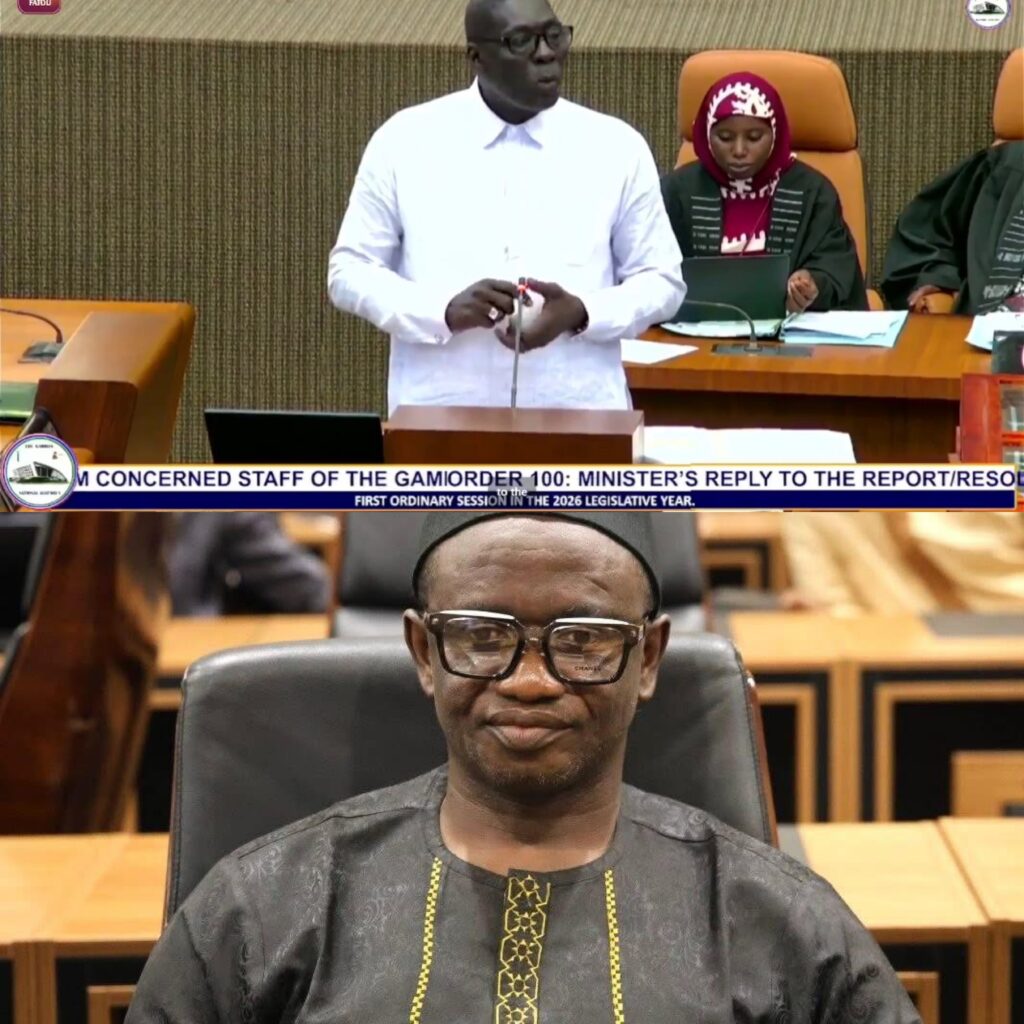
A tense exchange erupted in the National Assembly on Monday as opposition lawmakers confronted the tourism minister over what they described as an overdue response to a report by the Assembly’s Petitions Committee.
The dispute unfolded when the Minister of Tourism and Culture, Abdoulie Jobe, appeared before lawmakers to respond to a petition submitted by staff members of the Gambia Tourism Board. The petition had been reviewed by the National Assembly’s Petitions Committee, which subsequently issued recommendations requiring a ministerial response.
Alagie S. Darboe, the lawmaker representing Brikama North and the Assembly’s minority leader, challenged the minister’s delay, citing Standing Order 100, which requires ministers to respond within 30 days after the adoption of a committee report.
“The minister has fallen short of that timing,” Mr. Darboe said, pressing Mr. Jobe to explain why the response had not been submitted within the prescribed period.
Mr. Darboe warned that the failure could amount to contempt of the National Assembly, referencing a provision of the standing orders that states a minister who fails to submit a required report may be deemed in contempt.
Mr. Jobe rejected the criticism, arguing that the Assembly’s standing orders did not apply to him when acting in his capacity as a member of the executive branch.
“You have your standing orders here. We have our standing orders in government,” Mr. Jobe told lawmakers. “When I am here, your standing orders apply to me. When I am as an executive, your standing orders do not apply to me.”
The remark drew immediate objection from Mr. Darboe, who accused the minister of disregarding the authority of Parliament.
“The minister cannot, on the floor of this chamber, disregard our standing orders,” Mr. Darboe said. “It is a contempt of the National Assembly.”
He added that ministerial procedures within the executive branch could not supersede constitutional provisions or parliamentary rules, noting that other senior officials, including the vice president, had previously sought extensions from the Assembly when they were unable to meet reporting deadlines.
Mr. Jobe maintained that he had not violated any law or constitutional provision and said his ministry had formally communicated the delay to the clerk of the National Assembly.
“We had written on several occasions to the clerk to explain that we have to submit this matter to the Cabinet,” he said. “The fact of the matter is that I have not violated any constitutional provision.”
The majority leader, Billay G. Tunkara, who represents Kantora, urged caution, suggesting that it would be premature to accuse the minister of contempt before reviewing the official record of correspondence between the ministry and the Assembly.
“I think it will be premature to hold the minister in contempt,” Mr. Tunkara said. “Let us go back to the records to see whether the minister has actually communicated to the clerk about difficulties in meeting this timeline.”
The debate then shifted to specific recommendations in the committee’s report, including matters related to ecolodge projects overseen by the Gambia Tourism Board.
Mr. Darboe questioned the ministry’s decision to reject certain recommendations without providing detailed explanations.
“The rationale behind the rejection is not explained,” he said. “The remark column states ‘rejected,’ but the basis for that rejection is not provided.”
Mr. Jobe said the decision was tied to procurement procedures and approvals granted by the Gambia Public Procurement Authority. He also noted that law enforcement authorities had begun investigating aspects of the matter.
“GPPA, however flawed their processes were, have written to the GT Board authorizing them to proceed,” the minister said, adding that the police had commenced their work.
Addressing questions about the removal of the board’s chairperson, Mr. Jobe outlined the procedure for such decisions, saying the minister may recommend action to the president, who ultimately determines whether a board member should be dismissed.
“If, for whatever reason, the minister believes that the chairperson or a member of the board is not performing, he will make a recommendation to the principal,” Mr. Jobe said.
The exchange underscored continuing tensions between lawmakers and the executive branch over parliamentary oversight and the implementation of committee recommendations.
Comments are closed.