


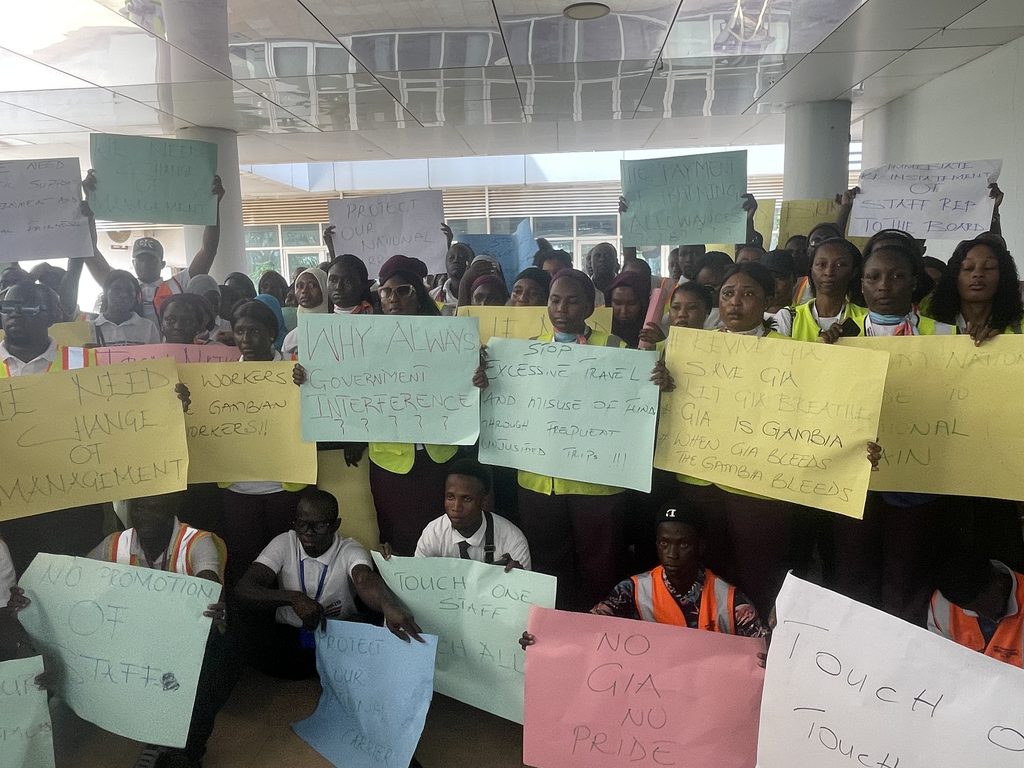
By Seedy Jobe
Staff of Gambia International Airlines (GIA) staged their second protest in two months on Monday, demanding improved working conditions, the restoration of medical coverage and action over alleged mistreatment by management.
The protest at the company’s headquarters brought employees face to face with senior officials, including the Secretary General and Head of the Civil Service, the Permanent Secretary at the Ministry of Works, and GIA Board Chair Alagie Sanyang.
Speaking on behalf of staff, Customer Service Supervisor Dardoh Faal said employees were protesting to protect their livelihoods and the company’s future.
“Our livelihoods are threatened, our job security is unforeseen, we are frustrated,” Faal said, adding that repeated promises had failed to produce meaningful action.
She identified the suspension of the staff medical scheme as their most pressing concern. She also highlighted limited promotion opportunities and stagnant career progression, despite employees pursuing further education.
Faal questioned the lack of government support to replace GIA’s ageing ground-handling equipment, while expressing concern that additional competition could further undermine the company.
“We have seven flights off season, 13 during the season. And you want to bring another competitor to damage GIA? To us, that is not being patriotic,” she said.
Customer Service Agent Ramatoulie Cham said employees had raised their concerns repeatedly without securing a resolution.
She said the protest was not intended to cause trouble or damage GIA, but reflected growing frustration over unfulfilled promises. Staff, she added, wanted management and government officials to address their concerns directly.
Cham said employees were not opposed to competition, but feared decisions that could jeopardise the national carrier’s future. She described the absence of medical coverage as particularly distressing, saying some employees were falling ill without the means to pay for treatment.
GIA Corporate Planning Supervisor Badou Jagne said the grievances extended beyond those who attended the protest.
He called for the immediate restoration of the medical scheme, stressing that employees needed access to healthcare to perform their duties effectively.
Jagne also urged the reinstatement of a staff representative on the GIA Board. He said the absence of staff representation had created a communication gap, leaving employees without adequate information about key board decisions.
He further alleged that training allowances owed to operational staff for training undertaken over the past four years remained unpaid, undermining morale.
Raising concerns about workplace safety, Jagne alleged that inadequate safety standards at Banjul International Airport were putting workers at risk. He argued that an emphasis on low ground-handling charges had compromised safety.
While acknowledging that competition was common at airports, Jagne called for regulated pricing for ground-handling services, saying current charges were not economically sustainable.
Responding to the grievances, Board Chair Alagie Sanyang said the gathering was his first meeting with staff since his appointment three weeks earlier. He described the occasion as both happy and sad.
Sanyang said the government was committed to reviving GIA and disclosed that President Adama Barrow wanted the airline to own an aircraft before the end of 2027.
“If you see the SG of the Civil Service, Permanent Secretary of the Ministry of Works, and board members came here, there is a reason. It is because the government is keen on reviving GIA,” he said.
Sanyang said he had given up his remuneration in favour of staff and offered to personally sponsor a staff party. He added that he and the board’s vice chair had travelled to Senegal without receiving per diem payments to address issues affecting GIA.
He appealed for calm and respectful dialogue, assuring employees that the board would not make commitments it could not fulfil.
Staff are demanding the immediate reinstatement of medical coverage, payment of outstanding training allowances, improved welfare and stronger guarantees of job security.
Comments are closed.