

IEC Finalizes Voter Register at 1.14 Million, Sets Dates for Presidential Nominations

By Seedy Jobe
The Independent Electoral Commission (IEC) has finalized the national voter register for the December 5 presidential election, confirming 1,146,474 registered voters and announcing the completion of key electoral preparations, including the revision of voter lists and recruitment of polling staff.
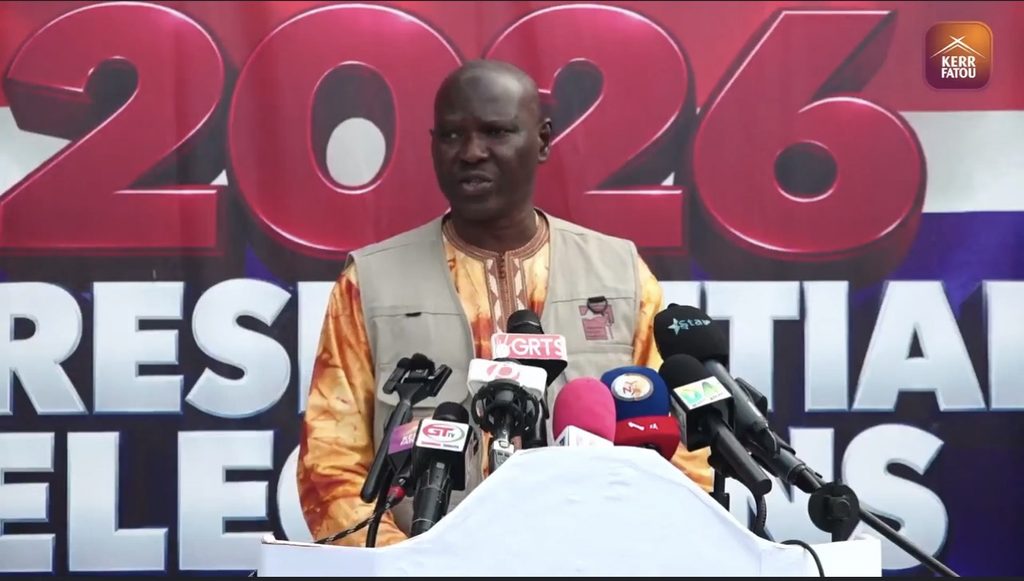
IEC Chairman Joseph Colley disclosed the figures on Monday during a press conference at Election House in Kanifing, where he outlined the commission’s preparations for the upcoming election, including presidential nominations, voter card replacements, and the accreditation of election observers.
Mr. Colley said the commission had completed the supplementary voter registration exercise, conducted between April 8 and May 21, 2026, and subsequently distributed provisional voter lists to political parties in electronic format in July for scrutiny.
The lists were also published to allow registered voters and other eligible persons to submit objections and appeals in accordance with electoral laws.
According to the IEC chairman, 1,694 objections were filed against entries on the provisional register, while no appeals were recorded.
To adjudicate the objections, revising courts presided over by magistrates appointed by the Chief Justice were established across the country’s electoral regions, except Banjul and Sibanor, where no objections were submitted.
The courts sat for 60 days, from August 24 to October 24, 2026, to hear and determine the cases.
Mr. Colley said the courts ordered the removal of 165 names from the provisional voter register following their consideration of the objections.
The affected registrations were spread across 38 polling stations in five electoral regions. Kerewan recorded the highest number of deletions, with 75 names removed, followed by Janjanbureh with 45, Basse with 38, Brikama with six, and Kanifing with one.
Following the removal of ineligible names from the provisional voter register, the Independent Electoral Commission (IEC) has confirmed that the combined master register and master supplementary register contain 1,146,474 registered voters ahead of the December 5, 2026, presidential election.
According to the IEC, the regional distribution of registered voters is as follows:
| Electoral Region | Registered Voters |
|---|---|
| Banjul | 24,820 |
| Basse | 140,175 |
| Brikama | 437,020 |
| Janjanbureh | 140,899 |
| Kanifing | 210,437 |
| Kerewan | 127,181 |
| Mansakonko | 65,942 |
| Total | 1,146,474 |
Brikama accounts for the largest share of registered voters, with 437,020, followed by Kanifing with 210,437. Janjanbureh and Basse have 140,899 and 140,175 registered voters, respectively, while Kerewan has 127,181.
Mansakonko accounts for 65,942 registered voters, while Banjul has the smallest electorate, with 24,820.
Together, Brikama and Kanifing account for approximately 56.5 percent of the country’s registered voters, underscoring their electoral significance ahead of the presidential election.
Mr. Colley explained that, in compliance with the Elections Act 2025, the commission would provide political parties with electronic copies of the finalized master register and master supplementary register, marking the conclusion of the voter register revision process.
The IEC will also provide information on voter cards associated with names removed through the revising courts, along with details of other deletions from the provisional register.
Mr. Colley disclosed that the country will have 1,773 polling stations for the presidential election, reflecting adjustments made to accommodate the registered voting population.
He said the commission would begin a nationwide assessment of polling stations within the coming week to determine their suitability and make any necessary adjustments before election day.
The exercise, he explained, is intended to ensure that polling facilities are appropriately located and adequately prepared to accommodate voters.
Turning to the nomination process, Mr. Colley said the IEC had published the schedule for aspiring presidential candidates on October 28, using what he described as transparent and objective criteria.
The nomination exercise is scheduled to begin on November 3 and conclude on November 14, 2026.
He disclosed that 27 presidential aspirants had collected nomination forms as of the press conference, indicating significant interest in contesting the December election.
Mr. Colley assured political parties, independent aspirants and the public that the commission was putting arrangements in place to ensure a smooth, peaceful and orderly nomination process.
The IEC chairman also announced a 15-day exercise for the replacement of lost, damaged or mutilated voter cards, which began on Sunday, November 1, and will conclude on November 15.
He said the replacement service is being offered free of charge at all 10 IEC regional offices nationwide.
Registered voters can obtain replacement cards at any IEC office, regardless of where they originally registered.
The offices will operate daily from 8 a.m. to 6 p.m., including weekends, throughout the exercise.
On election observation, Mr. Colley said accreditation of domestic and international observers, as well as media organizations and journalists, was ongoing.
He disclosed that the commission had received applications from local and international organizations and individuals seeking to observe or cover the electoral process.
Accredited organizations have been directed to collect their accreditation cards from Election House in Kanifing.
The IEC chairman further announced that recruitment of polling staff had been successfully completed.
He said the final list of recruited personnel would be displayed at IEC offices before the commencement of training, onboarding and deployment ahead of the election.
Mr. Colley concluded by reaffirming the commission’s commitment to conducting the December 5 presidential election independently, impartially and in strict accordance with the law.
He said the IEC would continue to uphold transparency, integrity, fairness and inclusivity throughout the electoral process.
“The core principles of transparency, integrity and fair play, together with compliance and inclusivity, continue to be its beacon in the execution of this sacrosanct mandate entrusted to it,” he said.
Comments are closed.