

Darboe Accuses Government of Witch Hunt Against UDP Councils Over White Paper
By Seedy Jobe
United Democratic Party (UDP) Secretary General and party leader ANM Ousainu Darboe has condemned the government’s White Paper on the Local Government Commission of Inquiry report, describing its recommendations as a politically motivated witch hunt targeting opposition-led councils.
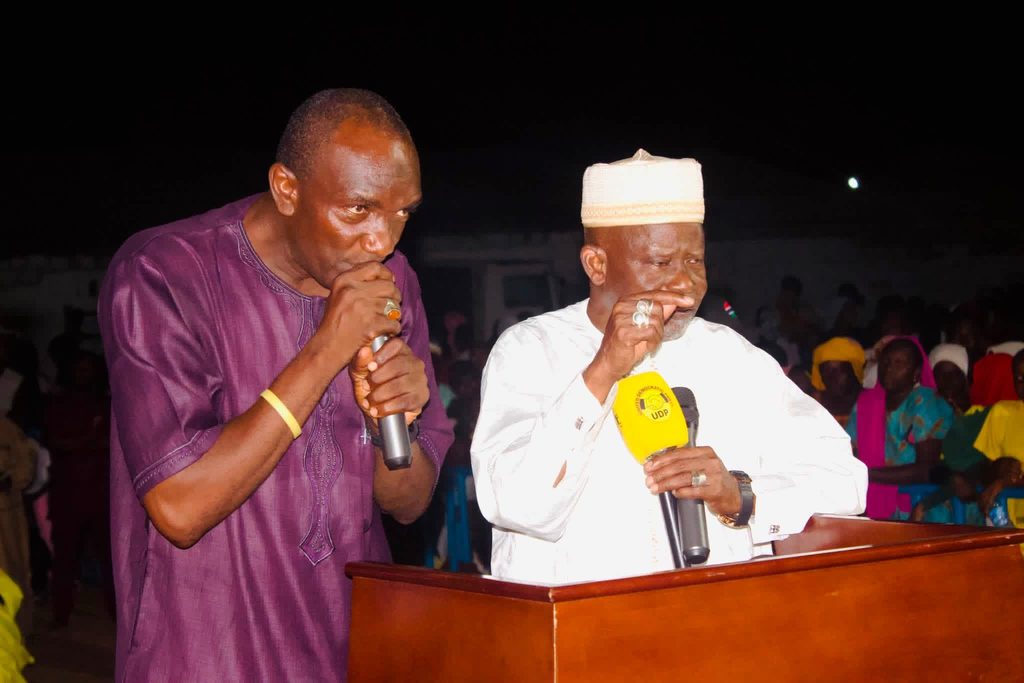
Speaking at a UDP political meeting in Lamin on Friday, less than 24 hours after the government released the White Paper, Mr. Darboe accused the Barrow administration of selectively pursuing opposition officials while overlooking alleged financial misconduct within the central government.
His remarks followed the government’s announcement of measures barring several local government officials from holding public office, alongside recommendations for criminal investigations into alleged wrongdoing.
According to Mr. Darboe, those affected include UDP council leaders Chairman Danjo, Chairman Landing B. Sanneh and Banjul Mayor Rohey Malick Lowe, as well as Kanifing Municipal Council Mayor Talib Ahmed Bensouda, who is now the presidential candidate of Coalition 2026.
Mr. Darboe argued that Mr. Bensouda was also being targeted because of his previous association with the UDP, claiming that the government’s hostility toward his party had extended to the former UDP member.
While acknowledging that public officials who violate the law should be held accountable, the opposition leader questioned the timing of the government’s decision, which comes just days before the nomination process for the December 5 presidential election.
He suggested that the timing raised serious concerns about the administration’s motives and whether the measures were intended to undermine opposition parties ahead of the polls.
Mr. Darboe recalled warning at a political gathering in Jambur in 2025 that the Local Government Commission of Inquiry was being used as an instrument to target councils controlled by the UDP.
He maintained that the government’s latest actions had reinforced those earlier concerns.
The UDP leader also questioned what he described as inconsistencies in the government’s approach to accountability, citing former Brikama Area Council Chairman Sheriffo Sonko.
Mr. Darboe accused Mr. Sonko of financial mismanagement during his tenure, alleging that D30 million had been taken from council funds for honorarium payments without corresponding legal consequences.
He questioned why opposition council officials were facing sanctions and potential criminal investigations while individuals accused of similar or more serious financial misconduct had allegedly escaped accountability.
Mr. Darboe said the UDP supported the principle that all public officials should be treated equally before the law, regardless of their political affiliations.
He warned that re-electing President Adama Barrow in December could further deepen what he described as growing inequality and selective enforcement of the law.
Turning to financial accountability at the national level, Mr. Darboe accused the administration of failing to act on successive Auditor General’s reports that, he said, had identified millions of dalasis in unexplained or missing public funds.
He claimed that despite the findings contained in those reports, the government had failed to initiate comparable police investigations or arrests against officials implicated in alleged financial irregularities.
The opposition leader contrasted that perceived inaction with the government’s swift announcement of investigations involving UDP-affiliated council leaders.
He argued that the disparity demonstrated a pattern of selective justice in which opposition officials faced heightened scrutiny while individuals associated with the ruling administration were treated differently.
Mr. Darboe urged Gambians to reject what he described as politically motivated injustice, saying the December 5 presidential election would provide voters with an opportunity to demand accountability and a change in leadership.
He warned that allowing such practices to continue would undermine public confidence in state institutions and weaken the principle of equality before the law.
The UDP leader maintained that the country’s democratic future depended on citizens using their votes to challenge what he characterized as the government’s increasingly unequal application of justice.
Comments are closed.