
Djeliba Leisure Group, Qcell Sign Fiber Agreement to Strengthen Connectivity in Tourism Sector

By Seedy Jobe
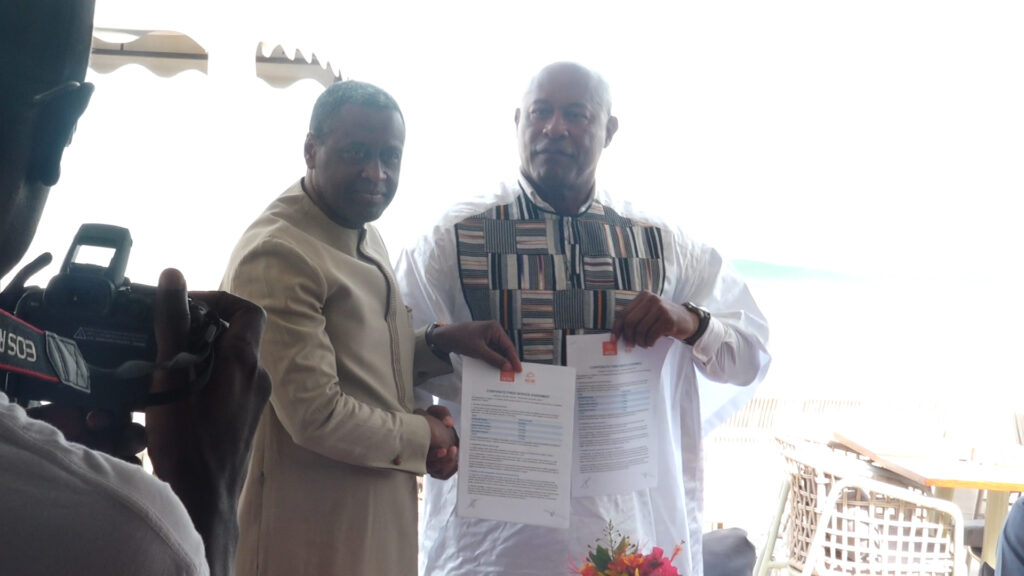
Djeliba Leisure Group and Qcell on Friday signed a corporate fiber agreement aimed at improving connectivity and digital services across The Gambia’s tourism sector.
The signing ceremony took place at the Barracuda Beach restaurant at Kombo Beach Resort in Kotu. Both companies described the deal as a landmark partnership between two leading Gambian-owned enterprises.
Under the agreement, Qcell will supply fiber connectivity to five Djeliba properties: Tamala Beach Resort, Kombo Beach Resort, Kalimgba Beach Resort, Balafon Beach Resort, and Palm Beach Resort. The initial combined capacity exceeds 800 megabits per second.
Muhammed Jah, CEO of The QGroup, said the public signing was intended to demonstrate confidence in Gambian entrepreneurship. He praised Malleh Sallah, CEO of Djeliba Leisure Group, as one of the country’s finest hospitality entrepreneurs, noting that Kombo Beach Resort, once close to being a ghost town, and Tamala Beach Resort had both been revived under his leadership.
Mr. Jah said QGroup’s core mission is to make life easier for Gambians and local businesses across telecommunications, banking, and automobiles.
He said Qcell entered the market in 2009 as the fourth GSM operator but has since led on technology. According to Mr. Jah, the company was the first to launch 3G, 4G, and, two years ago, 5G in The Gambia, the last of which was launched by President Adama Barrow at Kairaba. He added that Qcell has frequently been the first to commercially launch these technologies in West Africa.
Describing mobile data as a “security product,” Mr. Jah observed that people now buy internet credit before breakfast, and that hotel guests complain more about poor internet than about a missed meal.
Mr. Jah explained that fiber, as a dedicated line, is faster and more stable than wireless connections, where antennas are shared among many users. He said Qcell is the only GSM operator that runs and maintains its own fiber network end to end, taking full responsibility for service quality.
He added that Qcell is the largest private-sector shareholder in the ACE submarine cable, enabling it to provide up to 10 gigabits to any client, with full redundancy through a second international cable. He said this was demonstrated months ago, when a nationwide internet outage lasted almost a day but did not affect Qcell customers.
Mr. Sallah welcomed the partnership, saying the new service has already been activated at Kombo Beach Resort and is performing satisfactorily. He described the agreement as an example of how Gambian-owned businesses can support one another and build lasting enterprises.
He said Djeliba’s hotels are capable of competing with leading hospitality establishments in Senegal, and stressed that tourism remains one of The Gambia’s largest private-sector employers and a major contributor to the economy. He estimated the sector’s contribution to gross domestic product at between 16 and 20 percent, with a wider impact on agriculture, fisheries, telecommunications, and banking.
Despite more than 50 years of tourism development, Mr. Sallah said The Gambia has yet to fully exploit its potential. He pointed to the country’s cultural heritage, history and wildlife as attractions capable of drawing significantly more visitors, and argued that a stronger industry could bring in millions of additional tourists while creating opportunities for local businesses.
He encouraged Gambian entrepreneurs to explore the tourism supply chain rather than crowd into already saturated sectors, adding that Djeliba Leisure Group is willing to work with local suppliers.
Mr. Sallah concluded by urging Gambians to embrace unity, hard work and honesty, which he described as essential to sustainable business success and national development.
Comments are closed.