

Gambia’s Special Prosecutor Lays Out Evidence-Driven Strategy for TRRC Cases
By Seedy Jobe
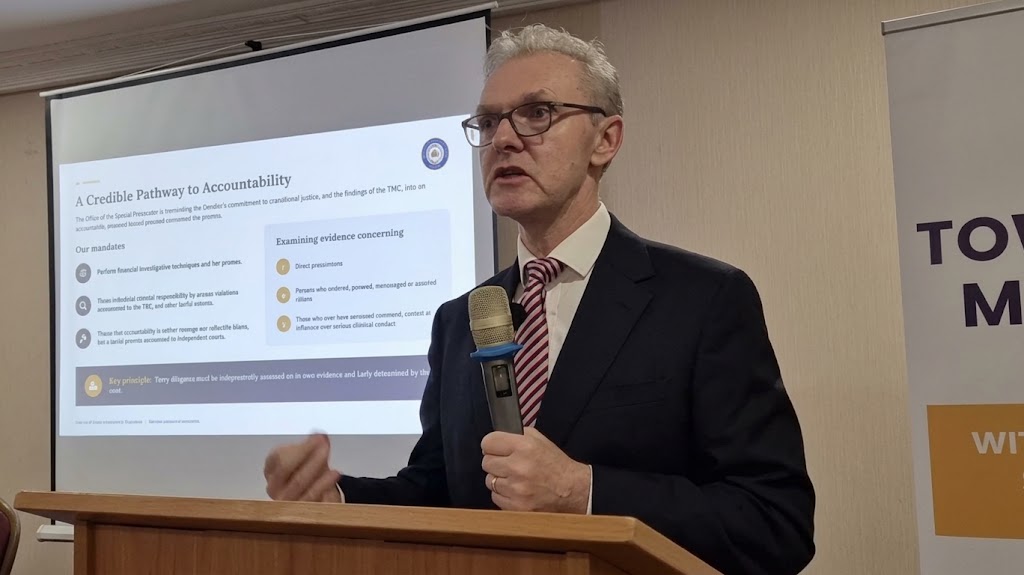
The Gambia’s special prosecutor, Martin Hackett, has outlined a prosecution strategy for crimes identified by the Truth, Reconciliation, and Reparations Commission, saying his office is building cases around evidence, established principles of criminal liability, and the right to a fair trial.
Speaking Friday at a town hall meeting with legal practitioners at the Ocean Bay Hotel in Cape Point, Mr. Hackett said the Special Prosecutor’s Office was examining potential cases not only against alleged direct perpetrators but also against people suspected of ordering, planning, encouraging, or assisting crimes.
The office is also considering potential liability involving those who may have exercised command, control, or influence over serious criminal conduct, he said.
“These are modes of liability that we are actively looking at in our case building,” Mr. Hackett said.
The effort is part of The Gambia’s broader attempt to pursue accountability for abuses documented by the TRRC, which investigated human rights violations committed during former President Yahya Jammeh’s 22-year rule.
Mr. Hackett said prosecutors were reviewing the commission’s recommendations, assessing the strength of available evidence, and developing investigative plans. Once sufficient funding is available, he said, investigators will begin interviewing witnesses to obtain evidence that meets the standards required in court.
That process will require some victims who testified before the TRRC to be interviewed again, he said, because testimony gathered by a truth commission does not necessarily satisfy the evidentiary requirements of a criminal prosecution.
Mr. Hackett stressed that evidence would have to be securely preserved and that statements and other material would be reviewed for disclosure to the defence. Prosecutors, he said, must disclose material that could undermine their case or assist defendants.
The office is also developing an evidentiary strategy, secure information systems, and standard operating procedures while seeking financial and technical assistance from foreign governments and international organizations.
Among the areas under review are enforced disappearances, mass graves, and exhumations, which Mr. Hackett said could require forensic expertise, cross-border cooperation, and mutual legal assistance. Cases involving unlawful killings are also expected to depend heavily on witness testimony.
But Mr. Hackett said victims would remain central to the process, particularly in cases involving sexual and gender-based violence.
“Sexual and gender-based violence requires investigators trained to take court-standard statements from survivors,” he said.
The prosecutor’s office is seeking assistance from international organizations and foreign embassies to train investigators to conduct such interviews thoroughly and sensitively, he said. The aim is to obtain comprehensive accounts while minimizing the need to repeatedly return to survivors for additional information, which could compound their trauma.
Mr. Hackett, who said he previously worked in Britain as an accredited rape and sexual violence prosecutor and a counterterrorism prosecutor, emphasized that specialized investigative training would be critical to building cases capable of surviving scrutiny in court.
He also urged lawyers on both sides to approach the proceedings as a shared responsibility to the justice system, particularly because cases before the Special Division of the High Court could involve former senior government officials, military personnel and police officers.
“There isn’t a perfect prosecution any more than there is a perfect defence,” he said, acknowledging that mistakes were inevitable but arguing that careful preparation and cooperation could keep them to a minimum.
Mr. Hackett said the same balance must govern the treatment of vulnerable witnesses during trials. Defence lawyers must be permitted to challenge testimony and ask legitimate questions, he said, while witnesses and victims must be treated with dignity.
“It’s about having a fair trial,” he said. “It’s about being fair to the defendant and allowing defence counsel to ask proper questions of a victim. But it’s also being fair to that victim, that that victim is still treated with respect.”
For Mr. Hackett, that balance — accountability for alleged crimes without compromising the rights of the accused — will be central to the prosecution effort.
The objective, he said, is to establish “a credible pathway to accountability” grounded in evidence, law and fair process.
Comments are closed.