


Opinion By Dr. Ousman Gajigo
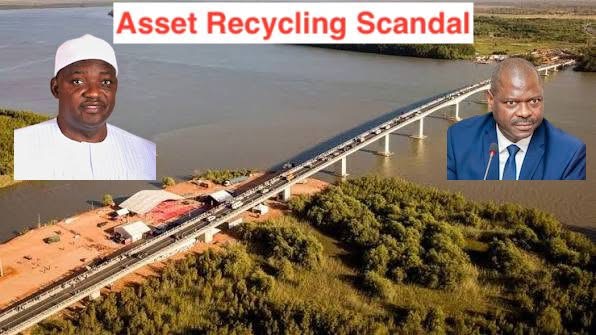
Two years ago, Adama Barrow’s government signed the so-called Senegambia Asset Recycling deal with Africa50. It was presented as an opportunity when, in reality, it was a massive financial and strategic loss to the country.
Let me refresh the memory of those who have forgotten key details. Under the deal, Africa50 pays at most $100 million upfront to the Gambian government for a 25-year concession of the Senegambia Bridge. However, all the infrastructure work currently being done around the bridge is being subtracted from that $100 million. As a result, the amount the government will actually receive upfront will be far less than $100 million. All toll revenues will go to Africa50, which will also be exempt from tax payments. As part of the deal, the Gambian government cannot build a bridge within a 50km radius (roughly between Kerewan and Kuntaur) for the next 25 years.
There are several problems with this deal. The first is labeling. Asset recycling involves monetizing an existing asset to help finance another important infrastructure project. While there is nothing wrong with the concept in principle, simply labeling an agreement “asset recycling” doesn’t make it one -and the Africa50 concession does not meet that standard. The relatively small amount obtained from the deal went directly into the general budget, where virtually all of it was spent on recurrent expenditure.
The most glaring problem was the massive undervaluation of the bridge. Going by the financial model behind the deal, the lump-sum payment received by the government severely underpriced the bridge. Based on historic and projected traffic over the bridge, its value is around $500 million. In other words, the country lost about $400 million in this deal.
Let’s put that amount in perspective. $400 million is higher than the value of all the roads Adama Barrow’s government has constructed – and most of those were built with debt. In other words, the government could have built more roads had the asset recycling deal been properly negotiated and executed– without shackling the country with billions of dalasi of debt.
With only a fraction of that $400 million – roughly $200 million – the country could have built enough power plants not only to meet our electricity needs but to export power to Senegal and Guinea-Conakry. Instead of enduring constant power outages, the country would have had a reliable and stable power supply today.
One of the clearest pieces of evidence for Minister Seedy Keita’s gross incompetence is that he was not even aware of the costly blunder he spearheaded. On several occasions, he spoke to the media and confused the cost of construction with the value of the bridge. Yes, the Senegambia Bridge was built at a cost of about $100 million, but that is vastly different from its value today.
Another major problem with the Africa50 deal was that the government kept an important clause secret until I pointed it out. The most significant is the restriction on our infrastructural development: specifically, the agreement prohibits the government from building any bridge between Kerewan and Kuntaur for the next 25 years. Building and operating ferry services in the same area is also prohibited. These restrictions were included to maximize Africa50’s profits. For a government that goes around touting its infrastructural accomplishments, such as they are, shackling the country with such a restriction was a major betrayal of public trust.
During the negotiations with Africa50, the government made no use of outside experts, such as legal or transaction advisors – expertise that numerous development partners could easily have provided at no cost to the government. I know this because I have personally facilitated such experts for the Gambian government in the past on an important negotiation, which generated over a billion dalasi in revenue for the country. But Minister Seedy Keita oversaw this Senegambia bridge negotiation in secret despite having no experience or expertise in such matters.
In short, the Africa50 deal was economically unfavorable, procedurally opaque, improperly branded, and a demonstration of profound incompetence. It was a betrayal of trust and a failure of duty. It cost The Gambia both revenue and long-term strategic flexibility over a vital piece of national infrastructure.
For this blunder alone, Adama Barrow needs to be removed from power.
Comments are closed.