

NDI Pre-Election Mission Cites Democratic Gains, Stalled Reforms Ahead of Gambia’s 2026 Election

By Makutu Manneh
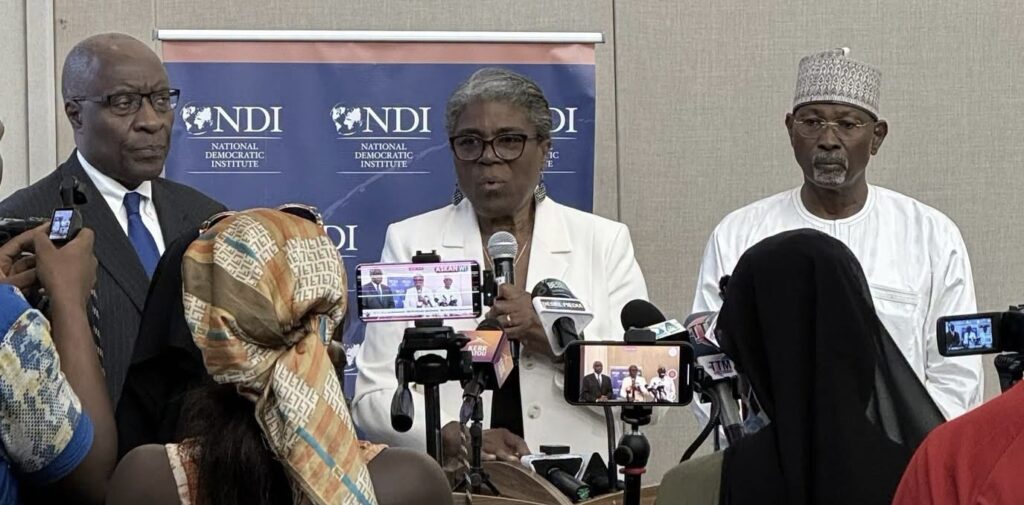
The National Democratic Institute has praised The Gambia’s democratic progress over the past decade but warned that stalled constitutional reforms, restrictive laws, and broad presidential powers remain concerns as the country prepares for its December 2026 presidential election.
In observations released following a pre-election assessment mission, NDI pointed to the expansion of multiparty politics and greater press freedom since the political transition that followed the 2016 presidential election. But the institute said those gains have been accompanied by a failure to complete some of the reforms envisioned after the end of former President Yahya Jammeh’s 22-year rule.
Among the most significant setbacks, NDI said, is the failure to replace the 1997 Constitution, which remains in force after proposed new constitutions failed to advance through the National Assembly in 2020 and 2024.
“Civil society deplored the apparent lack of political will to find consensus on a new constitution, as demonstrated in two failed attempts at the National Assembly in 2020 and 2024,” the institute said.
As a result, NDI noted, The Gambia continues to operate under the Jammeh-era Constitution, which does not include presidential term limits — a reform the institute said is supported by 86 percent of Gambians, according to a recent Afrobarometer survey.
The mission also raised concerns about laws inherited from both the former authoritarian government and the colonial era, warning that their continued presence could leave room for a return to repressive practices.
Of particular concern, NDI said, is the Public Order Act of 1961, which requires organizers to obtain permission from the inspector general of police before holding demonstrations or public assemblies. The institute noted that the law gives authorities considerable discretion to approve or deny such requests, raising concerns about its potential effect on freedom of assembly.
NDI also drew attention to the extensive appointment powers granted to the president under the 1997 Constitution. Those include appointments involving the chairperson of the Independent Electoral Commission, the chief justice, five nominated members of the National Assembly, and cabinet ministers. Such powers, the mission said, are widely perceived as giving the executive significant influence over key state institutions.
Despite those concerns, the institute found broad agreement among political parties that the country’s political space has become considerably more open over the past decade.
“The 24 registered political parties going into the 2026 election include many new parties registered with the IEC in the past few years,” NDI said.
With the presidential election approaching, the institute observed that political parties have increasingly turned to coalition-building in an effort to improve their electoral prospects under The Gambia’s first-past-the-post system. Several parties have already begun announcing alliances ahead of the vote.
NDI called on the government to revise the Public Order Act and other laws that could be used to restrict political and civic freedoms. It said regulations governing public gatherings should not allow permit requirements to become a means of suppressing freedom of assembly.
The institute also recommended a review of laws affecting the media to ensure journalists can work freely and called for stronger implementation of legislation intended to expand civic and political rights.
Among those measures, NDI urged authorities to fully implement the Access to Information Act and other reforms designed to institutionalize democratic practices introduced since the 2016 political transition.
The mission also called for national identity documents to be made easily and affordably accessible to citizens, saying greater access could eliminate the justification for relying on the attestation system during voter registration.
The findings present a mixed picture of The Gambia nearly a decade after its historic political transition: a country with a substantially more open political environment, but where some of the institutional and constitutional changes once envisioned as safeguards for that democracy remain unfinished.
Comments are closed.