


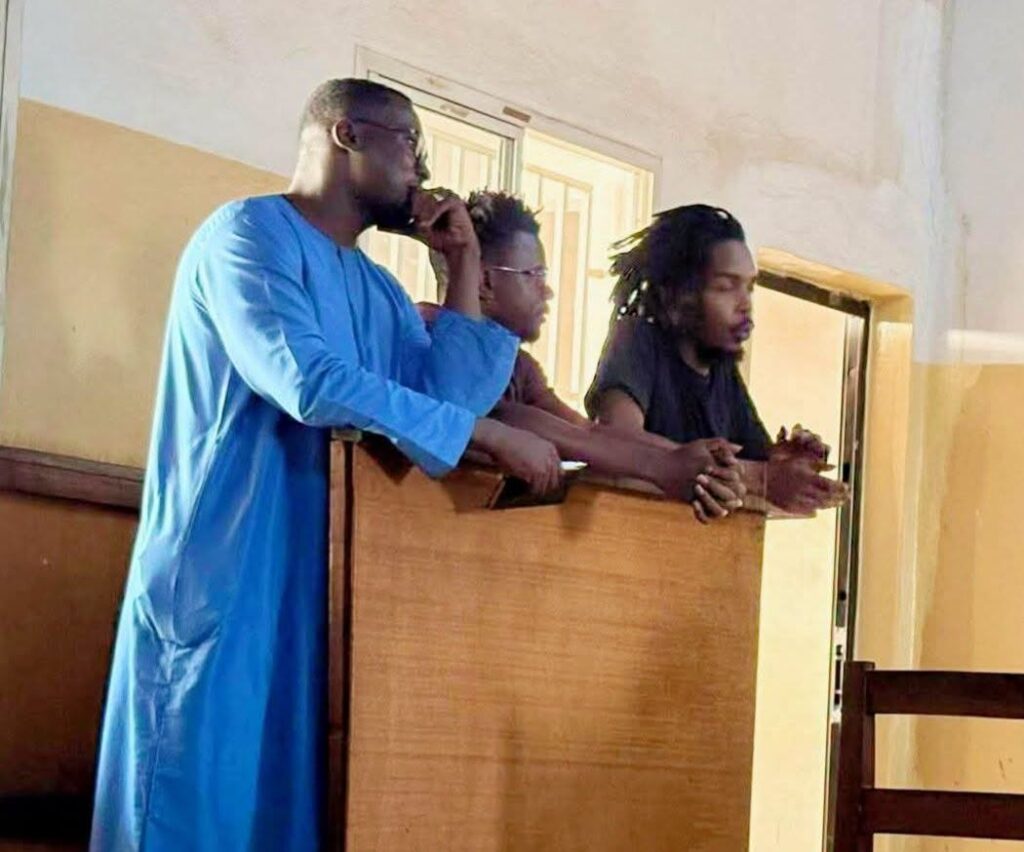
Principal Magistrate Sallah Mbai has acquitted and discharged three members of GALA, ruling that prosecutors failed to establish a prima facie case against them in connection with a gathering outside the National Audit Office last year.
The accused—Kemo Fatty, Alieu Bah, and Omar Saibou Camara—were arrested on September 15, 2025, after joining others outside the National Audit Office for a planned press conference over the controversial removal of the Auditor General.
They were later arraigned before the Kanifing Magistrates’ Court by the Inspector General of Police on two counts: unlawful assembly, contrary to Section 63 of the Criminal Offences Act, 2025, and common nuisance, contrary to Section 137(1). All three pleaded not guilty.
At the close of the prosecution’s case, defence counsel L.S. Camara filed a no-case submission, arguing that the state had failed to prove the essential elements of the charges.
In her ruling, Magistrate Mbai agreed, holding that criminal liability could not be founded on “suspicion, conjecture, or public perception.” She said the prosecution bore the burden of proof throughout the case and had failed to present evidence requiring the accused persons to open their defence.
The prosecution, led by Police Commissioner A. Sanneh, called four witnesses. Superintendent Dawda Jallow testified that he arrived at the scene with about 50 police officers and initially dispersed a group of journalists. He said another group, including the accused, later arrived to hold a press conference without a permit.
But under cross-examination, Superintendent Jallow admitted that the accused were not present when he first arrived, did not block police access to the premises, and were arrested because they insisted on holding a press conference without a permit.
Another witness, Superintendent Modou Lamin Korta, testified that he saw between 20 and 30 people at the scene and observed Omar Saibou Camara moving away after speaking with police. He also said Alieu Bah returned to the gate and insisted on his right to remain there. Under cross-examination, however, he conceded that police had unrestricted access to the building and that Bah was standing in a public place when he was arrested.
ASP Landing Bojang, who was deployed with Police Intervention Unit officers, said officers attempted to persuade the crowd to disperse before tear gas was eventually used. But he admitted under cross-examination that he did not personally arrest any of the accused, did not know where they were arrested, and could not state the specific reasons for their arrests.
The final prosecution witness, Sub-Inspector Ousman Colley, a member of the investigation panel, was not present at the scene. He testified that investigations showed the accused refused to disperse and lacked a permit. But he acknowledged that his evidence was based entirely on information provided by others.
In assessing the evidence, Magistrate Mbai applied the legal test in R v Galbraith and Section 215 of the Criminal Procedure Act, which allows a court to discharge an accused person where the prosecution fails to establish a case requiring an answer.
On the charge of unlawful assembly, the court held that prosecutors needed to prove not only that three or more people had gathered, but also that they shared a common unlawful purpose and acted in a manner likely to create a reasonable fear of violence or disorder.
The magistrate found that the prosecution had failed to meet that threshold.
The ruling effectively ended the case without requiring the three activists to enter a defence.
Comments are closed.