


By Makutu Manneh
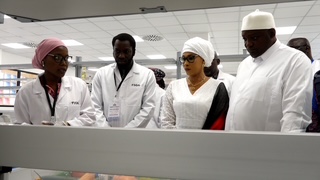
President Adama Barrow on Friday presided over the inauguration of The Gambia’s first National Food and Drug Quality Control Laboratory, a modern facility established to ensure that food, medicines, and other consumable products distributed in the country meet rigorous standards of quality, safety, and efficacy.
The laboratory is mandated to conduct systematic testing of pharmaceuticals, food products, cosmetics, water, and other health-related items, ensuring that both imported and locally distributed goods comply with national and international regulatory standards. Prior to its establishment, The Gambia had no domestic testing capacity, requiring all samples to be sent abroad for analysis.
In his inaugural address, President Barrow described the facility as a landmark achievement aligned with the country’s national development agenda and his administration’s broader vision of building a resilient, self-reliant, and prosperous nation. He emphasized that the laboratory reflects a government commitment to people-centered development—one that will serve scientists, safeguard future generations, and stand as tangible proof of the government’s ability to deliver on its promises.
“Countries that want to maintain a healthy population must ensure that their nationals eat the right mix of food and take safe and effective medications,” President Barrow said. He added that the facility is equipped with modern technology capable of detecting harmful elements and bacteria in foodstuffs, and that trained personnel will be on hand to test and certify the safety and efficacy of medicines available in the country.
Matarr Touray, the World Bank Resident Representative, speaking on behalf of development partners and the Ministry of Health, underscored the laboratory’s significance in the context of past public health failures. He recalled the deaths of children linked to contaminated cough and cold syrups—a tragedy that exposed the critical absence of domestic quality control infrastructure—and noted that the new facility would help prevent similar disasters by detecting substandard and falsified products, enabling timely regulatory intervention, and strengthening market surveillance.
Touray cautioned, however, that physical infrastructure alone cannot guarantee results. “Buildings and equipment alone do not guarantee success,” he said. “The true value of this laboratory will be measured by the quality of its operations, the competence of its workforce, the integrity of its systems, the sustainability of its financing, and the consistency with which it delivers reliable results.”
Ousman Bojang, Governor of the West Coast Region, expressed pride that the facility is located within his region and commended President Barrow and the Minister of Health for what he called a significant national achievement.
Looking ahead, the Ministry of Health has outlined an ambitious expansion plan that includes extending similar services to other regions, deploying mobile testing units, training a new generation of laboratory scientists, and positioning the facility as a regional reference center for quality control and public health safety.
Comments are closed.