


By Makutu Manneh
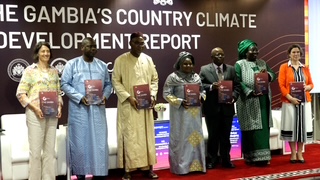
The Gambia government on Tuesday launched a comprehensive climate and development report that officials say will guide policy decisions and shape future investment as the country confronts rising environmental risks alongside economic pressures.
The Country Climate and Development Report, unveiled at the Sir Dawda Kairaba Jawara International Conference Center, sets out a framework for strengthening climate resilience, advancing low-carbon growth, and aligning development priorities with the country’s exposure to climate shocks. Government officials, development partners, civil society groups, and private sector representatives attended the launch.
Developed with support from the World Bank, the report examines how climate change is affecting economic performance and identifies priority sectors and investment pathways intended to reduce vulnerability while sustaining growth.
Representing President Adama Barrow, Vice President Muhammed B.S. Jallow said The Gambia contributes less than 0.01 percent of global greenhouse gas emissions but remains highly exposed to climate-related risks.
He noted that more than 60 percent of the population lives in coastal and urban areas vulnerable to flooding, sea-level rise, and other climate impacts. He called for stronger efforts to reduce investment risk, reinforce financial systems, and expand a pipeline of “bankable, climate-resilient projects.”
“We must also address critical gaps between policy ambition and implementation,” Mr. Jallow said. “The Gambia has one of the most progressive climate policy frameworks in the region. However, the challenge now lies in execution, translating policies and plans into tangible results that improve lives.”
The Minister of Finance and Economic Affairs, Seedy Keita, warned that climate change poses mounting macroeconomic and fiscal risks. He said that under a high-impact scenario, climate shocks could reduce gross domestic product by as much as 9 percent by 2040, or by about 5 percent under a less severe trajectory.
Mr. Keita said the effects of climate change are already visible in declining agricultural productivity, reduced labor output, infrastructure damage, and disruptions to tourism, which he described as key threats to growth, employment, and fiscal stability.
“Climate change has social implications,” he said. “It is expected to slow poverty reduction and push tens of thousands of Gambians into poverty if not addressed by 2050.”
Franklin Mutahakana, the World Bank Group’s resident representative, said the institution would continue supporting The Gambia’s climate agenda by working with public and private actors to convert risks into opportunities for sustainable development.
He described the report as a practical framework for scaling up climate-aligned investment and mobilizing financing to support resilience, job creation, and inclusive growth.
The Minister of Environment, Climate Change and Natural Resources, Rohey John Manjang, said the report provides critical data and scientific analysis to inform policymaking, warning that inaction would carry significant long-term consequences.
The 2026 Country Climate and Development Report identifies agriculture, water resources, and infrastructure as priority areas, recommending targeted interventions to reduce vulnerability while supporting economic expansion.
Comments are closed.