

Finance Minister Discloses Over D1.23 Billion in Tax Arrears Owed by SOEs and Councils

By Fatou Sillah
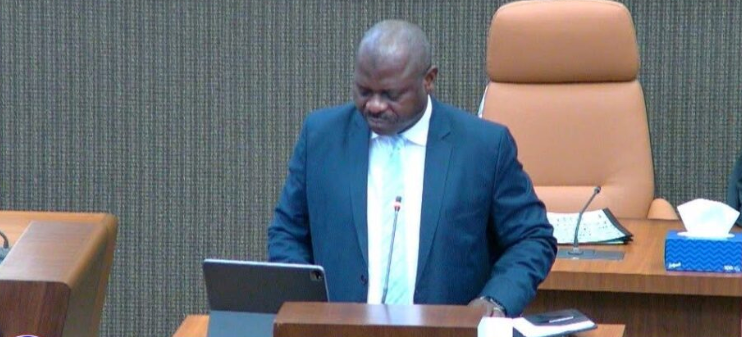
The Minister of Finance and Economic Affairs, Seedy Keita, has informed the National Assembly that state-owned enterprises (SOEs) and local government councils collectively owe the Gambia Revenue Authority (GRA) more than D1.23 billion in outstanding tax arrears.
Minister Keita made the disclosure on Tuesday while responding to a question raised by the National Assembly Member for Wuli East on behalf of the Member for Upper Saloum during the oral questions and answers session.
“I wish to inform the Honourable Assembly that as of May 2026, the total amount owed to GRA from this agency stands at D1,233,586,207. These arrears are limited to state-owned enterprises and local government authorities,” he stated.
According to the minister, the bulk of the outstanding liabilities is owed by two major telecommunications entities. GAMCEL owes D730,065,041, while Gamtel owes D296,353,631.
Other SOEs also feature on the arrears list, including the National Food Security Processing and Marketing Company, which owes D1,405,042; the Gambia Ports Authority, D10,000,000; Gambia Ferry Services, D55,941,636; the National Water and Electricity Company (NAWEC), D40,000,000; the Gambia International Airlines (GIA), over D31 million; and the Gambia Printing and Publishing Corporation, D45,762,366.
The minister further revealed that several local government councils also have outstanding obligations to the tax authority. These include Banjul City Council (D1,965,393), Janjanbureh Area Council (D1,564,880), Kerewan Area Council (D3,901,725), Kanifing Municipal Council (D2,458,496), Basse Area Council (D3,054,206), Brikama Area Council (D8,733,881), Kuntaur Area Council (D231,017), and Mansakonko Area Council (D416,546).
Responding to a supplementary question on tax recovery mechanisms, Minister Keita explained that the GRA first engages taxpayers through negotiated payment arrangements.
“When there is a tax obligation to GRA, the first approach is that GRA engages the taxpayer and agrees on a payment plan, and that is ongoing,” he said.
He added that the Authority is empowered by law to take enforcement action where taxpayers default on agreed arrangements, including legal proceedings and, where necessary, business closures following court judgments.
“If the taxpayer defaults, GRA may pursue the matter to court, and if the judgment is done, GRA sometimes will go and close their shop; those are according to the laws, the powers given to the GRA,” he stated.
The minister also explained that the GRA operates a dedicated enforcement unit tasked with recovering outstanding revenues from defaulters.
“After a payment plan is defaulted, they can foreclose on your business activity. We have had cases where GRA will go and close shops and prevent you from operating your businesses upon receiving the court judgment in their favor,” he said.
The minister further noted that GRA has a dedicated enforcement unit responsible for recovering outstanding revenues and ensuring compliance.
He also referenced past enforcement considerations involving GAMCEL, noting that such measures are used as a last resort to recover public funds.
“I remember in one instance particularly, I think it was for GAMCEL at one time, they wanted to even close down their operation because of the arrears of taxes. So, those are methods they use to recover funds,” he said.
Comments are closed.