


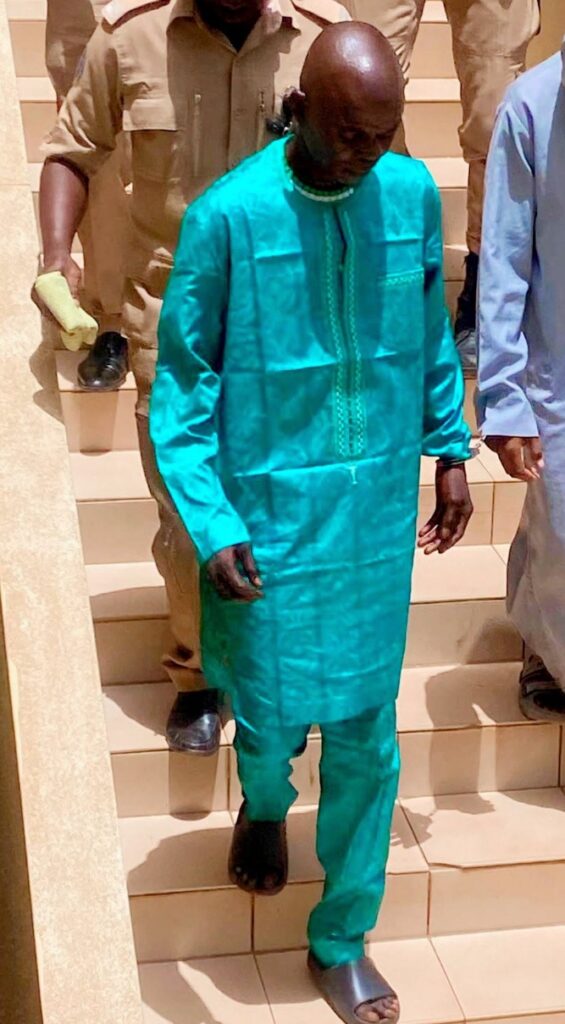
Justice Jaiteh of the High Court has convicted Ismaila Janneh of murder and sentenced him to death for the fatal stabbing of Alieu Jallow during a confrontation in Brufut Ghana Town in December 2023.
In a judgment delivered before a packed courtroom, the judge found that prosecutors had proved beyond a reasonable doubt that Janneh stabbed Jallow in the back with a knife during a dispute rooted in allegations that Jallow had stolen two mobile phones and D1,200 from him.
The court convicted Janneh of murder under Section 187 of the Criminal Code and imposed the mandatory death sentence prescribed by Section 188, which was in force when the offence was committed. Justice Jaiteh also directed the Minister of Justice, in accordance with the law, to determine the manner in which the sentence is to be carried out.
The ruling comes despite legislative changes introduced by the Criminal Offences Act 2025, which replaced the mandatory death penalty for murder with life imprisonment. Justice Jaiteh held that the newer law could not apply retrospectively because the offence occurred on Dec. 27, 2023.
Janneh, who was arraigned on March 18, 2024, pleaded not guilty and denied fatally stabbing Jallow.
Prosecutors called five witnesses in support of their case.
The principal eyewitness, Babucarr Manneh, testified that he and Jallow were at the Ghana Town football field on the night of the incident when Janneh confronted them over the alleged theft of two mobile phones. According to Manneh, Janneh insulted Jallow’s mother and demanded that Jallow accompany him to a police station.
Manneh said Janneh struck him, drew a knife and attempted to stab him before Jallow intervened with a stick, which broke during the struggle. Janneh then turned the knife on Jallow and stabbed him before fleeing, Manneh testified.
Although police conducted two searches, investigators never recovered the weapon.
Assistant Superintendent Dodou Sanneh, who led the investigation, testified that Janneh later surrendered himself at the Police Intervention Unit, initially claiming he had only used a stick during the confrontation.
Police officer Muhammed Baldeh told the court that officers rushed the wounded Jallow to Brufut Clinic before transferring him to Kanifing General Hospital, where he was pronounced dead. Baldeh recalled Jallow pleading with officers for help, saying he believed he was dying.
The prosecution’s medical evidence came from pathologist Dr. Ousman Leigh, who testified that the post-mortem examination revealed a 19.5-centimeter-deep stab wound that penetrated the victim’s back, punctured his right lung and caused massive internal bleeding. Approximately 1.7 litres of blood had accumulated in the chest cavity, and Dr. Leigh concluded that Jallow died from hemorrhage caused by the stab wound.
During cross-examination, Dr. Leigh acknowledged a typographical omission in his report but maintained that it did not affect his medical findings.
Police officer Lamin Sonko also testified that he recorded Janneh’s cautionary and voluntary statements, which were admitted into evidence.
Testifying in his own defence, Janneh denied stabbing Jallow.
He claimed that Jallow and Manneh had earlier robbed him of two mobile phones and D1,200 near Ghana Town Bridge and that repeated efforts to recover the property through the police had led to continuing disputes.
Janneh told the court that on the night of the incident, the two men attacked him at the football field, with Jallow wielding a stick and Manneh using a bottle and later a bag. He said he was struck on the neck and knee while attempting to flee and claimed that Manneh accidentally hit Jallow with a bag, causing him to fall.
He denied carrying a knife or threatening to kill Jallow.
Defence counsel argued that the prosecution had failed to establish guilt beyond a reasonable doubt, citing the absence of the alleged murder weapon and what counsel described as inconsistencies in the medical evidence.
The defence further contended that the evidence suggested Janneh had acted in self-defence after Jallow allegedly struck him first with a stick.
Justice Jaiteh rejected the defence arguments, holding that the prosecution had satisfied every element required to prove murder.
Relying on established legal authorities, including Woolmington v. DPP and Batch Samba Faye v. The State, the judge said the prosecution was required to prove that the victim had died, that the accused caused the death, that the killing was unlawful and that it was committed with malice aforethought.
The judge found that the cause of death was undisputed and accepted Babucarr Manneh’s testimony as “credible, direct, and materially corroborated” by the medical evidence.
Justice Jaiteh ruled that the failure to recover the knife did not undermine the prosecution’s case because the eyewitness account was supported by consistent forensic evidence. He also found that the typographical omission in the autopsy report was immaterial.
Rejecting Janneh’s version of events, the judge held that it failed to account for the fatal penetrating wound.
“The deceased did not die from a fall, blunt force, or impact from a bag. He died from a deep penetrating injury to the back of the chest,” Justice Jaiteh said.
The court also dismissed the claim of self-defence, noting that Janneh simultaneously denied using a knife while seeking to justify its alleged use. Even if Jallow had struck first with a stick, the judge ruled, responding with a knife aimed at a vital part of the body amounted to excessive and unlawful force.
Justice Jaiteh further held that malice aforethought could be inferred from the nature of the weapon, the manner in which it was used and the vulnerable area of the body that was targeted.
Before imposing sentence, Justice Jaiteh addressed what he described as the growing culture of violence among young people, calling the case “a painful reminder of the growing danger posed by anger, impatience, revenge, and the reckless use of knives.”
He urged parents, teachers, religious leaders, and communities to instill discipline, restraint, and respect for human life.
Finding no discretion under the law applicable at the time of the offence, Justice Jaiteh sentenced Janneh to death and directed the Minister of Justice, under Section 28 of the Criminal Code, to determine the manner of execution.
The judge also informed Janneh of his right to appeal both his conviction and sentence under Section 251 of the Criminal Procedure Code.
Although Janneh has been sentenced to death, The Gambia has maintained a long-standing moratorium on executions, meaning any death sentence remains subject to appeal and is not ordinarily carried out.
Comments are closed.