

Darboe Tells Mansaring Suu Women They Hold the Key to Healing Gambia’s Wounds

By Seedy Jobe
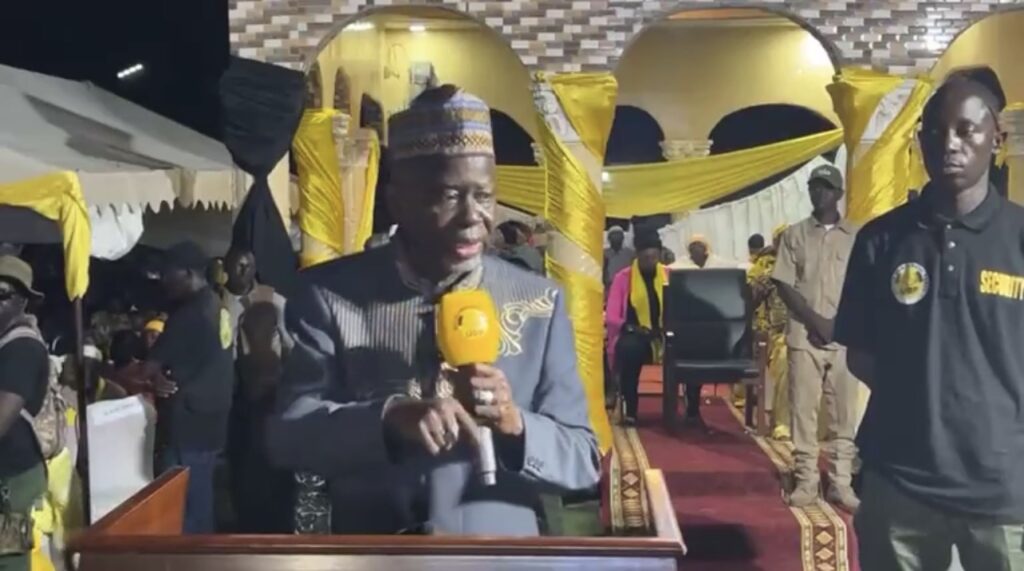
ANM Ousainu Darboe, leader of the United Democratic Party (UDP), has urged women in Mansaring Suu, Brikama, to take a leading role in bringing political change to The Gambia, saying they hold the power to address what he described as the country’s deepening economic and social challenges.
Speaking on Sunday during a visit to a women’s kafo as part of the Gambia First Coalition’s political engagements, Mr. Darboe likened the country’s difficulties to a deep wound that could be healed through collective political action.
He thanked the women for recognizing the challenges facing the country and for their determination to bring about change.
Mr. Darboe pointed to conditions in the public health system as evidence of what he described as the government’s failure to provide essential services. He alleged that patients at the main hospital in Banjul were being forced to lie on floors, newborn babies were sharing beds, and women who had recently given birth were being accommodated together because of inadequate facilities.
He argued that the solution rested with voters, particularly women, whom he urged to unite behind the Gambia First Coalition in the December presidential election.
Turning to young voters, Mr. Darboe said the December 5 election would have far-reaching consequences for their future.
Addressing young people, whom he referred to as the “yellow boys and girls,” he urged them to look beyond political rhetoric and consider the long-term implications of their electoral choices.
He said the election was not primarily about their parents’ generation but about the kind of country young Gambians would inherit. He called on them to vote for the UDP and its coalition partners to safeguard their future.
Mr. Darboe also invoked the legacies of the late Malang Kelefa Jatta and Jokou, whom he credited with standing against injustice and fighting to secure a better future for subsequent generations.
He argued that many of the injustices they opposed remained prevalent, citing alleged political discrimination in workplaces, intimidation of opposition supporters, and the seizure of private property.
According to Mr. Darboe, even individuals who profess political neutrality risk being labeled opposition sympathizers, while those openly associated with opposition parties face harassment and other forms of discrimination.
He also criticized restrictions on political gatherings, questioning why citizens should be required to obtain permits for what he described as ordinary meetings in private homes.
Mr. Darboe drew parallels between those restrictions and the circumstances that led to Malang Kelefa Jatta’s imprisonment, arguing that the struggle for political freedoms remained unfinished.
The UDP leader also addressed longstanding disputes over land ownership in the Kombo region, revisiting a position he said he had defended during his 2001 presidential campaign in Brufut.
He maintained that the designation of land as state land did not automatically transfer ownership to the government.
Citing Section 7 of the State Lands Act, Mr. Darboe argued that the government’s responsibility was to administer and protect designated lands for the benefit of communities rather than treat them as government property.
“We want everyone to be the owner of his own property,” he said.
He emphasized that a UDP-led administration would respect private property rights while retaining the authority to acquire land for legitimate public purposes.
However, he said such powers should not be used to dispossess communities and subsequently transfer their land to institutions such as the Social Security and Housing Finance Corporation, where residents could be required to pay substantial sums to obtain plots.
He cited a deposit of 75,000 dalasis as an example of the financial burden he said such arrangements imposed on families seeking access to land.
Mr. Darboe pledged that a government led by the UDP and its coalition partners would address land disputes, protect property rights and confront what he characterized as longstanding political and administrative injustices.
He concluded by urging Gambians to use the December election to empower the Gambia First Coalition to pursue those reforms, reiterating that the responsibility for changing the country’s direction ultimately rested with voters.
Comments are closed.