


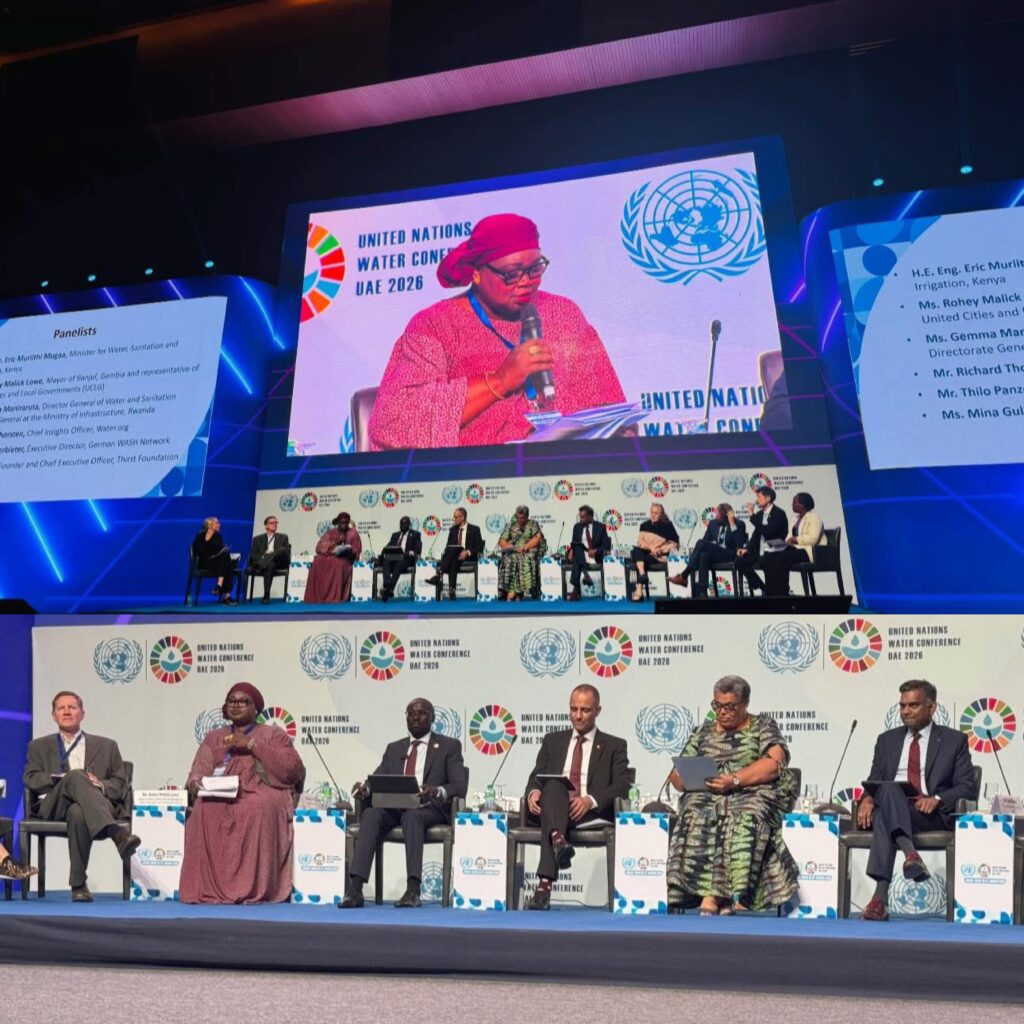
Mayor Rohey Malick Lowe at the conference
By Seedy Jobe
The mayor of Banjul, Rohey Malick Lowe, on Monday pressed global leaders and policymakers to place local governments at the heart of efforts to secure equitable access to water and sanitation, arguing that accountability for such services ultimately rests closest to the people they affect.
Speaking on the second day of preparatory meetings for the United Nations Water Conference in Dakar, Ms. Lowe called for greater recognition, authority, and resources for cities, which she described as the frontline of water governance.
In remarks later shared on her Facebook page, Ms. Lowe said she addressed the gathering not as a distant participant in global debates but as an elected official directly answerable to residents.
“I stood before world leaders, ministers, and experts not as an observer, but as your mayor,” she said, emphasizing the immediacy of local responsibility.
Water and sanitation, she argued, are not abstract policy concerns but daily determinants of dignity and opportunity. “I spoke for every household in Banjul and the world that depends on clean, accessible water. I spoke for every mother, every student, and every worker for whom sanitation is dignity,” she said.
Ms. Lowe rejected approaches that frame water primarily as an economic asset or technical infrastructure.
“Water is not a commodity. It is a human right and a common good. When treated only as infrastructure or a market, inequality grows. But when governed as a public trust, lives change,” she added.
She also pointed to what she described as a persistent gap between national policymaking and realities on the ground. “The real gap is not in laws; it is on the ground, in our streets and communities. Too often, policies are written in capitals but fail in cities.”
Ms. Lowe outlined four shifts she said were essential to closing that gap: formally recognizing local governments within national frameworks; tailoring policies to local contexts rather than relying on uniform solutions; funding water and sanitation as a human right by investing in entire systems rather than isolated projects; and strengthening accountability at the local level.
“Bring accountability home because when taps run dry, you don’t call the ministry; you come to your mayor,” she said.
She closed her address with a direct appeal to international partners and national authorities. “Recognize us. Resource us. Work with us,” she said. “That is how rights become real and irreversible.”
Reaffirming her commitment to Banjul, Ms. Lowe said she intended to ensure that the city’s experiences and needs help shape the global water agenda. “This fight is our fight,” she said. “And I am here to make sure Banjul’s voice is heard.”
Comments are closed.