


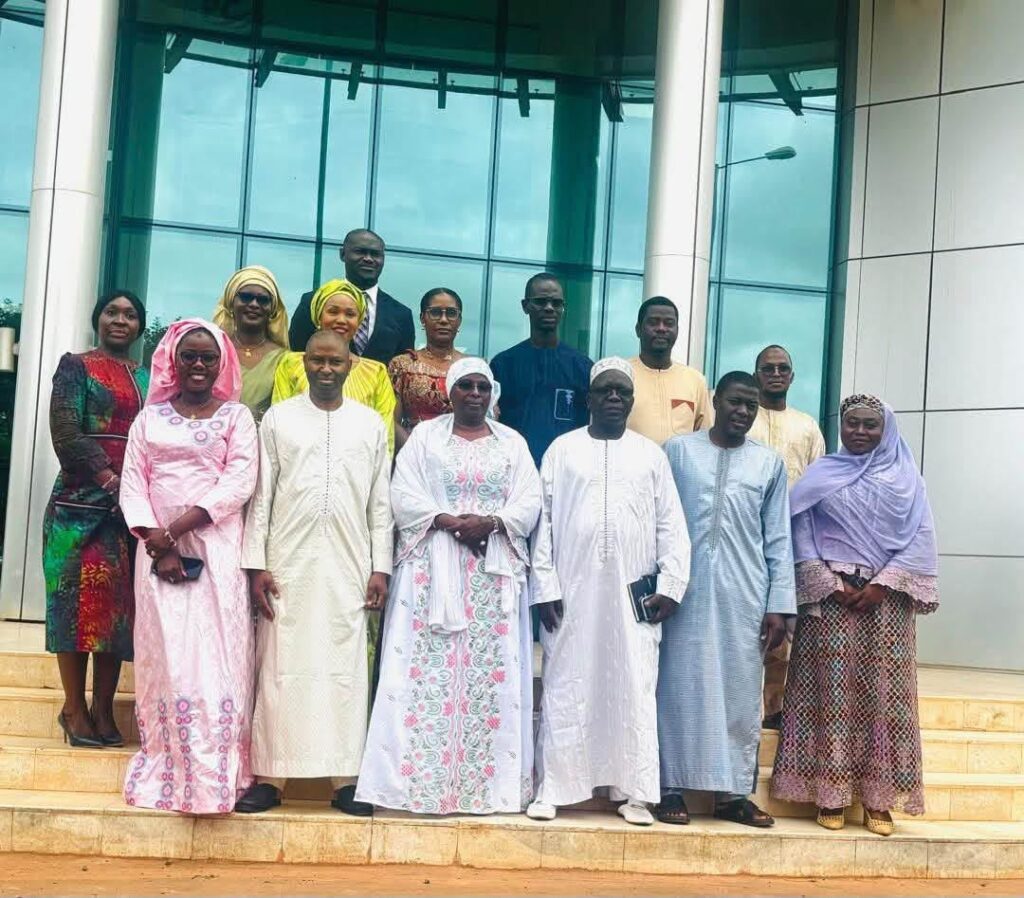
By Seedy Jobe
The Gambia and Ghana on Friday signed a memorandum of understanding to expand cooperation in the petroleum sector, a move officials from both countries said would strengthen institutional capacity, improve regulatory oversight, and support the development of The Gambia’s emerging oil and gas industry.
The agreement, signed at Petroleum House in Banjul, brings together the Gambia Petroleum Commission and the Petroleum Commission of Ghana in a partnership centered on technical assistance, knowledge sharing, and institutional development.
Officials described the accord as the formalization of years of collaboration between the two regulatory bodies, including technical exchanges and study visits, while laying the groundwork for broader cooperation as The Gambia continues exploring its offshore petroleum potential.
Speaking at the signing ceremony, the Director General of the Gambia Petroleum Commission, Cany Jobe, said the partnership comes at a critical stage in the country’s petroleum development, emphasizing that the success of the sector will depend as much on strong institutions as on the discovery of commercial oil and gas reserves.
Although The Gambia has promising geological prospects, she said, sustainable development cannot be achieved through natural resources alone.
“We approach our exercise of petroleum exploration with the understanding that strong institutions are just as important as a resource discovery,” Ms. Jobe said.
She said attracting credible investors and preparing the country for any future commercial discoveries would require transparent regulation, capable institutions, and public confidence.
Drawing on Ghana’s experience, Ms. Jobe noted that the country’s emergence as an oil producer followed decades of geological research, technical expertise, and institutional development. She said Ghana’s experience illustrates that petroleum development requires patience, long-term planning, and sustained investment in governance long before production begins.
Emeafa Hardcastle, the Chief Executive Officer of the Petroleum Commission of Ghana, described the agreement as the culmination of several years of engagement between the two commissions, including approximately six technical visits by Gambian officials to Ghana.
She said the memorandum’s success would ultimately depend on its implementation rather than the signing ceremony itself.
“In an increasingly interconnected world, collaboration and cooperation are key to sustainable growth,” Ms. Hardcastle said. “This agreement will allow our two institutions to foster deeper cooperation and stronger institutional, technical, and economic ties between our nations.”
She said the partnership would enable both countries to combine their expertise, resources, and innovation to strengthen petroleum regulation and promote mutual development.
Ms. Hardcastle also urged African countries to deepen cooperation rather than compete by weakening fiscal or regulatory standards in an effort to attract investment. She said stronger collaboration among petroleum-producing nations would enhance local content development, regulatory effectiveness, and long-term energy security.
Representing the Government of The Gambia, Abdoulie Jallow, Permanent Secretary at the Ministry of Petroleum, Energy and Mines, welcomed the Ghanaian delegation and described the agreement as another milestone in the longstanding relationship between the two countries.
Mr. Jallow said Ghana’s experience in developing its petroleum industry provides valuable lessons for emerging producers such as The Gambia. He noted that Ghana has already supported the Gambia Petroleum Commission through technical exchanges, study tours, and capacity-building initiatives that have strengthened the country’s regulatory institutions.
He said the memorandum represents more than a formal agreement, describing it as a shared commitment to institutional development and the principle that African countries can accelerate progress by learning from one another.
“The Gambia, as an emerging petroleum jurisdiction, recognises that building strong institutions is just as important as discovering petroleum resources,” Mr. Jallow said. “Our vision is to establish a transparent, accountable and efficient petroleum sector that delivers lasting benefits to the Gambian people. Achieving that vision requires learning from those who have successfully walked this path before us.”
Officials from both countries said the agreement is expected to expand cooperation in petroleum regulation, institutional capacity building, downstream petroleum development, and petrochemical opportunities as Ghana and The Gambia work to develop resilient and internationally competitive oil and gas industries.
Comments are closed.