
Eight Presidential Candidates Sign Peace Pact Ahead of December Election

By Makutu Manneh
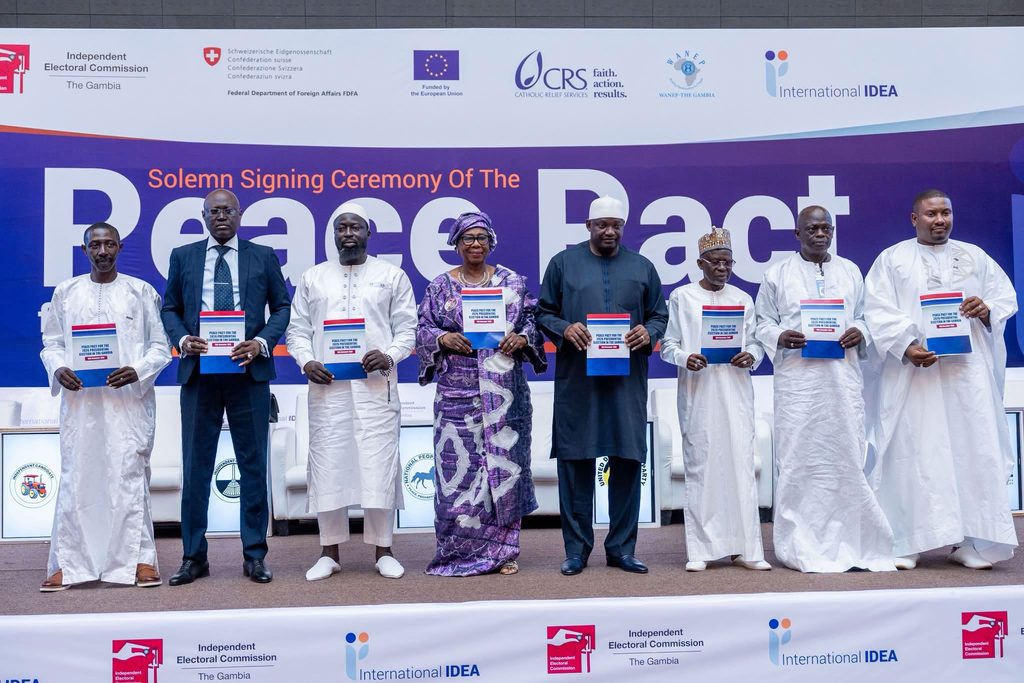
Eight presidential candidates signed a peace accord on Monday, November 16, pledging to conduct peaceful, issue-based campaigns and uphold democratic principles ahead of The Gambia’s December 5, 2026, presidential election.
The agreement, comprising 11 articles, sets out commitments aimed at preventing electoral violence, hate speech, tribal bigotry, intimidation, and the misuse of state resources. It also addresses press freedom, the responsible use of digital media and artificial intelligence, the independence of state institutions, and the roles of religious and traditional leaders in maintaining peace.
The pact further calls on candidates to respect the electoral process, uphold the authority of the Independent Electoral Commission (IEC), and resolve election-related disputes through established legal channels.
The signatories were President Adama Barrow of the National People’s Party (NPP); Ousainou Darboe of the United Democratic Party (UDP); Talib Ahmed Bensouda of UNITE; Lamin J. Darboe of the Team Gambia Grand Coalition; Almameh Gibba of the No-To-Alliance movement; independent candidate Dr. Isatou Touray; Ebrima Tabora Manneh of the People’s Alliance Party (PAP); and Modou Lamin Sima of the Alliance of Progressive Citizens (APC).
Ansu Sanneh of the National Builders Party, who was also nominated for the presidential election, did not attend the signing following his decision to join the UNITE-led Coalition 2026.
Speaking at the ceremony, President Barrow emphasized that political leaders must demonstrate their commitment to peace through their conduct rather than merely through public declarations.
He said the NPP had consistently promoted peace and development and urged political leaders to set an example by discouraging their supporters from engaging in violence, spreading hatred or undermining national unity.
“We will respect this spirit of peace pact that brought us together, and we encourage all candidates to do the same,” President Barrow said, reaffirming the commitment of the NPP and its political partners to the agreement.
UDP leader Ousainou Darboe, however, expressed disappointment that political parties had reached a point where a formal peace agreement was considered necessary.
He recalled that earlier generations of Gambian politicians conducted electoral campaigns peacefully without signing such accords, arguing that the increasingly adversarial nature of contemporary politics had contributed to a toxic political environment.
According to Mr. Darboe, political competition has increasingly become a contest in which some participants believe victory must be secured at all costs.
He expressed hope that the signing would represent a genuine commitment to peaceful political engagement rather than a symbolic exercise intended for public appearances.
“We assure the Gambians that we are committed to a peaceful election, although during the process whenever it is necessary for us to raise any queries, we do so without fear of any condition,” Mr. Darboe said.
His remarks underscored the distinction between maintaining electoral peace and exercising the right to challenge perceived irregularities through lawful means.
UNITE leader Talib Ahmed Bensouda similarly emphasized that the agreement should be understood as more than a ceremonial undertaking.
He said the signing represented a reaffirmation that the country’s interests must take precedence over individual political ambitions and partisan differences.
Mr. Bensouda reiterated Coalition 2026’s commitment to a peaceful, credible, transparent and democratic election, saying political parties should be able to campaign vigorously without allowing electoral competition to threaten national cohesion.
Other candidates echoed those sentiments, pledging to reject political violence, ethnic discrimination, hate speech and disinformation throughout the campaign.
Lamin J. Darboe of Team Gambia warned that the boundary between peace and conflict could be dangerously narrow, urging political leaders to exercise restraint and ensure their supporters conduct themselves responsibly.
Almameh Gibba of the No-To-Alliance movement said no political ambition should come at the expense of the country’s peace and unity.
Ebrima Tabora Manneh of the PAP described peace as an enduring feature of Gambian culture and national identity.
Independent candidate Dr. Isatou Touray stressed that elections should provide an opportunity for competing ideas and policy proposals rather than become a source of division among citizens.
Modou Lamin Sima of the APC, meanwhile, emphasized the relationship between peace and justice, arguing that lasting peace could only be achieved where justice prevails.
Beyond commitments to peaceful campaigning, the accord establishes expectations concerning the conduct of political parties, the use of public resources, the dissemination of information and respect for electoral institutions.
It also addresses monitoring, enforcement and the responsibilities of other institutions in safeguarding the electoral environment.
Under the agreement, candidates are expected to respect the electoral process, accept election results and pursue any grievances through the IEC and the courts rather than resorting to violence or intimidation.
The signing comes as The Gambia prepares for the December 5 presidential election, with political parties entering a crucial period of campaigning amid calls for restraint, tolerance and respect for democratic institutions.
Comments are closed.