


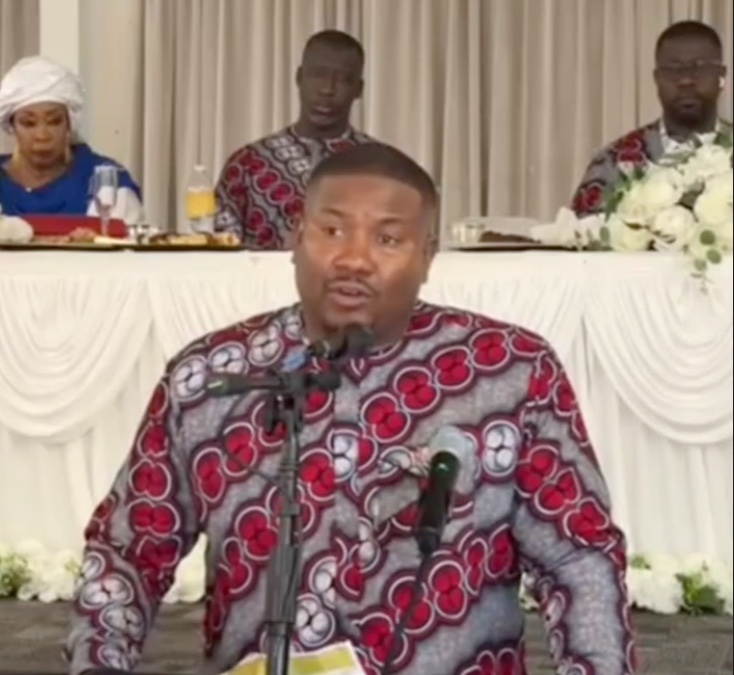
By Makutu Manneh
Talib Ahmed Bensouda, the mayor of the Kanifing Municipal Council and leader of the UNITE Party, told Gambians in Seattle on Friday that his party was established to restore what he described as missing values in governance and to offer a new political direction for The Gambia ahead of the country’s presidential election.
Addressing supporters at the UNITE Party Seattle Gala Dinner and Fundraising event, Mr. Bensouda said the party was founded on four core principles—patriotism, integrity, transformation, and equality—which he argued are essential to rebuilding public trust and advancing national development.
He said patriotism is the foundation of the party’s philosophy, contending that a genuine commitment to country has been largely absent from Gambian politics.
Drawing comparisons with the United States, where he was addressing members of the Gambian diaspora, Mr. Bensouda said he admired the sense of civic responsibility he observed among Americans, from the way they care for their communities to the pride they take in their country. While acknowledging that no nation is without its challenges, he said that spirit of national commitment was something The Gambia should aspire to cultivate.
“That is why the first word in UNITE is ‘unite for nation,'” he said. “The second is integrity. This is a key ingredient missing in Gambian politics. If we do everything with truth in public office and governance, regardless of the department, nation-building will become much easier. UNITE wants to bring integrity to the Gambian government.”
Mr. Bensouda identified transformation as the party’s third guiding principle, arguing that The Gambia must adopt a more ambitious approach to economic development if it is to break the cycle of poverty.
He said poverty has persisted across generations, affecting grandparents, parents, and children alike, and maintained that the country must pursue policies capable of creating lasting economic opportunities.
The fourth principle, he said, is equality.
Mr. Bensouda called for narrowing the gap between rich and poor while rejecting what he described as the divisive politics of regionalism, tribalism, and religious polarization.
He noted that The Gambia’s small geographic size should be an advantage rather than a source of division.
“We are the smallest country on mainland Africa,” he said, arguing that national unity is indispensable for development. He urged Gambians to identify first as citizens of one nation rather than along ethnic, regional, or religious lines.
Looking ahead to the 2026 presidential election, Mr. Bensouda expressed confidence in his party’s rapid growth, saying UNITE had expanded significantly since its formation and predicting it would become the country’s largest political party by September.
He also said he believed the party would prevail in the December election, attributing its momentum to sustained grassroots organizing rather than rhetoric.
Mr. Bensouda concluded by describing UNITE as a movement that reflects the aspirations of Gambians seeking greater prosperity and opportunity. He said the party’s economic vision centers on creating conditions in which young people can build successful lives at home, reducing the pressures that have driven many to seek opportunities abroad.
“Our goal,” he said, “is to make migration a choice, not a necessity.”
Comments are closed.