


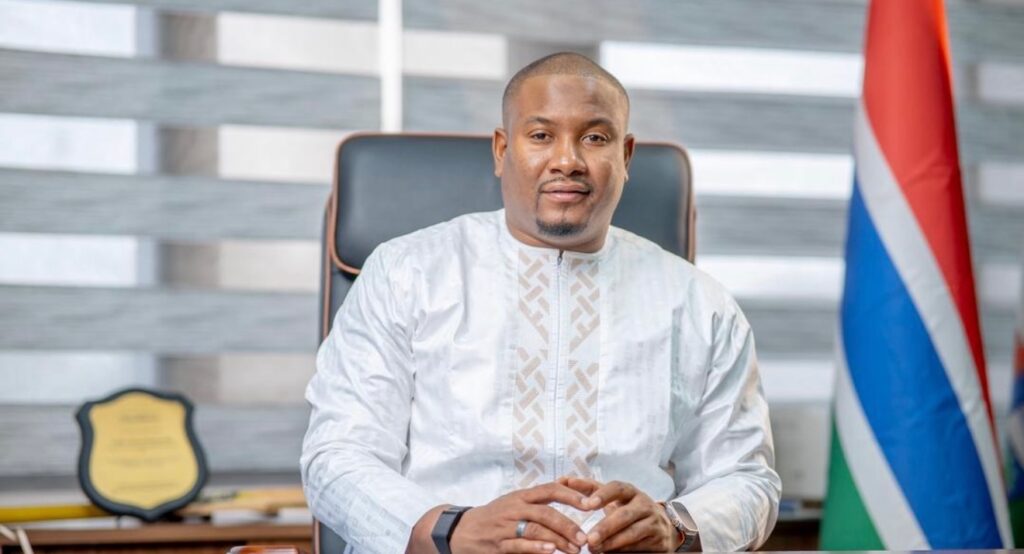
By Staff Writer
At a cavernous hotel ballroom turned political convention hall in Kololi on Saturday, Talib Ahmed Bensouda, the mayor of the Kanifing Municipal Council, formally launched the Unite Movement for Change, presenting it as a new political force aimed at reshaping governance in The Gambia.
Addressing delegates gathered for the movement’s national congress, Mr. Bensouda, who was elected leader of the movement, framed the moment as a turning point rather than a routine political assembly.
“Today is not an ordinary political gathering,” he said. “Today is a declaration.”
He described the launch as a signal that Gambians are ready for leadership that is “competent, disciplined, and prepared to govern” and called for a return to politics rooted in public service rather than personal survival.
The congress drew supporters from across the country and the diaspora, along with representatives of other political parties, civil society groups, and members of the press. It marked the formal debut of the Unite Movement for Change as an organized political entity ahead of the 2026 elections.
In a speech that blended criticism of the political status quo with a forward-looking agenda, Mr. Bensouda pointed to mounting economic pressures and public frustration. Young people, he said, face uncertain futures after graduation, while families contend with rising living costs and limited opportunities. Farmers, he added, remain vulnerable despite their contributions, and many communities continue to lack basic infrastructure and services.
Across the country, he said, citizens are increasingly asking how a nation with “so much promise” continues to struggle with direction.
Mr. Bensouda criticized what he described as a pattern of episodic, election-driven politics. Leaders, he said, often campaign energetically but fail to deliver results in office, allowing “noise” to replace measurable progress and “promises” to substitute for planning.
The new movement, he said, was formed not out of grievance but from a belief that governance in The Gambia can improve.
Drawing on his tenure in local government, Mr. Bensouda emphasized a practical approach to leadership, arguing that governance should be judged by tangible outcomes—functioning markets, passable roads, reliable services, and expanded economic opportunities.
“Leadership is not measured by how loudly a politician speaks,” he said. “It is measured by whether people’s lives improve.”
He also sought to position the movement as a national project, extending beyond urban strongholds. The movement, he said, belongs equally to communities across the country, from Basse to Brikama, Farafenni to Janjanbureh.
Mr. Bensouda spoke at length about concerns over governance and democratic institutions, warning against the politicization of state power. While affirming his respect for the rule of law and accountability, he cautioned that justice must not become selective and that institutions should not be used as political tools.
“Democracy cannot survive where fear replaces fairness,” he said, adding that political participation must remain open and protected.
He outlined five broad priorities for the movement: expanding employment and skills opportunities for young people; addressing the rising cost of living; prioritizing rural development; strengthening governance and institutional accountability; and promoting national unity.
On the question of leadership, Mr. Bensouda addressed critiques of his age and political background, arguing that youth, when paired with discipline and competence, can be an asset. His experience in municipal governance, he said, has underscored the importance of systems, service delivery and accountability in public office.
“This movement is not built on anger,” he said. “It is built on organization. It is not built on insults. It is built on ideas.”
He called for nationwide mobilization, urging supporters to organize at the community level and across the diaspora, emphasizing that lasting political change requires sustained structure rather than momentary enthusiasm.
By the end of his address, Mr. Bensouda cast the Unite Movement for Change as a response to what he described as a gap between political rhetoric and governance, and as an effort to channel public frustration into coordinated action.
“The Gambia does not need leaders who only know how to campaign,” he said. “The Gambia needs leaders who know how to govern.”
Framing the launch as the beginning of a broader political effort, he concluded with a pledge to “unite, serve and transform,” declaring that what began as an idea had now become a movement.
Comments are closed.