

Arona Tine Challenges Police Statements in Voir Dire Hearing Over Alleged Murder

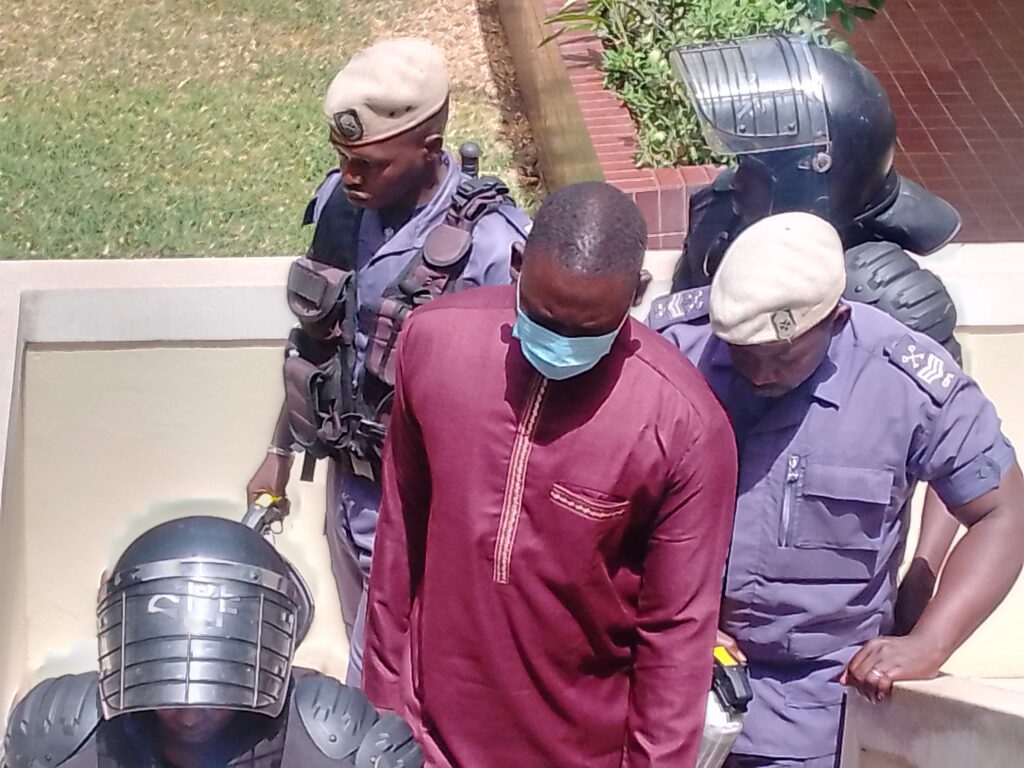
Arona Tine, Defendant
Arona Tine, the man accused of fatally stabbing 27-year-old Fatoumatta Kargbo at a currency exchange bureau in Westfield, returned to the witness stand Monday as his murder trial entered a crucial phase: a voir dire, or trial-within-a-trial, to determine the admissibility of his statements to police.
Tine contends that the cautionary and voluntary statements he gave while in police custody were not made of his own free will, a claim that, if upheld by the court, could significantly shape the prosecution’s case.
The defense has raised concerns about the conditions under which the statements were obtained, including alleged police coercion, denial of medical attention, and lack of access to legal counsel. These allegations are now under scrutiny before Justice Jaiteh of the High Court.
During cross-examination, State Counsel M. Sarr focused on the timeline of Tine’s hospital discharge and the physical condition in which he gave his statements. Asked whether he had been discharged from the hospital prior to making his statement, Tine said, “I was discharged in the morning, and the following day was when I gave the statement.”
The line of questioning then turned to the injuries sustained by the accused. Counsel Sarr suggested that Arona Tine had suffered his wounds after the alleged incident. Tine disagreed, clarifying, “I did not say that. The injuries I had on my body were treated, but the ones I had on my arms were sustained after the incident.”
Counsel Sarr pressed further, asserting, “You inflicted those injuries on yourself after the murder incident.” This drew an immediate objection from defense counsel Ade, who argued that referring to the event as “murder” was prejudicial, since only the court could determine whether a murder had occurred.
Justice Jaiteh, however, overruled the objection, noting that the term had already been used in Tine’s voluntary statement and was therefore acceptable in context.
Reframing the question, Counsel Sarr asked: “You stated you hurt yourself after murdering the deceased in your personal statement.” Tine responded that police never questioned him on that point. “When I reached the police station, when they brought me to the CID office, when they were questioning me, they did not ask me about that.”
Counsel Sarr continued his line of questioning, probing Tine’s allegations of police coercion, denial of medical treatment, and refusal of legal representation. Tine confirmed each of the claims with a simple “Yes.” When asked specifically whether he had requested a lawyer and been denied, he replied, “I asked them to call my lawyer, and they refused.”
Sarr then turned to whether these complaints had been formally recorded by either the police or medical personnel. Tine’s answers grew less direct. Pressed on whether the refusal of legal counsel was documented in any official statement, Tine responded, “They didn’t allow me a pen and paper to write.”
Tine also reaffirmed that he had been handcuffed so tightly that it caused injuries, which he claimed were still visible. He told the court that after his discharge from Banjul Hospital, he requested to be returned there for further treatment but was instead taken to Serekunda Hospital, where his request was denied.
In response, Counsel Sarr referred to the testimony of the police officer who recorded Tine’s cautionary and voluntary statements, noting that the officer claimed Tine showed no signs of injury and was deemed fit to provide a statement. Tine disputed that account, stating, “He knows that when he was taking my statement, I was having surgery.”
Counsel Sarr pressed further, asking Tine whether he was aware that the police officer who recorded his statement had testified that Tine was not under duress, was informed of his rights, and made the statement in the presence of an independent witness. When asked if he was effectively accusing all of them of lying, Tine responded firmly: “What they said about me is not true.”
The cross-examination continued with Counsel Sarr probing how details known only to Tine had ended up in the statement if it had not been given voluntarily. Tine’s answers grew increasingly vague, particularly regarding the timeline of his discharge from the hospital and events that followed.
Justice Jaiteh subsequently adjourned the matter to October 14, 2025, at 12:00 p.m., for the continuation of the cross-examination of Defence Witness 1.