


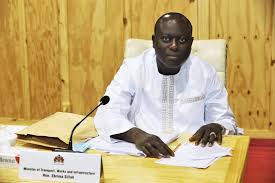
By Fatou Sillah
The Gambia’s Minister of Transport, Works, and Infrastructure, Ebrima Sillah, has criticized some opposition figures, accusing them of lacking a clear understanding of national development issues, particularly in the area of infrastructure.
Speaking in a recent interview on West Coast Radio, Mr. Sillah said a “new breed” of opposition voices dominating public discussions on radio and social media often comment on complex policy matters without sufficient research.
“I think there seems to be a serious lack of clarity or understanding on the side of the new breed of opposition leaders who are crowding many of these radio stations and social media platforms to talk about complex national development issues that they actually need to do a lot of research on,” he said.
Mr. Sillah also defended the government’s road construction program, describing it as a strategy designed to support key sectors of the economy, including agriculture and fisheries.
He said many roads built since 2017 have improved access between rural production areas and urban markets, reducing transportation costs and travel time for farmers and fishing communities.
In the Kiang West area, he said, improved road networks have significantly shortened journeys, allowing residents to reach major towns such as Brikama, Jarra Soma, and Farafenni more quickly. He described the changes as having a “tremendous impact” on livelihoods, particularly for fishing communities.
“Within two hours, they are able to reach Brikama; within 45 minutes, they are able to reach Jarra Soma or Farafenni. You can see the tremendous impact that this has on the lives of those fishing communities,” he said.
The minister said improved road access has also made it easier for farmers to transport produce, contributing to higher earnings. Lower transportation costs, he added, have translated into better returns for producers.
“Now it is so easy; the cost of all those things has now been reduced, and as a result, the take-home for a lot of these farmers is actually very, very good,” he said.
He explained that road construction is based on usage and economic relevance, not just traffic volume, and that rural roads are designed differently from urban highways.
“So it is not only about traffic; you have to look at usage. Then we classify them as rural roads, urban roads, and also highways,” he said.
Mr. Sillah emphasized that road construction decisions are based not only on traffic volume but also on patterns of use and economic relevance. He said authorities classify roads into rural, urban, and highway categories, each designed to serve different needs.
He added that growing traffic along major corridors, including the OIC Highway, reflects the increasing importance of road infrastructure to the country’s development.
“Roads are very important in this country,” he said, noting the limited size of the national network and the need for continued investment.
Comments are closed.