


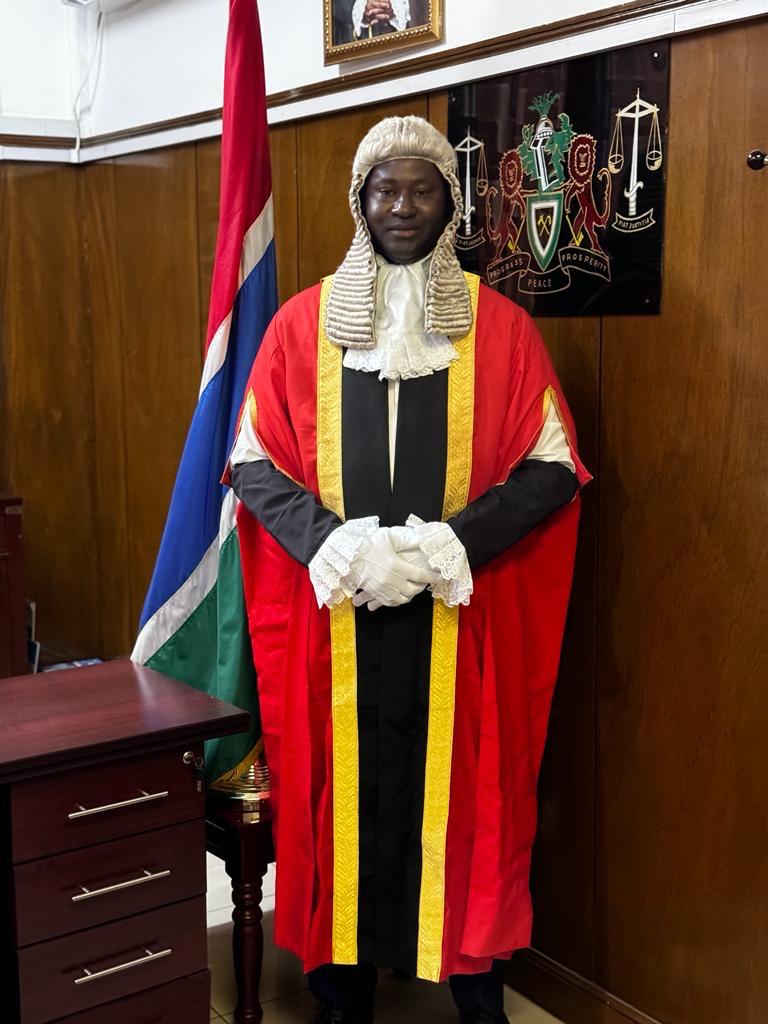
The High Court, presided over by Justice Ebrima Jaiteh, has dismissed the state’s objection to the admissibility of an audio recording of a conversation between Mama Jabbi and Ousainou Bojang, along with its English transcription.
The State was represented by Director of Public Prosecutions (DPP) A.M. Yusuf and F. Touray, while J. Jeng and A. Sillah appeared for the first and second accused persons, respectively.
The ruling followed an objection raised by DPP Yusuf challenging the defence’s attempt to tender a flash drive containing the audio, which was recorded in a local language, and its corresponding English transcription. Defence Counsel A. Sillah made the application under Section 3 of the Evidence Act, 1994.
DPP Yusuf argued that the evidence was inadmissible because the accompanying certificate for computer-generated evidence allegedly failed to comply with the mandatory requirements outlined in Section 22 of the Evidence Act.
In delivering his decision, Justice Jaiteh examined the legal scope of what qualifies as “computer-generated evidence” under Section 22. He noted that the Act defines a computer as a device used for storing and processing information, including information derived through calculation, comparison, or other processing methods.
Justice Jaiteh emphasized that the certification requirement applies only when the information presented is the product of computational processes—such as calculations, algorithmic outputs, comparisons, statistical analyses, or similar automated operations.
He clarified that “not all materials that pass through or are stored in a computer constitute ‘computer-generated evidence’ within the meaning of Section 22. Merely using a computer as a storage or word-processing tool does not transform every document or audio file into computer-generated output requiring certification.”
Applying this interpretation, Justice Jaiteh held that the audio recording in question was not an algorithmic or computational output but simply a human-made recording stored on a flash drive and later transcribed manually.
“The law does not elevate form above substance,” he stated. “What carries probative value is the content of the audio and the accuracy of the transcription—not the certificate accompanying it.”
Justice Jaiteh concluded that the State’s objection was purely technical and did not affect the substance, relevance, or reliability of the evidence. He further held that the alleged non-compliance with Section 22 had no bearing on admissibility.
The court admitted the flash drive and the English transcription into evidence, marking them as Exhibit D38, and noted that the weight and credibility of the evidence will be assessed at a later stage in the proceedings.