


By Seedy Jobe
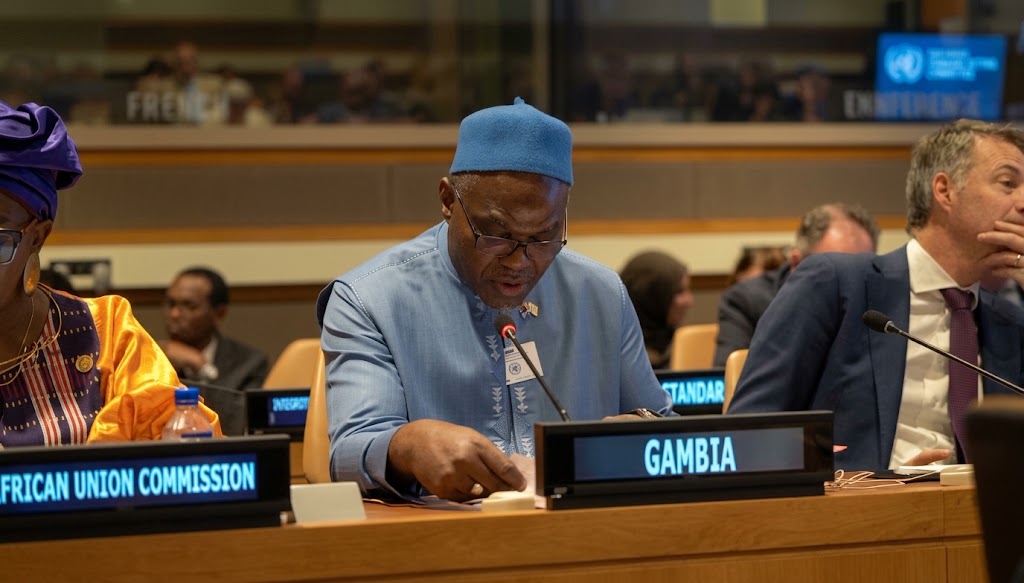
Vice President Muhammed B.S. Jallow has called for greater international investment to help African households transition from firewood and charcoal to cleaner cooking technologies, warning that cost and limited access continue to put cleaner alternatives beyond the reach of millions.
Mr. Jallow made the remarks at a high-level clean cooking event in New York, held on the sidelines of the 81st United Nations General Assembly.
Addressing development partners, the vice president said Africa’s clean cooking challenge remains urgent, with millions of households continuing to rely on traditional fuels not because of a lack of demand for cleaner energy, but because of barriers related to affordability, access, and investment.
In The Gambia, he said, only 1.6 percent of the population has access to clean cooking fuels and technologies, while rural communities depend almost entirely on wood fuel. That dependence, he said, exposes households—particularly women—to harmful indoor air pollution and associated health risks.
Mr. Jallow said The Gambia has placed clean cooking at the center of its climate response, incorporating clean cooking measures into its nationally determined contribution.
He said the country’s energy sector has a conditional emissions-reduction target of more than 50 percent, with efforts focused on reducing household emissions from fuels such as charcoal and firewood while expanding access to cleaner and more efficient cooking technologies.
The vice president also highlighted The Gambia’s Climate Prosperity Investment and Financing Strategy, describing it as a nationally driven framework aimed at mobilizing domestic and international investment to strengthen climate resilience. Clean cooking and renewable energy, he said, are among the strategy’s key investment priorities.
Mr. Jallow stressed, however, that the transition to cleaner cooking must take into account the economic realities facing households.
A transition that families cannot afford, he said, will not succeed, while solutions that fail to reflect local circumstances are unlikely to achieve the scale needed to produce meaningful change.
For least developed countries with limited fiscal space, Mr. Jallow said, a successful transition will depend on access to sustainable technologies, stronger national capacity, and financing arrangements that make implementation possible.
He called for stronger international partnerships to ensure that countries seeking to turn their climate commitments into tangible improvements for their citizens have access to the resources necessary to do so.
Mr. Jallow also urged greater African ownership of the clean cooking agenda, saying countries on the continent should play a stronger role in designing solutions suited to their energy needs, building institutions capable of sustaining those solutions and ensuring that the transition to cleaner energy contributes to broader economic development.
“Africa should not have to choose between meeting basic energy needs and pursuing a cleaner and more sustainable future,” he said, adding that with adequate investment and international cooperation, the continent can achieve both.
Mr. Jallow said The Gambia stands ready to work with Kenya, Norway, the Clean Cooking Alliance, and other partners to advance the clean cooking agenda and expand access to affordable, sustainable energy solutions.
Comments are closed.