


By Makutu Manneh
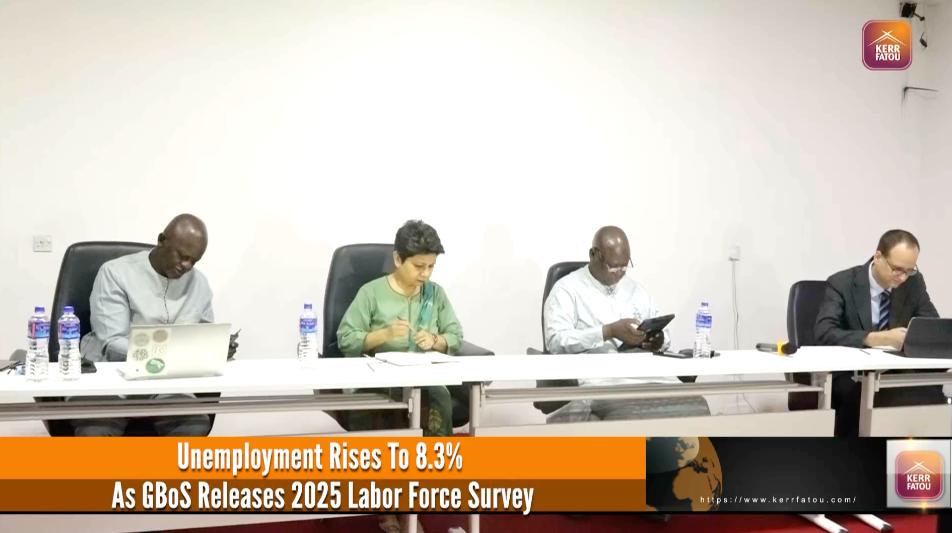
The Gambia Bureau of Statistics (GBoS) has released the results of the 2025 Labour Force Survey, revealing a rise in unemployment and persistent structural challenges in the national labor market.
The survey, conducted with technical and financial support from the World Bank, is a key instrument for assessing employment trends and guiding policy decisions.
According to the findings, the national unemployment rate has increased to 8.3%, with youth unemployment reaching 11.5%. Informal employment remains the backbone of the economy, accounting for 81% of all jobs. Overall labor underutilization stands at 26.7%.
The report also points to marked disparities across demographic groups. Young women face disproportionately higher unemployment and are more likely to work in informal sectors, with limited access to formal employment. Participation among persons with disabilities has dropped significantly, from 32.8% to 20.1%.
Statistician General Nyakassi M.B. Sanyang reported that the labor force is expanding, with the participation rate rising from 43.6% to 47.1%—equivalent to more than 56,000 new entrants. He cautioned, however, that this growth is accompanied by structural challenges, including rising youth unemployment, persistent exclusion of many from the labor force, and widespread informality, particularly among women, young people, and persons with disabilities.
Sanyang stressed that the survey’s findings go beyond numbers, describing them as a critical resource for action. He urged policymakers—especially the Ministry of Employment—to use the evidence to craft targeted, inclusive, and forward-looking labor policies.
“I encourage all institutions, that is, government institutions, the private sector, academia, and civil society, to use the resources meaningfully. Evidence-based policy is no longer optional, but it is essential, and this is the main reason why we are providing this data,” he said. “We know what is happening at the moment in terms of unemployment. This is a very pressing issue for the government, and without such information, the right policy cannot be developed to address this issue,” he added.
Representing the World Bank, Senior Economist Morite Meyer underscored the central role of labor markets in shaping household income, poverty reduction, and inclusive growth. He expressed hope that the Labour Force Survey for The Gambia will provide a robust evidence base to guide the formulation of policies and programs.
“I consider this event an important milestone for the survey, yet it is not the endpoint. I am hoping the labor force survey 2025 becomes a reference point for decision-making, analytics, and discussions,” he said.
Fabba Jammeh, Director of Employment at the Ministry of Employment, acknowledged the significance of the findings, noting that while ongoing job creation initiatives are producing results, the benefits are not being felt evenly across all groups. He emphasized that the ministry will take urgent and deliberate measures to address these disparities.
“In collaboration with the Gambia Bureau of Statistics and other key partners, the ministry will use the findings of the survey to inform ongoing labor market interventions, especially those targeting youth, informality, and vulnerable groups,” he stated.
This marks GBoS’s second comprehensive labor force survey, designed to track evolving dynamics in employment, unemployment, and labor underutilization. The bureau announced plans to conduct a biannual survey in 2026, followed by quarterly surveys beginning in 2027 to strengthen monitoring and inform decision-making.