

New Generators Arrive to Boost Gambia’s Power Supply as VP Says Electricity Has Stabilized

By Seedy Jobe
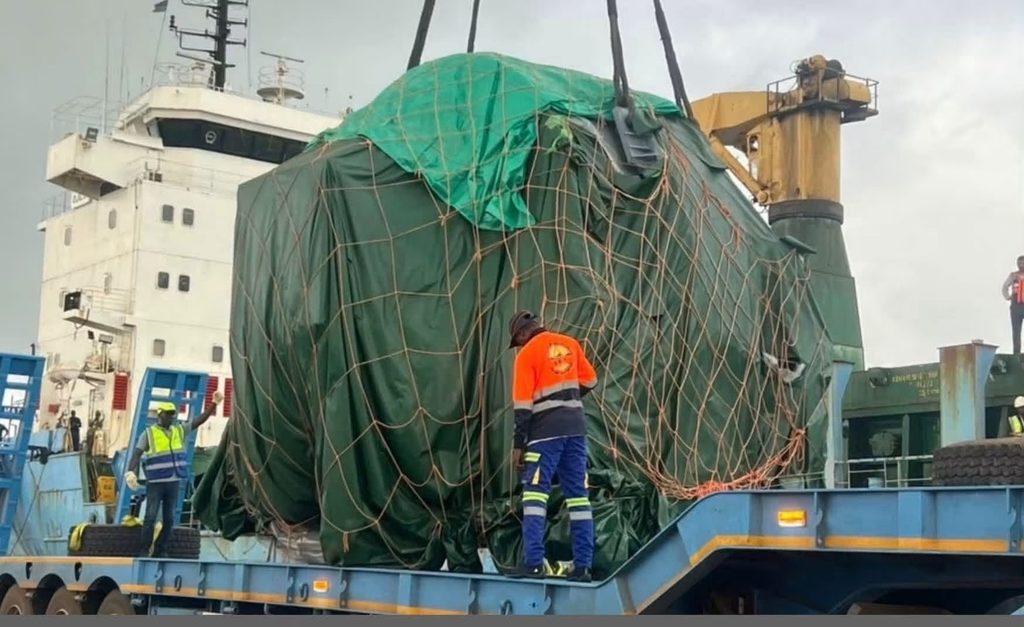
Vice President Muhammad B.S. Jallow on Monday received a consignment of newly imported generators at the Banjul Port, part of the government’s effort to increase domestic electricity generation following months of persistent power outages.
Mr. Jallow received the equipment on behalf of President Adama Barrow, who is currently on his annual Meet the People Tour. He was accompanied by cabinet ministers, the managing director of the National Water and Electricity Company, or NAWEC, other senior government officials, and members of the media.
The generators are expected to increase the country’s installed generation capacity and ease electricity shortages that have disrupted communities across the Greater Banjul Area in recent months, prompting protests in several places.
Their arrival follows President Barrow’s recent pledge that the electricity crisis would be resolved by the end of October. Government officials had said meeting that deadline depended in part on the arrival of additional generating capacity.
Speaking alongside members of the National Energy Task Force, including its chairman and NAWEC’s managing director, Mr. Jallow said the new generators formed part of the government’s immediate response to the country’s power challenges.
He said electricity supply had already stabilized but that the government was seeking to increase generation capacity further to reduce the risk of another crisis.
The vice president described the generators as a short-term intervention, saying the government was also pursuing medium- and long-term measures aimed at providing a more permanent solution to the country’s electricity problems.
Mr. Jallow also reiterated President Barrow’s pledge to achieve universal access to electricity by the end of 2026, which would extend power to every community, village, and hamlet in the country. He said development partners, including the Chinese government, had pledged support toward achieving that goal.
NAWEC Managing Director Gallo Saidy described the arrival of the generators as a significant step and said it demonstrated progress toward fulfilling the president’s commitment.
Mr. Saidy said the generators would soon be installed and commissioned, providing additional capacity during periods when the national grid experiences generation shortfalls.
Each of the two generators has a capacity of about 10.5 megawatts, he said, providing a combined 21 megawatts of additional capacity. A third 10.5-megawatt unit is expected to arrive later.
Mr. Saidy said the generators were procured under a project initiated by President Barrow and were separate from energy assistance pledged by the Chinese government.
Finance Minister Seedy Keita said the government had adopted a coordinated approach to tackling the electricity crisis and strengthening the country’s energy security.
He described the arrival of the first consignment as evidence that the government was following through on its commitments, noting that some had questioned whether the president’s October deadline could be met.
Mr. Keita said the government was listening to public concerns over electricity shortages and thanked development partners for responding to the country’s needs.
He said the generators were procured through an independent power agreement, or IPA, under which a private company supplies electricity while the government serves as the offtaker at a negotiated price.
The arrangement, he said, reflects the government’s effort to work with the private sector while increasing domestically generated electricity rather than relying solely on imported power.
Information Minister Dr. Ismaila Ceesay said the equipment arrived in six components and would be transported to NAWEC’s Brikama facility, where platforms have already been prepared for installation and integration into the national grid.
Dr. Ceesay said the energy sector faced significant challenges when the Barrow administration took office in 2017, including years of underinvestment, outdated grid infrastructure, high system losses and electricity access of about 45 percent.
He said the government had since focused on upgrading the grid, expanding electricity access and increasing generation capacity while pursuing renewable energy and cheaper electricity imports from Guinea and Senegal.
The latest power crisis, Dr. Ceesay said, was aggravated by technical problems in Senegal and supply constraints in Guinea, exposing the country’s vulnerability to disruptions in imported electricity.
Those problems prompted President Barrow to establish a National Energy Task Force, headed by the vice president, to develop short-, medium- and long-term measures to strengthen electricity supply and reduce the country’s exposure to external energy shocks.
Comments are closed.