

Court Grants Leave for Harouna Kebbeh to Testify in GACH Global’s D58 Million Fraud Suit

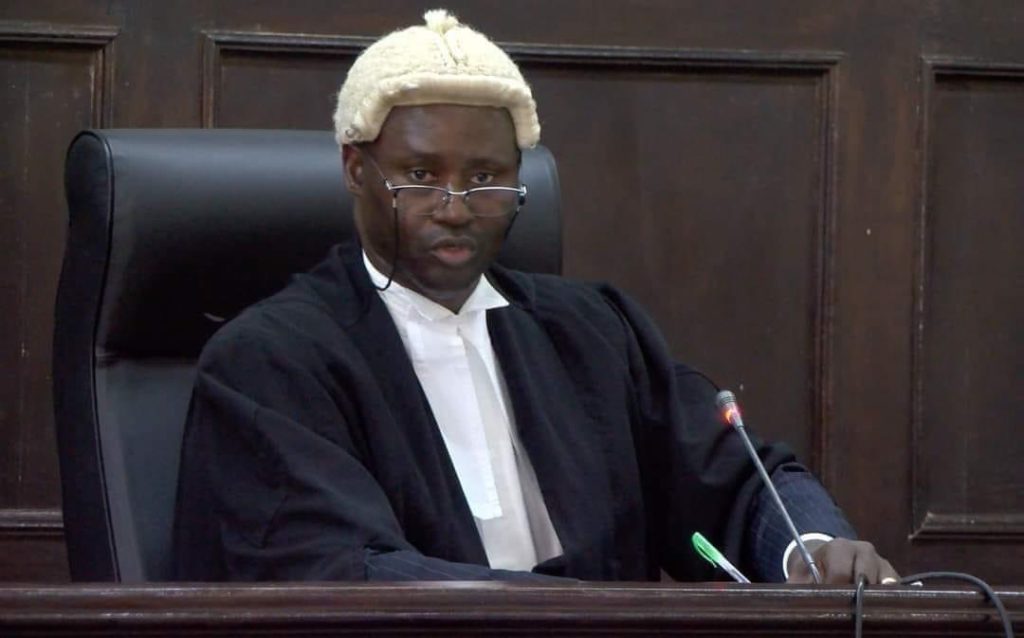
The High Court, presided over by Justice Jaiteh, has granted an application permitting Harouna Kebbeh to testify as an additional witness in a civil suit brought by GACH Global Trading Company.
GACH Global, owned by Abubakary Jawara, has sued its former employee, Khadijatou Kebbeh, and the former Managing Director of Gam Petroleum, Saikou Drammeh, over allegations of fraud and theft arising from petroleum supply transactions. The company is seeking to recover more than D58 million, alleging that the defendants misappropriated funds intended for fuel purchases.
The claim includes over D58 million in principal, US$221,000 for supplied products, US$1,600 in commissions, D1 million in legal fees, and interest.
When the matter was called, Counsel L.S. Camara, K. Jallow, and F. Jallow appeared for the first defendant, Khadijatou Kebbeh; Counsel B.S. Conteh represented the second defendant, Saikou Drammeh; while Counsel Ida Drammeh appeared for the plaintiff, GACH Global.
Addressing the court, Counsel K. Jallow informed the bench that an application had been filed on 29 December 2025 seeking leave for the first defendant to file an additional witness statement from Harouna Kebbeh. Counsel Jallow submitted that Harouna Kebbeh is central to the dispute, as his name features prominently in the pleadings and oral testimony already before the court.
She further noted that the plaintiff’s second witness, Abdoulie Saine (PW2), had testified that he personally witnessed Harouna Kebbeh deliver bags of cash containing €749,965 and US$240,000 to the residence of Saikou Drammeh in Brufut.
Counsel Jallow argued that, given the repeated references to Harouna Kebbeh in the proceedings, his direct testimony is necessary to enable the court to determine the truth regarding the alleged physical handover of the funds. She urged the court to grant the application in the interest of justice, relying on Order 23 Rule 14(6) and (7) of the High Court Rules.
While Counsel Ida Drammeh, appearing for GACH Global, did not oppose the application, Counsel B.S. Conteh objected on behalf of the second defendant, stating that a 17-paragraph affidavit in opposition had been filed. Counsel Conteh argued that once trial has commenced, a party cannot introduce new evidence, describing the application as an “amendment disguised as a request to call an additional witness.”
In response, Counsel Jallow contended that the affidavit in opposition violated Sections 90 and 91 of the Evidence Act, as it contained legal arguments, conclusions, and bare denials, which are impermissible in affidavit evidence. She referred the court to Order 23 Rule 14(19), which empowers the court to grant leave where the interests of justice so require.
In his ruling, Justice Jaiteh identified the sole issue for determination as whether the court should permit the additional witness statement under Order 23 Rule 14(7) of the High Court Rules. He described the provision as “straightforward, permissive, and discretionary,” noting that it does not restrict the court based on the stage of the proceedings, provided the application is made in good faith.
The judge observed that the central question in the case is whether money paid by the plaintiff was handed over to the second defendant through Harouna Kebbeh. He noted that PW2, Abdoulie Saine, had already testified under cross-examination that he saw Harouna Kebbeh deliver money to the second defendant’s residence.
Justice Jaiteh rejected the argument that the application amounted to an amendment, explaining that an amendment alters pleadings, whereas calling a witness merely seeks to prove matters already pleaded.
He was also critical of the affidavit in opposition, particularly paragraph 10, which described the proposed witness as a “tainted witness.”
“That is a conclusion of law and credibility, a determination reserved exclusively for the court. A deponent is not entitled to usurp the judicial function,” Justice Jaiteh held.
Citing authorities including Lord Denning, the judge emphasised that procedural rules are “handmaids of justice, not its mistress,” and that the primary duty of the court is to do justice rather than punish parties for technical lapses.
Justice Jaiteh concluded that refusing the application would deprive the court of potentially crucial evidence. He therefore granted leave, holding that Harouna Kebbeh’s witness statement was properly filed and served.
The matter was adjourned to 4 February 2026, between 14:15 and 16:00 hours, for the continuation of proceedings, including the testimony of the first defendant, Khadijatou Kebbeh.
Comments are closed.