

Banjul City Council Inaugurates Crab Island Sustainable Development Centre, Praises EU Partnership

By Seedy Jobe
The Banjul City Council on Friday inaugurated the Crab Island Sustainable Development Centre, a new facility aimed at promoting youth empowerment, creativity, and sustainable urban development in the capital.
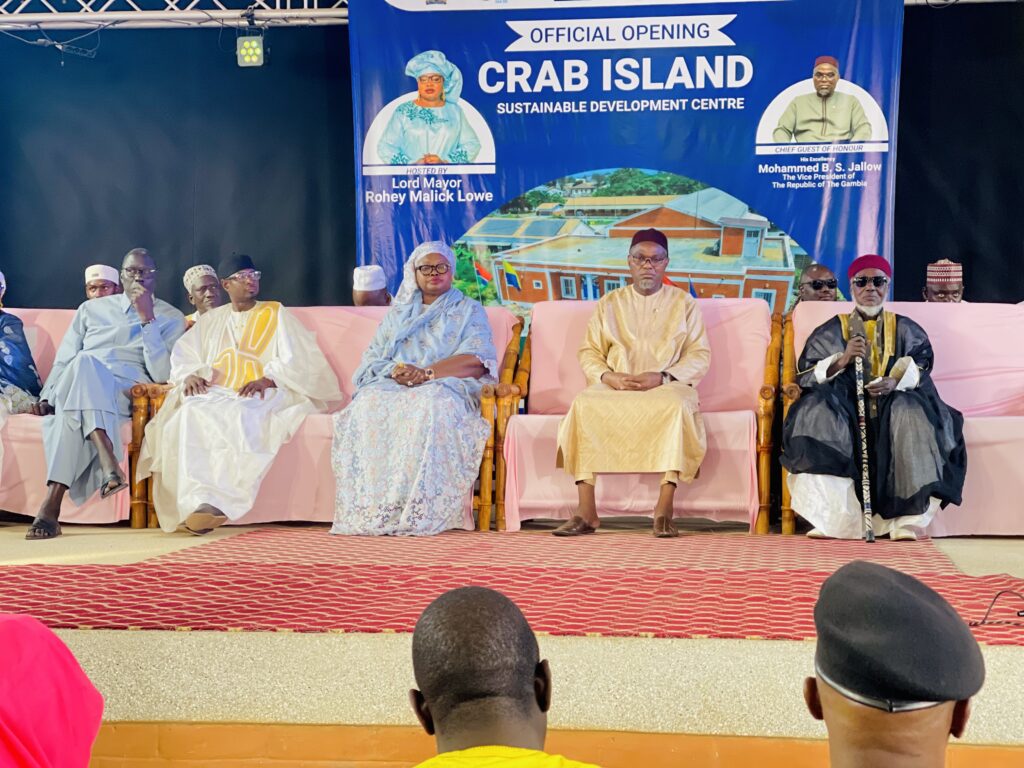
The inauguration ceremony, hosted by Banjul Mayor Rohey Malick Lowe, was attended by Muhammed B. S. Jallow, the vice president of The Gambia, along with senior government officials, the deputy speaker of the National Assembly, the Imam Ratib of Banjul, the minister of tourism and culture, the chairman of Mansakonko Area Council, and representatives of private and development partners.
The new facility, known as the Crab Island Sustainable Development Centre, transforms the former Crab Island school site into a hub designed to foster innovation, learning, and community engagement.
Developed through a city-link partnership between Banjul and the Belgian coastal city of Ostend and funded by the European Union, the center includes a community radio station, music recording studio, arts and cultural spaces, innovation and learning facilities, an information technology training center, renewable energy installations, urban gardening areas, a basketball lawn, and a restaurant and event space.
The event also featured the first edition of an annual religious conference and the inaugural Banjul City Iftar, bringing together religious leaders, development partners, and members of the community.
In her remarks, Ms. Lowe described the center as a milestone in the city’s development and a symbol of renewed ambition for Banjul.
“When the history of modern Banjul is written, let it record that today we turned a corner,” she said. “With this building, we have reimagined what city service can be.”
The mayor thanked the European Union for supporting the project, noting that the partnership went beyond financial assistance.
“The European Union did not just fund this project; they believed in us,” Ms. Lowe said. “They trusted our leadership and invested in the potential of our people.”
She said the facility’s 800-seat hall, radio and recording studios, and innovation hub would amplify Gambian voices and nurture the next generation of entrepreneurs.
“This is not just a project; it is a legacy,” she added, saying the center aligns with the national development priorities of the government.
Vice President Jallow, who officially opened the facility, said the project represents an important step in advancing sustainable development and strengthening international partnerships.
“This occasion marks an important milestone in our collective efforts to build a greener, more resilient, and prosperous future for our people,” he said, expressing the government’s appreciation to the European Union for its continued support to The Gambia.
Mr. Jallow said the collaboration among the European Union, the city of Ostend, and the Banjul City Council demonstrates what can be achieved when international partnerships and local leadership work toward a common goal.
“The Sustainable Development Centre stands as a powerful symbol of what can be achieved when international partnerships and local leadership come together with a shared purpose,” he said.
Speaking at the ceremony, the deputy mayor of Banjul, Abdou Aziz Dabakh Gaye, said the inauguration marked more than the opening of a building.
“The purpose of today’s gathering is not merely to cut a ribbon,” he said. “It is to dedicate this space as a living center of opportunity, creativity, learning, and sustainable development for the people of Banjul.”
Mr. Gaye noted that the site holds deep historical significance, having once housed Crab Island Basic Cycle School, which has educated generations of Gambian students since the late 1950s.
He said the center’s development began with a modest community gardening initiative under the Banjul–Oostende city-link partnership.
“Just as seeds planted in the soil grow into gardens, visions planted in the hearts of people grow into institutions,” he said, noting that the project later expanded under a European Union-funded program implemented between 2022 and 2024 to promote sustainable city development.
Comments are closed.