


By Seedy Jobe
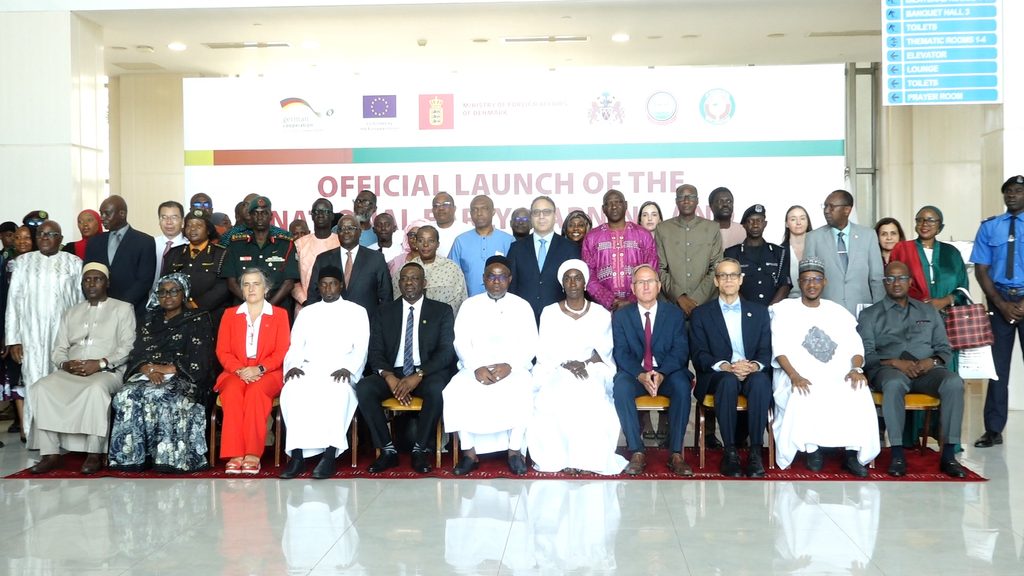
The National Centre for Coordination of Response Mechanism (NCCRM), in partnership with the European Union and GIZ, on Tuesday officially launched The Gambia’s National Early Warning and Response Policy 2026–2035, establishing a national framework designed to identify emerging threats and coordinate responses before they escalate into crises.
The policy outlines a coordinated approach to early warning, conflict prevention, and crisis response, bringing together government institutions, security agencies, civil society organizations, and development partners to monitor risks and facilitate timely intervention.
The launch, held at the Sir Dawda Kairaba Jawara International Conference Centre in Bijilo, was attended by Vice President Muhammed B.S. Jallow, cabinet ministers, ECOWAS representatives, international delegates, security officials, civil society representatives, and development partners.
Speaking at the ceremony, Vice President Jallow described the policy as a pioneering framework in the subregion and said it should not be regarded as simply another government document.
He said peace and stability do not occur by chance but require deliberate investment and strong institutions capable of detecting emerging challenges before they develop into full-blown crises.
Mr. Jallow stressed that early warning systems are only effective when they lead to early action, saying the launch should mark the beginning of implementation rather than the end of the process.
He called on government institutions, security agencies, civil society organizations, traditional and religious leaders, and development partners to take ownership of the policy and translate its objectives into tangible results.
Binta Singhateh, director general of the NCCRM, said the policy marked a new chapter in The Gambia’s efforts to protect communities and strengthen national resilience.
She said the framework would bring together the various institutions and actors responsible for identifying, analyzing, and responding to risks, emphasizing that early warning cannot be the responsibility of a single institution.
Ms. Singhateh thanked ECOWAS, GIZ, government institutions, and civil society organizations that participated in the consultation, drafting, and validation of the policy, describing it as the product of a collective national effort.
Anthony Oluwatosin Ogunjimi, vice president of the ECOWAS Commission, described the policy as a strategic and forward-looking commitment to protecting the country against emerging threats.
He said The Gambia faces an increasingly complex risk environment shaped by climate change, public health challenges, governance concerns, and socioeconomic vulnerabilities, requiring a more proactive and coordinated approach to prevention.
According to Mr. Ogunjimi, the policy is intended to shift the country from primarily reacting to crises to developing a comprehensive system capable of identifying risks earlier and protecting communities before threats intensify.
He said the framework is also aligned with the ECOWAS early warning system, the African Union’s peace and security architecture, the United Nations Sustainable Development Goals and the Sendai Framework for Disaster Risk Reduction.
Immaculada Roca i Cortés, the European Union ambassador to The Gambia, said anticipating risks and acting early are essential to sustaining peace, noting that prevention is far less costly than responding to the consequences of violence or instability after they occur.
She praised what she described as strong national ownership of the initiative by the Office of the Vice President and the NCCRM, adding that an effective early warning system would be particularly important during an election year.
Providing an overview of the policy’s implementation, Momodou J.A. Senghore, an environmental analyst at the NCCRM, said the centre was established in 2019, launched in 2022 and given a statutory foundation through an Act of Parliament in 2025.
Mr. Senghore said implementation would be carried out in phases.
In the short term, he said, efforts will focus on operationalizing the Act and developing regulations and standard operating procedures. The medium-term phase will focus on strengthening multisectoral analysis, response coordination and technology-driven risk assessments, including annual simulation exercises.
Mr. Senghor said The Gambia remains among the world’s 100 most vulnerable countries, with more than 70 percent of the population dependent on climate-sensitive sectors such as agriculture and fisheries. He identified flooding, drought, coastal erosion and public health emergencies among the major risks facing the country.
Officials said the policy will provide a national mechanism for consolidating information, analyzing emerging threats and coordinating timely responses across several sectors, including governance, security, health, the environment, food security and socioeconomic stability.
The framework also places particular emphasis on ensuring that vulnerable communities and groups are included in national prevention, preparedness and response efforts.
Comments are closed.