

Higher Education Minister Defends Four-University Model, Citing Need for Specialization

By Makutu Manneh
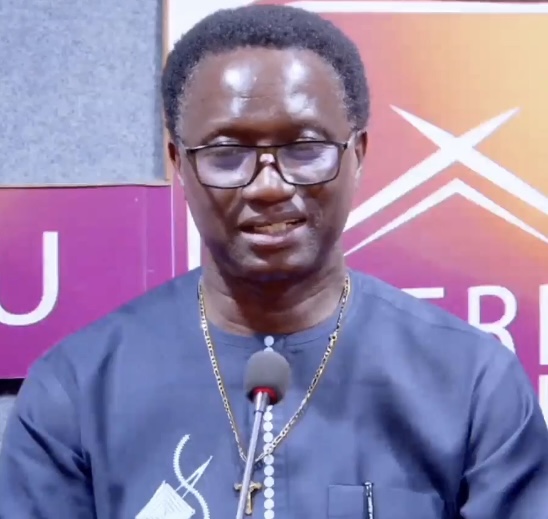
Professor Pierre Gomez, the Minister of Higher Education, Research, Science and Technology, has defended the government’s decision to establish four separate public universities, saying the model is intended to promote specialization, competition, and the development of skills critical to The Gambia’s economy.
Professor Gomez made the remarks in response to a question on Kerr Fatou about whether the country’s public universities could instead have been consolidated under an expanded University of The Gambia, potentially concentrating funding, academic programs, and other resources within a single institution.
While acknowledging that such an approach was a “valid school of thought,” Professor Gomez said the government favored separate institutions because it believes competition among universities can improve performance and allow each institution to develop expertise in specific fields.
He cited the University of Applied Science, Engineering, and Technology, or USET, as an example, saying the institution was established with a particular focus on technical and vocational education and training and engineering and practical skills.
Professor Gomez said the need for specialized training had become increasingly important as The Gambia undertakes major infrastructure projects while continuing to rely heavily on foreign expertise.
According to the minister, much of the technical work associated with the construction of roads, bridges, and other infrastructure is carried out by non-Gambians, a dependence he described as unsustainable for the country’s long-term development.
The Gambia, he said, has historically had too few locally trained engineers, with many Gambian professionals in the field receiving their education abroad. That shortage, he added, strengthened the case for establishing a university dedicated to engineering, applied sciences, and technical education.
Professor Gomez said the strategy was already beginning to yield results, pointing to the graduation of what he described as the country’s first cohort of locally trained engineers last year. Another group graduated this year, he said, with new cohorts expected to complete their training annually.
Beyond addressing the shortage of skilled professionals, Professor Gomez said building domestic technical capacity could also have economic benefits.
He argued that strengthening local expertise would allow a greater share of funding from development projects and grants to remain within The Gambia instead of being spent on foreign specialists brought into the country because the necessary skills are unavailable locally.
For the government, Professor Gomez said, the creation of specialized universities is therefore not simply an expansion of higher education but part of a broader effort to build the professional and technical workforce needed to support the country’s development.
Comments are closed.