


By Seedy Jobe
The Gambia’s 2026 Labour Force Survey has revealed persistent disparities in wages, child labor, disability employment, and migration, despite broader improvements in labor force participation and employment.
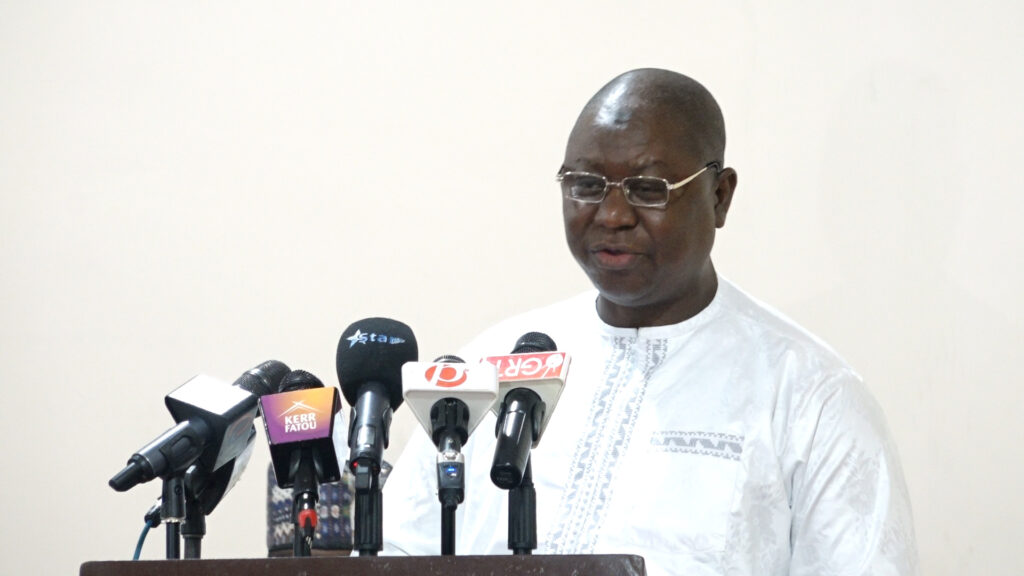
Nyakassi M.B. Sanyang, the Statistician General of the Gambia Bureau of Statistics, presented the findings on Friday, saying the survey provided a detailed account of inequalities across the country’s labor market.
“The true value of official statistics is realized not when they are published, but when they inform decisions, shape policies, guide investment, and contribute to improving the well-being of the Gambian people,” Mr. Sanyang said.
According to the report, male workers earn an average monthly income of D8,099—more than twice the D3,875 earned by female workers. Urban workers earn an average of D6,920 a month, compared with D4,947 among rural workers.
The survey also found significant levels of child labor. Using the national framework aligned with Gambian law, GBoS estimated that 12.9 percent of children between the ages of 5 and 17—about 108,087 children—are engaged in child labour.
The rate rises with age, from 12.3 percent among children aged 5 to 15 to 17.4 percent among those aged 16 and 17. It is also considerably higher in rural areas, where 19.5 percent of children are affected, compared with 7.9 percent in urban areas.
Kuntaur recorded the highest child labor rate among the country’s local government areas, at 34.7 percent. It was followed by Mansakonko at 22.6 percent and Janjanbureh at 17.9 percent. Kanifing and Banjul recorded the lowest rates, at 3.5 percent and 3.8 percent, respectively.
Agriculture remains the leading sector for child labor, accounting for 63.4 percent of affected children aged 5 to 15, according to Mr. Sanyang. The survey also found that 9 percent of children aged 5 to 17 are engaged in hazardous work.
Using the international measurement for Sustainable Development Goal Indicator 8.7.1, the child labor rate fell from 9 percent in 2023 to 7.4 percent in the first quarter of 2026.
The report showed some progress in employment among persons with disabilities. Their labour force participation rate increased from 20.1 percent in 2025 to 27.4 percent in 2026, while their employment rate rose from 19.4 percent to 26.5 percent.
Those figures, however, remain well below the 55 percent labour force participation rate recorded among persons without disabilities. Women with disabilities had the lowest level of employment, at 22.4 percent.
International migrants account for 6 percent of The Gambia’s working-age population. Their labour force participation rate stands at 65 percent, compared with 53.8 percent among native-born people. Migrants also recorded a higher employment-to-population ratio of 63.8 percent, compared with 50.3 percent among the native-born population.
Informal employment is also more widespread among migrants, affecting 90.1 percent of migrant workers, compared with 85.5 percent of native-born workers.
Senegalese nationals account for the largest share of international migrants, at 37.2 percent, followed by Guineans at 30.2 percent and Sierra Leoneans at 9.7 percent. Family-related reasons account for 62.4 percent of international migration, while 53.9 percent of migrants have lived in The Gambia for at least 10 years.
Internal migration is heavily concentrated in the Brikama Local Government Area, which accounts for 68.5 percent of all lifetime internal migrants. Kanifing follows with 18 percent. Marriage and other family-related reasons account for 77.7 percent of internal migration, while employment accounts for 6.6 percent.
The survey also found that 347,987 people, representing 24.3 percent of the population aged 15 and older, were engaged in production for their own use in 2026.
Household businesses remain the primary source of livelihood for 34 percent of households nationwide. Paid employment supports 27.5 percent of households, while 18.5 percent rely mainly on agriculture or fishing.
Mr. Sanyang said the findings contained “encouraging signs of progress,” including increased labour force participation and reductions in unemployment and labour underutilisation. But he cautioned that widespread informality, regional disparities, difficulties facing young people entering the workforce and child labour continued to demand sustained policy attention.
“For the Gambia Bureau of Statistics, these reports affirm our commitment to producing official statistics that are independent, methodologically sound and responsive to the needs of our country,” he said.
Mr. Sanyang urged policymakers, development partners, researchers, employers and private-sector leaders to use the findings to promote productive employment, decent work and inclusive economic growth.
Comments are closed.