


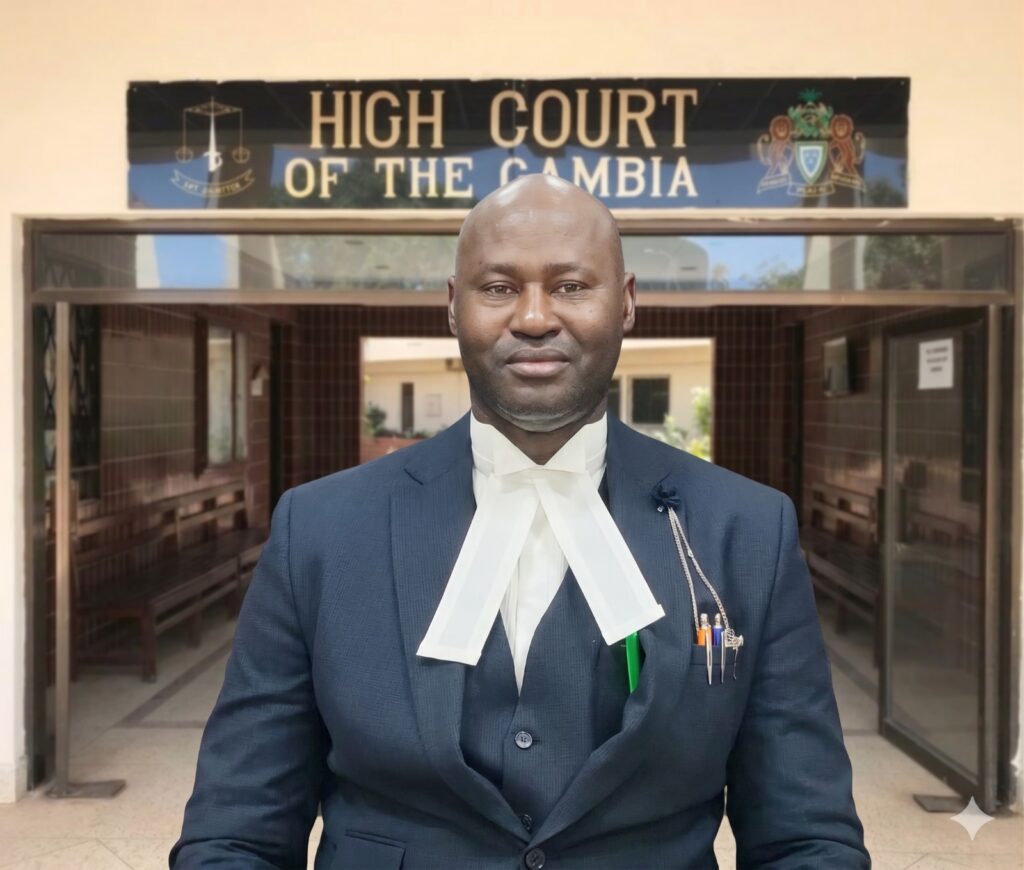
The High Court Criminal Division has granted bail to John Ebrima Carayol, a suspect charged by the Drug Law Enforcement Agency (DLEAG), after finding that the statutory provision cited in the charge sheet does not exist under Gambian law.
In a ruling delivered by Justice Ebrima Jaiteh, the court held that Section 45(4)(b) of the Drug Control Act 2003—under which the accused was charged—has no basis in the country’s legislation, rendering the charge fundamentally defective.
Justice Jaiteh described the issue as more than a mere technical irregularity, stating that reliance on a non-existent legal provision undermines the very foundation of a criminal charge. He emphasized that an accused person is entitled to know, with clarity and precision, the nature of the offence and the law allegedly violated.
“Where the charging provision is non-existent, the foundation of the charge becomes fundamentally questionable,” the judge stated, adding that courts must administer justice based on enacted law rather than assumptions about prosecutorial intent.
Carayol, represented by counsel A. M. Darbo, had filed a bail application supported by a 15-paragraph affidavit sworn by Julia Jassey on 21st May 2026. The affidavit included the DLEAG charge sheet as an exhibit. The State, represented by Senior State Counsel S. Camara, did not oppose bail but urged the court to impose strict conditions.
The charge alleges that Carayol was found in possession of 1 gram and 671 milligrams of cocaine, classified as a prohibited drug. However, Justice Jaiteh held that regardless of the factual allegations, the legality of the charge itself remained central to the issue of continued detention.
In determining the application, the court relied on Section 126 of the Criminal Procedure Act 2026, which establishes that bail is the rule rather than the exception for offences punishable by more than three years’ imprisonment, unless specific risks are demonstrated. These include the likelihood of absconding, interference with witnesses, obstruction of investigations, or commission of further offences.
Justice Jaiteh found that no such risks had been substantiated by the prosecution. He further anchored his decision in Section 19(2) of the Constitution, which guarantees the right to personal liberty and prohibits arbitrary detention.
“Liberty is a constitutional right, not a privilege granted at the discretion of the State,” the court noted, stressing that pre-trial detention must be justified by compelling and lawful reasons.
Having considered the defective charge, the absence of opposition from the State, and constitutional safeguards, the court granted bail to the applicant pending the determination of the case.
Bail was set at D500,000, with two Gambian sureties required to enter into recognizance of the same amount. At least one surety must be a civil servant of not less than Grade 10 or a person of demonstrable financial capacity acceptable to the Registrar.
Additional conditions include the submission of valid identification and proof of residence by the sureties, deposit of the applicant’s passport with the High Court Registrar, and a prohibition on applying for travel documents without court approval. Carayol is also required to report to the nearest DLEAG office every two weeks, attend court as required, and refrain from interfering with witnesses.
The court warned that any breach of these conditions could result in revocation of bail. The Officer-in-Charge of the prison was directed to release the applicant upon compliance with the conditions, unless he is otherwise lawfully detained.
Comments are closed.