

“Wishy-Washy and Incomplete”: Defence Urges Court to Dismiss Case Against Amie Bojang in Sukuta-Jabang Shooting Trial

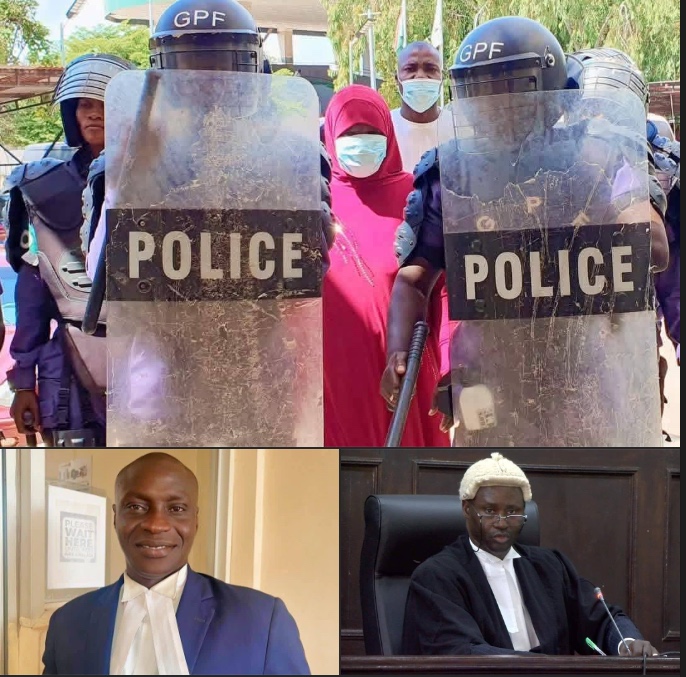
Defence Counsel Adama Sillah has filed a detailed Reply on Points of Law before Justice Jaiteh of the High Court in the ongoing Sukuta–Jabang Traffic Lights shooting trial, arguing that the prosecution’s case against the second accused, Amie Bojang, is legally deficient and founded on an investigation he described as “wishy-washy, incomplete, and riddled with loopholes.”
In the submission, Counsel Sillah challenges the prosecution’s interpretation of the law and its reliance on judicial authorities which, according to the defence, do not apply to the facts of the case.
The defence contends that the State has “woefully failed” to establish the essential elements of murder as required under Section 187 of the Criminal Code. Citing the Supreme Court decision in Batch Samba Faye v. The State (2014–2015), Counsel Sillah argued that the prosecution must prove not only that a death occurred but also that the accused’s actions directly caused the death.
While acknowledging that the deaths of two police officers were established through the testimony of pathologist Professor Gabriel Ogun (PW7), the defence maintains that there is “no linkage or nexus” between the deaths and the first accused, Ousainou Bojang.
Counsel Sillah further argued that although ballistics experts (PW12) linked shell casings recovered from the scene to a pistol admitted in evidence as Exhibit P28, the prosecution failed to present any evidence connecting that weapon to Ousainou Bojang.
According to the defence, the prosecution’s reliance on authorities such as Akpan v. State and Archibong v. State is misplaced because, in those cases, there was clear evidence linking the accused persons to the weapons used—an element the defence says is absent in the present case.
The defence submission also highlights what it describes as procedural lapses by the police, particularly the failure to conduct an identification parade. Counsel Sillah argued that reliance on a witness’s description of a “tall man” amounts to speculation and violates the accused’s right to a fair hearing under Section 24 of the 1997 Constitution.
Referencing Henry Otti v. The State, the defence maintained that an identification parade is crucial in cases where police must determine whether a suspect committed the offence. Counsel Sillah submitted that the court cannot rely on what he described as the “weak and uncertain” description of a “tall man,” characterising it as “mere conjecture.”
Counsel Sillah also challenged the terrorism-related charges, arguing that the State failed to comply with mandatory procedural requirements under the Anti-Terrorism Act. He noted that Section 60 and the Second Schedule of the Act require that a detained person be video recorded during detention.
According to the defence, no video recordings were made of any interactions between the police and Ousainou Bojang while in custody, rendering the terrorism allegations legally unsustainable.
On the charge that Amie Bojang acted as an accessory after the fact, the defence argued that the prosecution failed to prove she knowingly and deliberately assisted her brother to evade justice.
Counsel Sillah told the court that Amie Bojang testified under oath that she only helped her brother travel to seek spiritual assistance from a marabout after he claimed a “white lady” was threatening to release nude videos of him.
He further noted that prosecution witnesses PW9 and PW11 did not provide any testimony indicating that Amie Bojang knew about the deaths of the police officers at the time she assisted her brother.
The defence also raised concerns about Amie Bojang’s treatment in custody. According to Counsel Sillah, she testified that she was detained beyond the 72-hour constitutional limit, which he described as a “gross breach” of her fundamental rights under Section 19 of the Constitution.
The defence further alleged that she was held in the same detention cells as male suspects, a practice Counsel Sillah argued violates the Women’s Act 2010 as well as the Convention on the Elimination of All Forms of Discrimination Against Women (CEDAW).
Counsel Sillah additionally criticised statements made by senior state officials (DW6, DW7, and DW8) during a press briefing a day after the incident. He noted that officials had claimed the attacker was part of a six-member rebel group from Casamance, assertions they later acknowledged were unverified and based on undisclosed informants.
The defence argued that since the prosecution has failed to prove the principal offence of murder against Ousainou Bojang, the related charge of being an accessory after the fact against Amie Bojang cannot stand.
Citing the Nigerian Court of Appeal decision in Major Hamza Al-Mustapha v. The State, which warned against convictions based on “wishy-washy” investigations, Counsel Sillah concluded that the prosecution’s case has effectively collapsed.
He therefore urged the court to acquit and discharge Amie Bojang of all charges.
Comments are closed.